

We offer medical detox and multiple addiction treatment options in our
luxury treatment centres in Port Hope, Cobourg, and Ottawa.
Liver Disease Caused by Alcohol

Liver Canada defines liver disease from alcohol as damage caused by excessive drinking, most common in people aged 40 to 50 but possible at any age and in drinkers without alcohol dependence . Ontario records show a rapid rise among younger adults, with new cases of alcohol-related cirrhosis in people born after 1980 increasing 11.6% a year between 2000 and 2017. All drink figures here use the Canadian standard drink of 13.45 grams of pure alcohol, the amount in a 341 ml bottle of 5% beer.
You'll Learn
- Obesity doubles a heavy drinker's odds of fatty liver, and weight alone left an even bigger mark in one Italian study
- Men who drank daily faced more than triple the cirrhosis risk of men who drank on only a few days each week
- More than three-quarters of liver cells may stop working before a single symptom appears
- A liver enzyme ratio flags alcohol in over 80% of patients in some studies, and early cirrhosis can still pass routine bloodwork
- Fatty liver can clear in about two weeks without alcohol, yet up to one in three severe cases keeps worsening after quitting
How Does Alcohol Affect the Liver With Every Drink?
The liver can clear only so much alcohol at a time, so any surplus from a drinking session keeps circulating to the brain, heart and muscles until the liver gets to it.
Inside liver cells, alcohol dehydrogenase turns alcohol into acetaldehyde, and a second enzyme then converts that compound to acetate. The same reactions push the cell to make extra glycerol phosphate; fatty acids attach to it as triglycerides, and fat burning stalls at the same time, so the triglycerides accumulate.
When the liver has to handle alcohol every day, some of its cells can die, and others become damaged, which is how alcohol affects the liver once heavy drinking becomes routine.
Why Does Alcohol Leave More Fat in Some Livers Than Others?
Among heavy drinkers, obesity doubles the risk of alcohol-related liver fat, according to a population study in northern Italy. Ultrasound found fatty liver in 46% of normal-weight people drinking over 60 grams a day, roughly four and a half Canadian standard drinks, against 16% of normal-weight non-drinkers. With obesity added, the figure reached 94.5%.
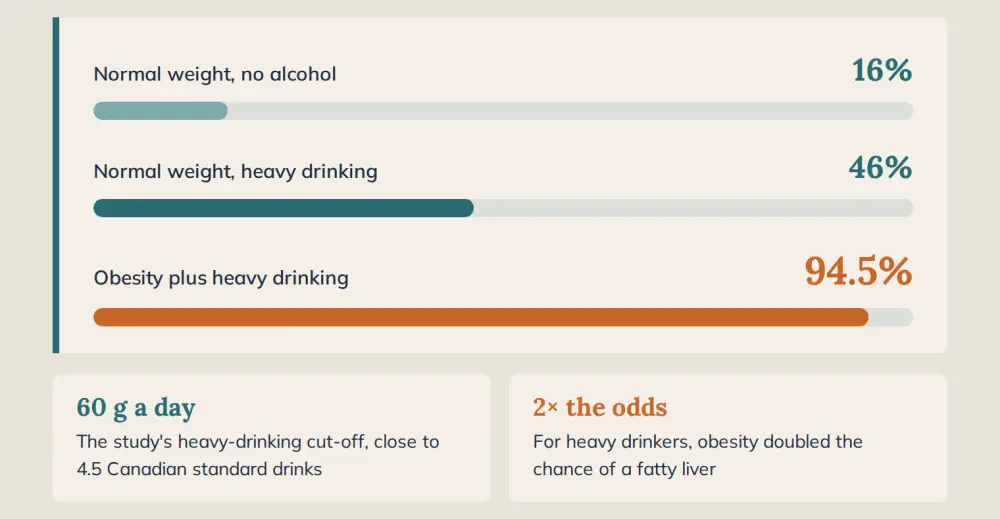
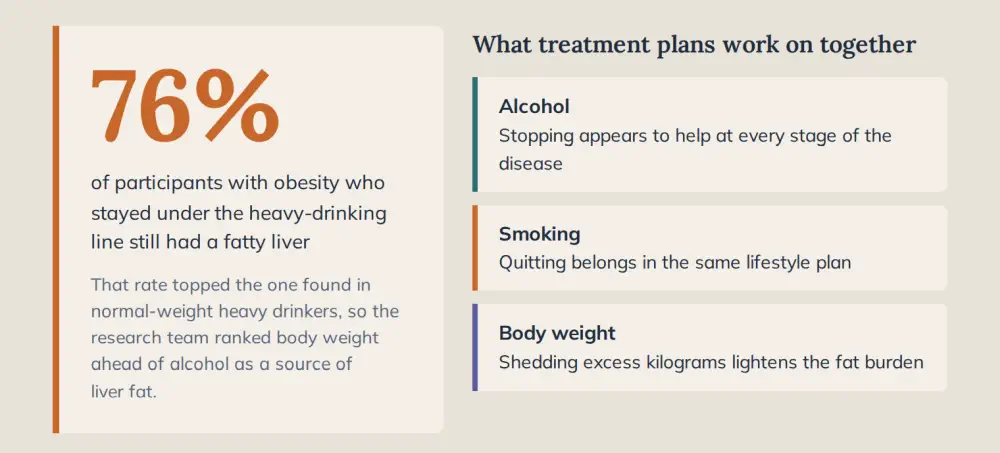
Weight on its own mattered even more in that study, with fatty liver present in 76% of obese people who did not drink heavily, and the authors concluded that excess weight contributes more than alcohol to fat in the liver. Treatment plans for alcohol-damaged livers list weight loss next to cutting alcohol and quitting smoking.
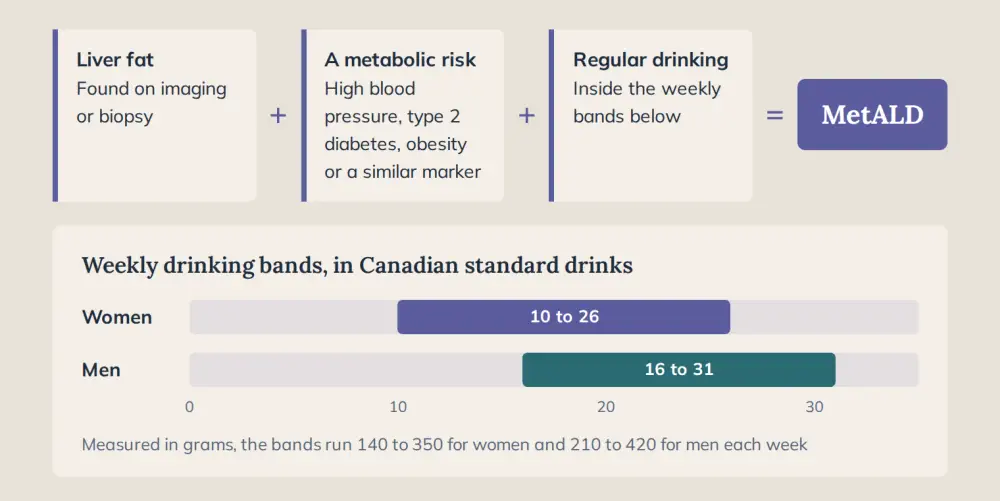
In 2023, hepatology societies gave this overlap its own category, MetALD, covering people with fatty liver and at least one metabolic risk marker such as excess weight, type 2 diabetes or high blood pressure. The drinking range it covers works out to about 10 to 26 Canadian standard drinks a week for women (140 to 350 grams) and 16 to 31 for men (210 to 420 grams).
What Are the Three Stages of Liver Disease From Alcohol?
Three stages make up liver disease from heavy alcohol use, and the NHS points out that they overlap more than their order suggests.
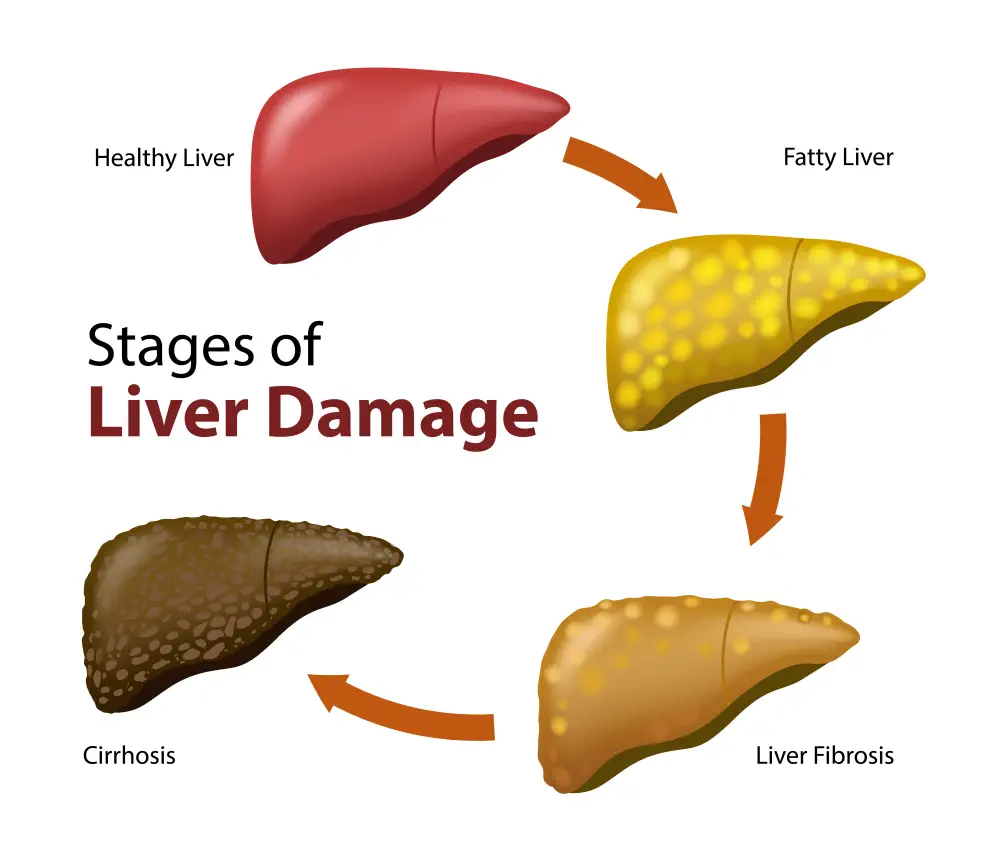
That overlap turns up in practice, where fatty liver, hepatitis and alcoholic cirrhosis occupy the same liver at once. In US Veterans Affairs studies, patients carrying both hepatitis and cirrhosis had a death rate above 60% over four years, and most of those deaths came in the first year.
Liver cancer sits outside the staging as a tumour that can grow out of a liver already damaged by alcohol.
Is Drinking Every Day Harder on the Liver Than Drinking a Few Days a Week?
Studies of drinking and liver injury have mostly counted volume, and a Danish cohort of 55,917 adults aged 50 to 64 added a second measure, the number of drinking days per week. Men who drank every day carried 3.65 times the cirrhosis risk of men who drank on two to four days a week. Results for women pointed the same way, though far fewer women were diagnosed.
Each drink also puts more alcohol into a woman's system than a man's, and women are more likely than men to end up with cirrhosis. Binges of four or more drinks in one sitting also appear on Liver Canada's list of harmful patterns, next to daily drinking.
An estimated 70% of people with alcohol-related liver disease are dependent on alcohol, and for them, alcohol addiction treatment tackles the dependence that keeps the daily habit going.
Why Do Alcoholic Liver Disease Symptoms Surface So Late?
More than three-quarters of the liver's cells can already be out of action by the time alcoholic liver disease symptoms appear. Fatty liver on its own rarely causes any, yet the NHS counts its presence as evidence that someone's drinking is already harmful.
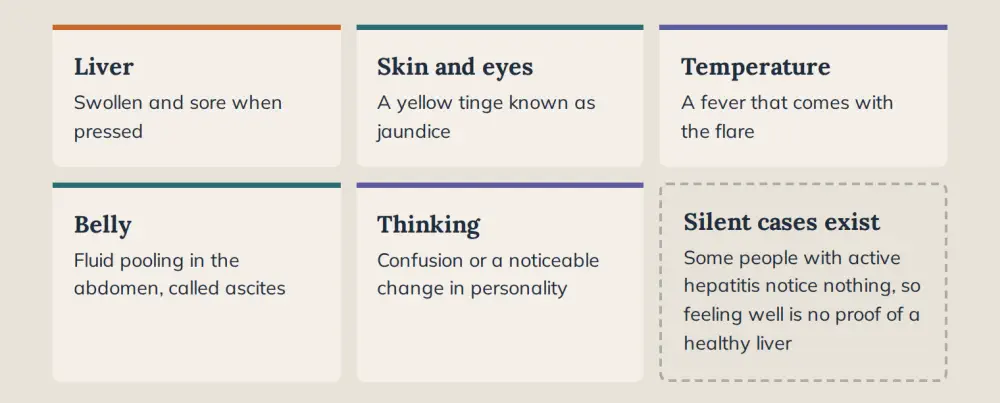
Inflammation brings sharper signals, and a flare of alcoholic hepatitis can cause a tender, enlarged liver, yellowing of the skin and eyes, fever, fluid collecting in the abdomen, and confusion or personality changes. Some people with the condition still feel nothing at all.
Once the liver can no longer keep up with its work, fatigue, poor appetite, internal bleeding, frequent infections and kidney failure can follow.
Which Signs of Liver Damage From Alcohol Show Up in Tests and on the Skin?
Regular physical exams and blood tests let a doctor catch early signs of liver damage from alcohol, as long as you are open about how much you drink.
- Almost every patient diagnosed with liver disease from drinking has raised liver enzymes. An AST reading more than twice the ALT reading makes alcohol the most likely cause, a pattern seen in over 80% of patients in some studies.
- GGT outperforms AST and ALT as a marker of heavy drinking, yet other organs and some medications can push it up too.
- Early cirrhosis without complications can still produce a normal exam and unremarkable routine bloodwork. A FibroScan measures the liver directly, using ultrasound to gauge stiffness, scarring and fat without a needle.
- Low albumin, a low platelet count and slow blood clotting, taken together, raise concern for late-stage scarring or cirrhosis.
- Star-shaped clusters of tiny blood vessels on the upper body and reddened palms are classic skin signs of cirrhosis. Up to a third of people with cirrhosis have these spider marks, and a higher count tracks with more severe disease, though up to three can be normal.
How Much Liver Damage From Alcohol Can Heal After the Last Drink?
A liver that has only built up fat can return to normal after about two weeks without alcohol. For alcoholic hepatitis or cirrhosis, the advice is lifelong abstinence, because in someone who keeps drinking, neither medication nor surgery can stop the liver from failing.
Most patients who quit see their liver function improve gradually, yet in as many as one in three people with severe liver damage from alcohol, the injury keeps getting worse even after they stop drinking completely. Steadier energy, a returning appetite and normal skin colour are among the signs your liver is healing from alcohol that people tend to notice.
Withdrawal symptoms peak during the first 48 hours after stopping, which is the stretch that medically monitored detox with round-the-clock nursing is built to cover.
Ready to Take the First Step?
Addiction doesn't get better on its own. Call us today for a free, confidential consultation and find out which program is right for your needs.
Why Recent Years of Drinking Count More Than Decades Past
In the Danish cohort, the amount people drank in their 40s and 50s was linked to alcoholic cirrhosis, and the amount they drank in their 20s and 30s was not. If you have been drinking heavily for years, that finding puts the weight on your current habits, which are the ones you can still change.
FAQ
Is it safe to take Tylenol for a hangover after heavy drinking?
Taking Tylenol after heavy drinking is risky because Liver Canada warns that combining alcohol with acetaminophen, its active ingredient, can harm the liver. Several antibiotics, antidepressants and pain relievers also interact with alcohol, so a quick check with a pharmacist is worthwhile.
Can milk thistle undo liver damage from drinking?
A 2007 Cochrane review of 13 trials with 915 patients found no reliable effect of milk thistle on deaths, complications or liver tissue in alcohol-related or viral liver disease. Quitting alcohol remains the most important early treatment, according to Liver Canada.
Does drinking speed up liver damage for someone with hepatitis C?
Drinking on top of hepatitis C damages the liver faster and raises the chance of cirrhosis, as it does with any existing liver condition. Liver Canada advises people living with hepatitis C, or with liver disease of any kind, to avoid alcohol entirely.
Is beer, wine or spirits easier on the liver?
A beer, a glass of wine and a shot of spirits count alike in Liver Canada's guidance, because a standard drink of any type puts the same load on the liver. The Danish cohort linked mostly wine drinking to lower cirrhosis risk in men, though the authors described it only as a possible association.
Can someone get a liver transplant in Canada if drinking caused their liver failure?
Yes, a doctor can refer the patient for assessment at a transplant centre, where a team reviews both physical health and psychological readiness. Six months of sobriety was long the standard expectation, and British Columbia changed its policy in 2019 to allow earlier transplant for a small group of patients with short life expectancy, chosen case by case.
Article sources
- Liver Canada. "Alcohol-Associated Liver Disease." Liver Canada. https://liver.ca/alcohol-associated-liver-disease/
- Flemming, J.A., Djerboua, M., Groome, P.A., et al. "NAFLD and Alcohol-Associated Liver Disease Will Be Responsible for Almost All New Diagnoses of Cirrhosis in Canada by 2040." Hepatology. https://pubmed.ncbi.nlm.nih.gov/34174003/
- Health Canada. "Low-risk alcohol drinking guidelines." Government of Canada. https://www.canada.ca/en/health-canada/services/substance-use/alcohol/low-risk-alcohol-drinking-guidelines.html
- Liver Canada. "Alcohol and The Liver." Liver Canada. https://liver.ca/wp-content/uploads/2021/12/Alcohol-and-the-Liver-.pdf
- Marsano, L.S., Mendez, C., Hill, D., et al. "Diagnosis and Treatment of Alcoholic Liver Disease and Its Complications." Alcohol Research & Health. https://pmc.ncbi.nlm.nih.gov/articles/PMC6668876/
- Bellentani, S., Saccoccio, G., Masutti, F., et al. "Prevalence of and risk factors for hepatic steatosis in Northern Italy." Annals of Internal Medicine. https://pubmed.ncbi.nlm.nih.gov/10644271/
- Rinella, M.E., Lazarus, J.V., Ratziu, V., et al. "A multisociety Delphi consensus statement on new fatty liver disease nomenclature." Hepatology. https://pmc.ncbi.nlm.nih.gov/articles/PMC10653297/
- NHS inform. "Alcohol-related liver disease." NHS 24. https://www.nhsinform.scot/illnesses-and-conditions/stomach-liver-and-gastrointestinal-tract/alcohol-related-liver-disease/
- Askgaard, G., Grønbæk, M., Kjær, M.S., et al. "Alcohol drinking pattern and risk of alcoholic liver cirrhosis: a prospective cohort study." Journal of Hepatology. https://pubmed.ncbi.nlm.nih.gov/25634330/