
We offer medical detox and multiple addiction treatment options in our
luxury treatment centres in Port Hope, Cobourg, and Ottawa.
Alcoholic Cirrhosis and What It Does to Your Liver

Doctors apply the label alcoholic cirrhosis to the late stage of alcohol-related liver disease, when so much working tissue has turned to scar that the organ can start to fail. Across Ontario, alcohol-associated liver disease accounted for 26% of the 202,022 adults with cirrhosis identified between 2000 and 2017. Once alcohol is gone, scarring at this stage can stop worsening, and some patients even regain lost liver function.
You'll Learn
- Why a Canadian drink holds less alcohol than the one used in American studies
- The drinking habit that more than doubled cirrhosis risk in a study of 400,000 women
- Which lost liver functions explain yellow skin, a swollen belly, and confusion
- What quitting within a month did for patients whose liver had started failing
What Turns Healthy Liver Cells Into Scar Tissue in Alcoholic Cirrhosis?
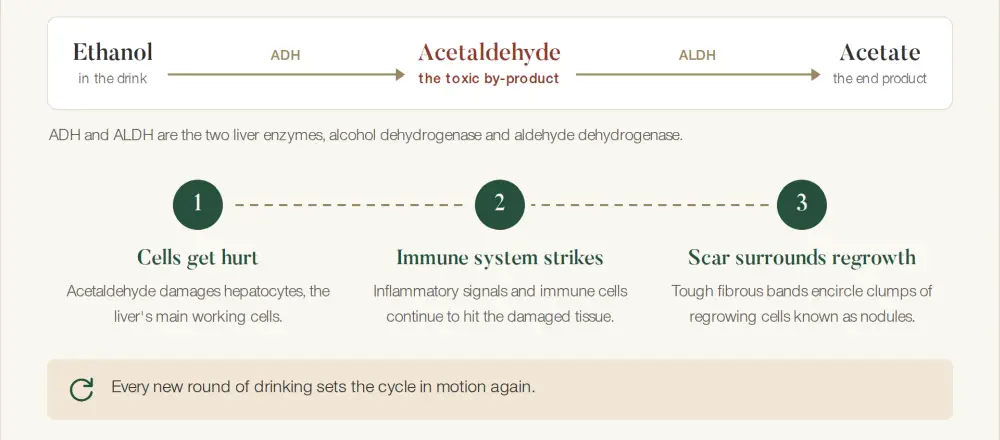
A repeating cycle of chemical injury, inflammation, and collagen buildup is what replaces working tissue with scar in alcoholic cirrhosis. Two liver enzymes handle alcohol, with alcohol dehydrogenase turning it into toxic acetaldehyde and aldehyde dehydrogenase converting that into acetate. As drinking continues, immune signalling molecules and white blood cells keep attacking the injured liver cells, and collagen collects around the small veins that drain the liver and along its blood channels until fibrous bands wall off clusters of regenerating cells called nodules.
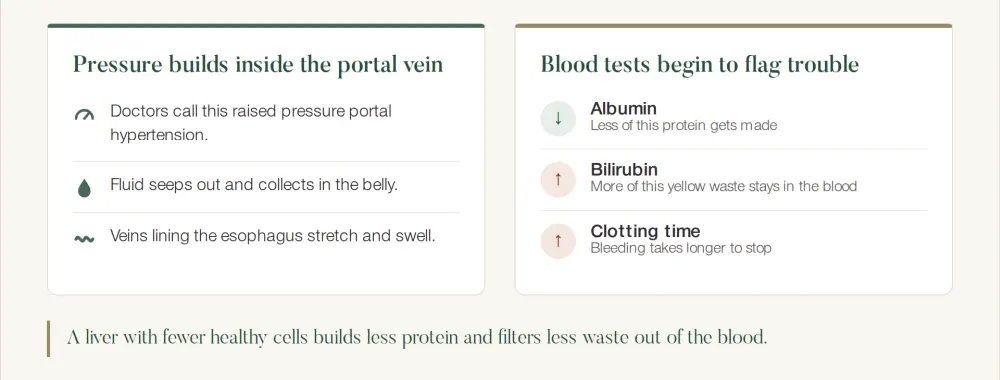
Scar tissue also stiffens the channels that carry blood through the liver, and the back-pressure in the portal vein, called portal hypertension, pushes fluid into the abdomen and swells veins in the esophagus. Blood tests then start to show low albumin, high bilirubin, and slower clotting, since fewer working cells remain to make proteins and clear waste.
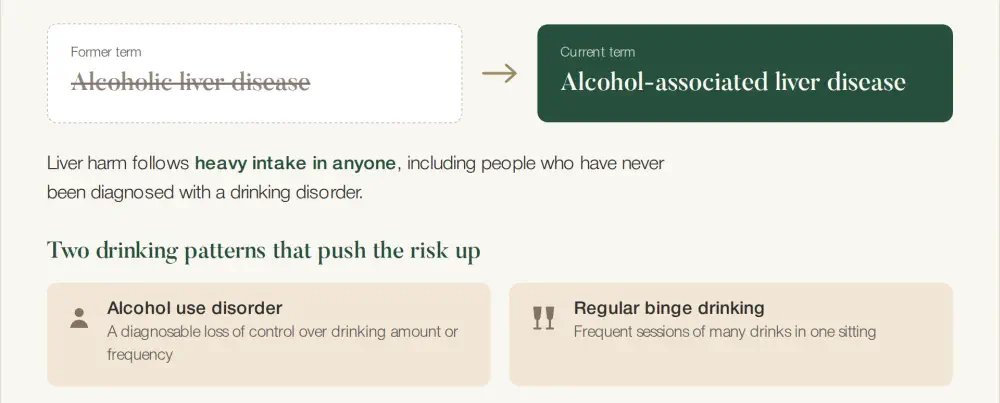
Cleveland Clinic explains that clinicians renamed the condition alcohol-associated liver disease because heavy intake causes the injury with or without a diagnosed dependency. Alcohol use disorder and routine binge drinking both raise the risk, which keeps alcoholism and liver disease closely tied even under the new name.
What Do Doctors See at Each of the Alcohol Cirrhosis Stages?
Pathologists recognize three histologic alcohol cirrhosis stages, which run from fatty liver to alcoholic hepatitis to cirrhosis, with fibrosis building as injury continues. The order is not fixed, and features of all three can appear together in one long-term drinker.
Fat Droplets After a Few Days of Heavy Drinking
Just a few days of drinking to excess can leave fat droplets packed inside liver cells, the earliest change in alcohol-related liver disease. Cleveland Clinic puts the share of heavy drinkers who reach this point at around 90%, and the fat clears once drinking stops. Some notice discomfort under the right ribs as the fat enlarges the liver, and many have no symptoms at all.
Inflamed Liver Cells in Alcoholic Hepatitis
Continued drinking can swell and inflame liver cells, producing alcoholic hepatitis, which may bring jaundice, fever, belly pain, nausea, and at times confusion. Severe episodes can end in liver failure, and UCSF transplant specialists read any episode as a warning that cirrhosis may follow.
How Liver Fibrosis From Alcohol Gets Graded
The METAVIR score used by pathologists grades scarring from F0, meaning none, to F4, meaning cirrhosis, with bridging scar bands appearing at F2 and F3. Readings of liver fibrosis can move in both directions with changes in alcohol intake. A small 12-month study of hospitalized patients who had metabolic syndrome and drank chronically found that non-invasive fibrosis scores improved in those who quit and kept worsening in those who carried on, and its authors describe the results as preliminary.
Compensated and Decompensated Cirrhosis
A nodular F4 liver that still covers the body's needs is described as compensated. Decompensation begins with the first episode of ascites, variceal bleeding, or hepatic encephalopathy – the medical names for abdominal fluid, bleeding from swollen veins, and toxin-driven confusion – and for anyone who keeps drinking after an alcohol-related cirrhosis diagnosis, the chance of living five more years falls below 50%.
How Much Alcohol Starts Cirrhosis When You Count Canadian Standard Drinks?
For both men and women, cirrhosis risk rises once intake passes about 30 g of alcohol a day, the figure Italy's Dionysos Study reached when it examined more than 6,500 residents to test how much alcohol starts cirrhosis in the general population. Risk kept rising as daily intake went up, and Cleveland Clinic notes that most people who reach alcohol-associated liver disease have been drinking heavily for five to 10 years.
Health Canada sets a standard drink at 13.45 g of pure alcohol, a smaller unit than the 14 g drink used in American research, so any US count of drinks per day converts into slightly more Canadian drinks.
| Daily alcohol intake | Canadian standard drinks | Everyday equivalent |
| 30 g | About 2.2 | A little over two 341 ml bottles of 5% beer |
| 60 g | About 4.5 | Roughly 85% of a 750 ml bottle of 12% wine |
| 120 g | About 8.9 | Half of a 750 ml bottle of 40% spirits |
By that measure, three regular 341 ml beers a night already carry a drinker past the Dionysos threshold.

The UK Million Women Study, which tracked more than 400,000 women for an average of 15 years, found that drinking pattern mattered alongside amount. Among participants having seven or more drinks a week, daily consumption raised cirrhosis incidence by 61% compared with non-daily consumption, and having alcohol every day outside of meals more than doubled it, even after accounting for how much and what type of alcohol the women drank.
Personal biology changes how much harm a given intake does, and women are more susceptible to alcohol-related liver injury than men. A 2023 prediction model for future cirrhosis relied on the age at which at-risk drinking began and inherited variants in the PNPLA3 and HSD17B13 genes. Obesity, a high-fat diet, and a coexisting hepatitis C infection all push the risk higher, and the choice of beer, wine, or spirits matters little.
Why Do Alcohol Cirrhosis Symptoms Stay Quiet, Then Turn Urgent?
Symptoms stay faint as long as the surviving tissue in a compensated liver covers the body's needs, and researchers note that some patients with alcohol-related liver disease are identified only after their first decompensation. Tiredness leads the list for many people with alcohol-associated liver disease, and other alcohol cirrhosis symptoms such as weakness, appetite loss, and weight loss can resemble those of unrelated health problems.
Decompensation brings alcohol cirrhosis symptoms that each point to a specific lost liver function, and two of them call for 911.
| What you notice | Lost liver function | Urgency |
| Yellow skin or eyes | Clearing bilirubin | Prompt medical assessment |
| Swollen belly or legs | Making albumin, controlling portal pressure | Prompt medical assessment |
| Vomiting blood or black, tarry stools | Keeping pressure off esophageal veins | Call 911 |
| Confusion, drowsiness, or a flapping hand tremor | Removing ammonia and other toxins | Call 911 |
| Easy bruising or frequent nosebleeds | Producing clotting proteins | Prompt medical assessment |
Kidney failure and severe infections can follow as well, and in the Ontario cohort, 25% of people with alcohol-associated cirrhosis died from a liver-related cause within 10 years.
What Happened When Patients With Failing Livers Stopped Drinking?
Quitting after decompensation changed that outlook in a 17-centre study of 633 patients, published in the Journal of Hepatology in 2026, where 33.8% had regained stable liver function by year five. Doctors call that recovery recompensation, and the Baveno VII criteria used in the study require at least three months of abstinence, a year without variceal bleeding, ascites and encephalopathy resolved without medication, and liver function scores back in the mildest range.
Stopping within a month of the first decompensation roughly doubled the likelihood of recompensation, and further complications at the time of abstinence lowered it. Among recompensated patients with alcoholic cirrhosis who stayed abstinent, none had a liver-related death or a liver cancer diagnosis during follow-up. Of the 24 recompensated patients who went back to drinking, 14 decompensated again and 7 died, compared with 6 repeat decompensations among the 173 who stayed sober.

Why Do Liver Specialists Treat Alcohol Addiction as Part of Cirrhosis Care?
American liver guidelines recommend treatment for every patient with alcohol use disorder and name inpatient alcohol rehabilitation among the options. The same guidance says care works best when medical and addiction needs are handled together, and one study of patients with alcohol-related cirrhosis who were still drinking found that a conversation about addiction treatment with the hepatology team was linked to 3.23 times the odds of being in treatment a year later.
Stopping alcohol carries its own danger for someone with liver damage, and a 2024 hepatology review advises a monitored setting for severe withdrawal, with sedatives that rely less on liver metabolism. Withdrawal delirium can also be hard to tell apart from hepatic encephalopathy.
Residential alcohol addiction treatment at the Canadian Centre for Addictions gives clients 30 to 90 days away from alcohol with 24/7 nursing, and our psychologists treat the anxiety, depression, and trauma that can keep a person drinking long after alcoholism and liver damage have been diagnosed. Since the recovery data favour people who stop within a month of their first complication, a residential setting that removes access to alcohol from day one fits that timeline. Clients stay at Woodlawn Inn in Cobourg or Hillcrest Mansion in Port Hope, and our organization has held Accreditation Canada status since 2018.
Ready to Take the First Step?
Addiction doesn't get better on its own. Call us today for a free, confidential consultation and find out which program is right for your needs.
What Ontario's 2040 Cirrhosis Forecast Means for Younger Drinkers
Queen's University researchers found alcohol-related cirrhosis rising 11.6% a year among Ontarians born after 1980, based on cases diagnosed from 2000 to 2017, and they project that alcohol and fatty liver disease will account for almost all new cirrhosis diagnoses in Canada by 2040. With alcohol-related cirrhosis climbing that quickly in a younger group, the fibrosis years before alcoholic cirrhosis are when addiction treatment has the most liver left to protect.
FAQ
My liver enzymes came back normal, so why does my doctor still suspect cirrhosis?
Enzymes such as ALT and AST can sit in the normal range once much of the liver has turned to scar, since fewer active cells remain to release them. Doctors combine routine blood results into scores such as FIB-4 and use transient elastography, known as FibroScan, to estimate liver stiffness.
Is non-alcoholic beer safe with alcoholic cirrhosis?
Beer labelled non-alcoholic can still hold trace amounts of alcohol, and its taste and ritual can revive cravings during recovery from alcohol use disorder. Hepatology teams disagree on these drinks, so check with your own specialist before trying one.
Which painkillers are safer for someone with a scarred liver?
Acetaminophen is the preferred painkiller for people with cirrhosis, kept well under the dose printed on the package. Clinical reviews cap it at 2,000 mg a day for long-term heavy drinkers, half of what an average adult can handle, so ask your own physician which limit applies to you. Ibuprofen, naproxen, and other anti-inflammatory drugs raise the risk of kidney injury and gastrointestinal bleeding once the liver is scarred, so hepatologists advise against them.
Are medications for alcohol cravings safe with cirrhosis?
Acamprosate involves no liver metabolism, and baclofen was the only relapse-prevention medication tested in a randomized trial of people with alcohol-associated cirrhosis when American guidance came out in 2019. Naltrexone and disulfiram depend on hepatic metabolism and can injure the liver, so prescribers weigh them carefully once cirrhosis is present.
Does Ontario still require six months of sobriety before a liver transplant?
Ontario made its alternative to the fixed six-month abstinence rule permanent in 2020, following a pilot at University Health Network in Toronto and London Health Sciences Centre. Candidates with alcohol-associated liver disease are now assessed individually for relapse risk and receive addiction treatment as part of the transplant pathway.
Article sources
- Wang PL, Djerboua M, Flemming JA. "Cause-specific mortality among patients with cirrhosis in a population-based cohort study in Ontario (2000–2017)." Hepatology Communications. https://www.ncbi.nlm.nih.gov/pmc/articles/PMC10309525/
- Patel R, Mueller M. "Alcohol-Associated Liver Disease." StatPearls, NCBI Bookshelf. https://www.ncbi.nlm.nih.gov/books/NBK546632/
- Cleveland Clinic. "Alcohol-Associated Liver Disease." Cleveland Clinic. https://my.clevelandclinic.org/health/diseases/alcohol-associated-liver-disease
- Bellentani S, Saccoccio G, Costa G, et al. "Drinking habits as cofactors of risk for alcohol induced liver damage." Gut. https://pubmed.ncbi.nlm.nih.gov/9462221/
- Health Canada. "Low-risk alcohol drinking guidelines." Government of Canada. https://www.canada.ca/en/health-canada/services/substance-use/alcohol/low-risk-alcohol-drinking-guidelines.html
- Simpson RF, Hermon C, Liu B, et al. "Alcohol drinking patterns and liver cirrhosis risk: analysis of the prospective UK Million Women Study." The Lancet Public Health. https://www.ncbi.nlm.nih.gov/pmc/articles/PMC6323353/
- Hofer BS, Tonon M, Buttler L, et al. "Incidence and implications of abstinence-induced recompensation in alcohol-related cirrhosis." Journal of Hepatology. https://www.journal-of-hepatology.eu/article/S0168-8278(26)00018-8/fulltext
- Bertha M, Choi G, Mellinger J. "Diagnosis and Treatment of Alcohol-Associated Liver Disease: A Patient-Friendly Summary of the 2019 AASLD Guidelines." Clinical Liver Disease. https://pmc.ncbi.nlm.nih.gov/articles/PMC8340354/
- Flemming JA, Djerboua M, Groome PA, Booth CM, Terrault NA. "NAFLD and Alcohol-Associated Liver Disease Will Be Responsible for Almost All New Diagnoses of Cirrhosis in Canada by 2040." Hepatology. https://pubmed.ncbi.nlm.nih.gov/34174003/