We offer medical detox and multiple addiction treatment options in our
luxury treatment centres in Port Hope, Cobourg, and Ottawa.
What Is Alcoholic Neuropathy and Can It Be Reversed?

Years of heavy drinking can injure the nerves outside the brain and spinal cord, a condition called alcoholic neuropathy that usually begins with tingling, burning or numbness in the feet. In 2024, 6.2 million Canadians reported heavy drinking, defined by Statistics Canada as four or more drinks for women or five or more for men on one occasion, at least monthly. Among people whose heavy drinking continues for years, nerve conduction testing later confirms neuropathy in 46.3%. Improvement is common once drinking stops and missing nutrients are replaced, yet leading medical references disagree on the odds of full reversal.
You'll Learn
- Why the toes are symptomatic first, and the fingers stay normal for years
- The two separate nerve injuries behind a diagnosis of alcoholic neuropathy, and how each one feels
- Why a clean nerve conduction result can still hide real harm
- Where two leading medical references contradict each other on reversal
- What a five-year follow-up found in men who stopped drinking
- The vitamin that damages nerves once the dose climbs too high
What Causes Alcohol Neuropathy to Start in the Feet?
A University of Sheffield team's 2019 review of 87 studies described alcohol neuropathy as a length-dependent, mostly sensory condition that worsens over time. In practice, length-dependent means the damage shows first in the nerve fibres with the farthest to travel, and those fibres end in the toes and soles.
Ethanol and its breakdown products harm nerve fibres directly, with free radicals, oxidative stress and inflammatory markers degrading both the axon and its myelin coating. Poor nutrition adds a second cause, since long-term drinking lowers calorie intake and impairs absorption in the gut, leaving nerves short of thiamine and other B vitamins, folic acid and vitamin E.
Toxic Damage vs Thiamine Deficiency
Researchers at Nagoya University compared 64 patients with alcohol-related neuropathy against 32 patients whose neuropathy came from thiamine deficiency alone, and the two injuries looked different both in the clinic and on nerve biopsy.
| Feature | Alcohol-Toxic Form | Thiamine-Deficiency Form |
| How quickly it worsens | Slowly | Rapidly |
| Dominant problem | Pain and burning, with loss of surface sensation; pain above all | Weakness, with loss of both surface and deep sensation |
| Fibres mainly lost | Small fibres | Large fibres |
Heavy drinkers who were also short of thiamine showed a variable blend of the two columns, leading the authors to conclude that thiamine status shapes how the condition presents.
How Do Alcohol Neuropathy Symptoms Move From Toes to Hands?
Medscape, a clinical reference for physicians, reports that tingling in the feet and toes appears to be the most common first complaint. For some people, pain arrives before anything else, and the symptoms of alcohol neuropathy appear symmetrically in both legs. From there, symptoms tend to spread in a recognizable order.
- Numbness, tingling and burning climb gradually from the feet up the legs.
- Walking grows unsteady as the feet lose their sense of position, and falls become more frequent.
- Heavier or longer drinking carries the same deficits into the hands.
In rare cases, the damage reaches the vagus or laryngeal nerves and leaves the voice hoarse and weak. Alcohol can also injure the autonomic nerves that run digestion, sweating and blood pressure, and Medscape names indigestion and altered movement of the stomach among the resulting gut problems.
None of these signs are unique to alcohol, so the cause has to be proven through testing.

How Do Doctors Tell Alcohol Nerve Damage Apart From Diabetic Neuropathy?
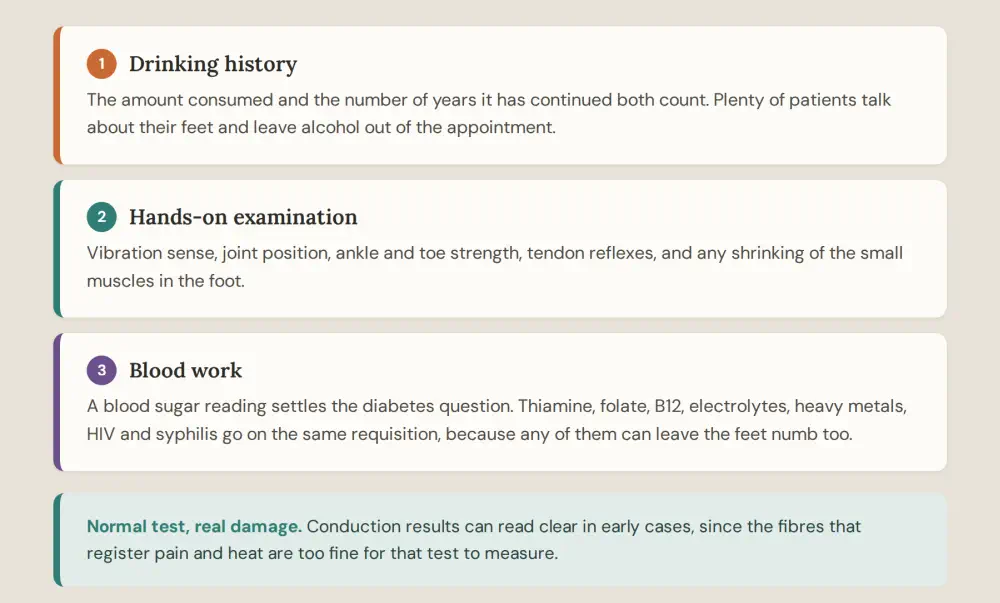
No single lab test confirms nerve damage from alcohol, and diabetic neuropathy can present in much the same way, so the two are separated by a blood sugar test and an honest drinking history more than by the symptoms themselves.
How much someone drinks, and for how many years, are the two questions that matter most in that history. StatPearls, the clinical reference hosted on the NIH's NCBI Bookshelf, warns that many patients describe their symptoms without ever mentioning alcohol. During the exam, doctors look for reduced vibration and position sense, weak ankle and toe movement, faded tendon reflexes and wasting of the small foot muscles. Blood work then checks electrolytes, thiamine, folate, vitamin B12, heavy metals, HIV and syphilis, since each can explain the same nerve pattern.
Heavy drinking also affects the brain, and Wernicke-Korsakoff syndrome appears among the conditions to rule out. Hallucinations or paranoia can signal a separate complication, alcohol-induced psychosis, which needs its own assessment.
When a Normal Nerve Test Misses Small-Fibre Loss
In early alcohol-related cases, nerve conduction results tend to come back normal or only slightly slowed, so a clean report can falsely reassure someone whose feet burn. The alcohol-toxic form in the table above can slip past this way, because its losses fall mainly on the thin fibres carrying pain and temperature. Needle EMG gives doctors a second check, since abnormal electrical activity in muscle turns up in many alcohol-related cases.
Why Do Medical References Disagree on Reversing Alcoholic Neuropathy?
StatPearls calls the overall prognosis of alcoholic neuropathy favourable and reports that most patients regain full function with abstinence. Medscape is far more cautious, describing the nerve damage as usually permanent even with treatment, and rating the odds of halting or partly improving it after abstinence as fair to good.
Stranger still, the StatPearls entry contradicts itself in its closing section, where it warns that lingering neuropathy is common even after people quit and calls management of the condition unsatisfactory.
Nerve biopsies offer the most concrete evidence that repair happens, since the Nagoya researchers found regenerating small fibres in patients with a long history of neuropathy. How fast that regrowth moves determines how long recovery takes.
What Timeline Can You Expect for Alcoholic Neuropathy Recovery?
Nerve functions come back on different schedules during recovery from alcoholic neuropathy, and one Swedish study followed patients for up to five years.
| What Recovers | Reported Timeframe |
| Autonomic function | Around 12 months of abstinence, with some digestive symptoms persisting |
| Examination and nerve test results | Several months to a few years of abstinence |
| Near-normal nerve function | Reached by 7 of 10 men re-examined three to five years after their first examination |
Other benefits of quitting alcohol can appear sooner, giving people reasons to stay sober through the slow months of nerve repair.
What the Swedish Follow-Up Says About Who Recovers
Every one of the seven men whose clinical and nerve test results returned to normal or near-normal had stopped drinking, according to the Karolinska Hospital team in Stockholm. The group ranged in age from 38 to 72 and had been drinking for 10 to 30 years, and the authors judged the outlook as good regardless of age. They attached one condition to that verdict, since other causes of neuropathy such as diabetes, cancer and nerve injury had to be ruled out first. There were ten patients, all of them men, who were included in this small study. The result shows what sobriety can achieve without predicting any one person's outcome.
Which Alcohol Neuropathy Treatment Options Held Up in Clinical Trials?
Clinical guidance centres care on stopping alcohol and replacing thiamine, vitamin B12 and folic acid. The Sheffield review found only sparse trial data on treatment for alcohol neuropathy, with what little exists pointing toward B-vitamin combinations that contain thiamine.
One randomized trial assigned 325 patients to placebo or one of two tablets taken three times a day, both combining vitamins B1, B2, B6 and B12, with one adding folic acid. After 12 weeks, both vitamin groups showed greater gains than placebo in vibration sense at the big toe, pain and other measures. Twelve weeks is short against a repair timeline measured in years, so the trial shows early gains and leaves long-term effects still untested.
Medscape lists gabapentin and amitriptyline, a tricyclic antidepressant, among the common first-line drugs for burning and shooting pain. Physical and occupational therapy help people rebuild movement and handle daily tasks during recovery.
Why Quitting Alone at Home Carries Medical Risk
People who stop suddenly after long, heavy drinking can go into withdrawal, which at its worst brings seizures, hallucinations or delirium tremens. CCFA's residential alcohol rehab programs at Hillcrest Mansion in Port Hope and Woodlawn Inn in Cobourg provide medically supervised withdrawal with 24/7 nursing and regular chef-prepared meals. Programs run from 30 to 90 days in a setting with no access to alcohol.
The Vitamin That Can Cause Nerve Damage of Its Own
The trial formula above included vitamin B6, a nutrient that in excess causes a sensory neuropathy of its own, with tingling in the hands and feet. Food alone cannot supply enough B6 to cause harm, so toxicity comes from high-dose supplements, prescribed or bought over the counter. Most reported nerve damage involved more than 1,000 mg a day, and a few case reports describe it below 500 mg a day after months of use. Several products taken together can push intake past any single label, so vitamin doses belong in a medical plan.
Ready to Take the First Step?
Addiction doesn't get better on its own. Call us today for a free, confidential consultation and find out which program is right for your needs.
Why a Monthly Symptom Record Matters for Nerve Recovery
Recovery that unfolds over months and years is easy to miss week to week, so a monthly note of where feeling has returned to your feet, how far the burning has retreated and how steady the stairs feel gives you and your doctor a clearer measure than memory. Brought to each appointment, that record lets the doctor adjust vitamins, pain medication or physiotherapy against real change.
FAQ
Why do some heavy drinkers never get nerve damage?
Risk varies from person to person, and the Sheffield review linked it to genetic differences and to the type of alcohol consumed. Clinical literature also counts a parental family history of the condition as a risk.
Can alcoholic neuropathy happen without an alcohol use disorder diagnosis?
Nerve injury tracks years of heavy use, and the total amount of alcohol consumed, whatever label someone's drinking carries. Drinking pattern matters too, as steady, uninterrupted drinkers are hit harder than people who drink in bouts.
Is an occasional drink safe once the tingling fades?
Clinical guidance builds treatment on abstinence from alcohol, so an occasional drink runs against the core of the plan. Regrowing fibres also meet the same direct toxic effect of ethanol that injured them in the first place.
How can I protect numb feet from burns and falls?
Loss of sensation raises the risk of falls, burns and pressure sores, so daily foot checks and testing bath water by hand help catch injuries early. Medscape recommends shoes with a roomy toe box and, for weak ankles, an ankle-foot brace that improves position sense and reduces sprains.
Do men and women face the same risk?
Published findings conflict, since StatPearls reports that women face a higher likelihood of the condition, with quicker onset and more severe symptoms, and the Sheffield review lists male sex among the identified risks. The review's authors add that these risks interact, which has made the typical features of the condition hard to pin down.
Article sources
- Statistics Canada. "January forecast: Cold, wet and dry." Statistics Canada. https://www.statcan.gc.ca/o1/en/plus/8895-january-forecast-cold-wet-and-dry
- Julian T, Glascow N, Syeed R, Zis P. "Alcohol-related peripheral neuropathy: a systematic review and meta-analysis." Journal of Neurology. https://www.ncbi.nlm.nih.gov/pmc/articles/PMC6851213/
- Sadowski A, Houck RC. "Alcoholic Neuropathy." StatPearls Publishing. https://www.ncbi.nlm.nih.gov/books/NBK499856/
- Koike H, Iijima M, Sugiura M, et al. "Alcoholic neuropathy is clinicopathologically distinct from thiamine-deficiency neuropathy." Annals of Neurology. https://pubmed.ncbi.nlm.nih.gov/12838517/
- Laker SR. "Alcoholic Neuropathy." Medscape eMedicine. https://emedicine.medscape.com/article/315159-overview
- Hillbom M, Wennberg A. "Prognosis of alcoholic peripheral neuropathy." Journal of Neurology, Neurosurgery, and Psychiatry. https://pubmed.ncbi.nlm.nih.gov/6086844/
- Peters TJ, Kotowicz J, Nyka W, et al. "Treatment of alcoholic polyneuropathy with vitamin B complex: a randomized controlled trial." Alcohol and Alcoholism. https://pubmed.ncbi.nlm.nih.gov/16926172/
- Saitz R. "Introduction to Alcohol Withdrawal." Alcohol Health and Research World. https://www.ncbi.nlm.nih.gov/pmc/articles/PMC6761824/
- StatPearls. "Vitamin B6 Toxicity." StatPearls Publishing. https://www.ncbi.nlm.nih.gov/books/NBK554500/