We offer medical detox and multiple addiction treatment options in our
luxury treatment centres in Port Hope, Cobourg, and Ottawa.
Does Alcohol Affect Sleep?

Alcohol and sleep have been studied in laboratories since the 1930s, and the findings contradict the reason most people pour the last drink of the evening. Sedation and sleep are separate states, and alcohol supplies one at the cost of the other. The damage concentrates in the back half of the night, hours that leave almost no trace in memory. How much damage depends on dose, timing, and who is doing the drinking.
You'll Learn
- The dose at which alcohol genuinely speeds up falling asleep, and why the number surprises people
- What a wearable reads as deep sleep on a drinking night
- Which hormone alcohol switches off, sending you to the bathroom at 3 a.m.
- Why drinking makes some snorers worse and leaves others untouched
- The group that loses close to half its REM sleep after a few drinks
- How sleep in the first months of sobriety predicts what happens a year later
Why Does Alcohol Make You Sleepy Within Minutes?
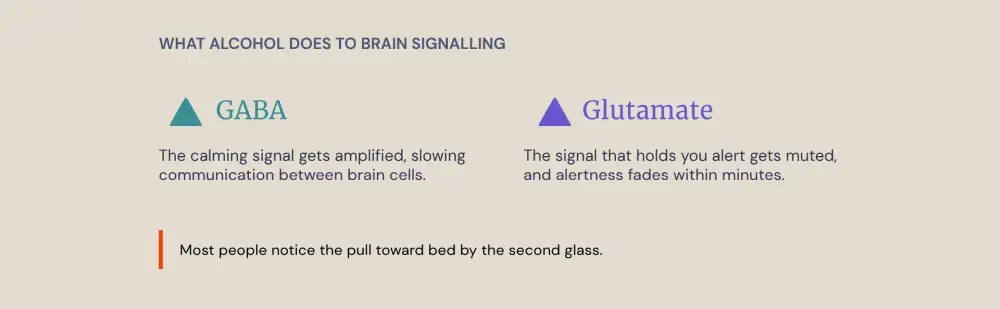
Alcohol depresses the central nervous system by boosting GABA, the brain's main inhibitory signal, and blunting glutamate, the excitatory one. Wakefulness circuits quiet down, and the eyelids grow heavy. Two glasses in, alcohol makes most people sleepy enough to head for bed early.
A 2024 meta-analysis found that alcohol shortened the time taken to fall asleep only at doses near 0.85 g/kg, roughly five standard drinks. One or two drinks made no measurable difference to sleep onset, and those smaller doses still cut into REM sleep.
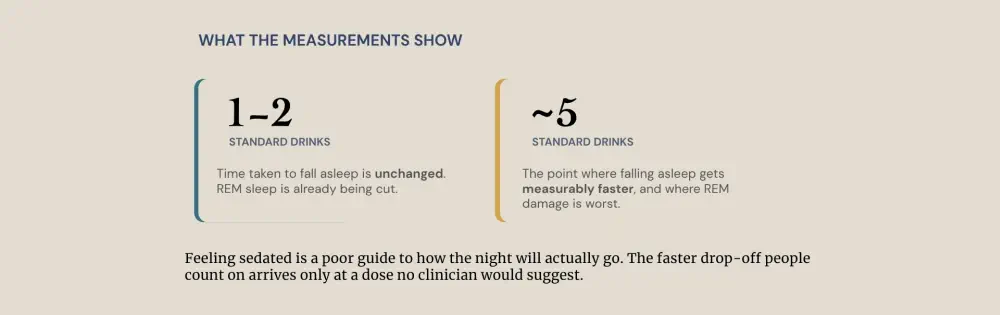
The belief holds up only at quantities nobody would recommend for sleep. At ordinary amounts, the drowsiness is real, and the head start is imagined.
How Does Alcohol Affect Sleep Quality Hour by Hour?
Sleep cycles run roughly 90 minutes, alternating slow-wave sleep with REM. Alcohol bends that pattern from the first cycle onward, and the second half of the night pays for the first.
| Measure | First half of the night | Second half |
| Slow-wave sleep | Increased | Reduced |
| REM sleep | Delayed, suppressed | Fragmented rebound |
| Awakenings | Few | Frequent |
| Heart rate | Lowered | Elevated |
| Body temperature | Raised | Unstable |
Drinking within about three hours of bed delays the first REM period and shortens total REM across the night, scaling by dose. Log a week of evening drinking and hours in bed barely move. Alcohol degrades sleep quality without touching sleep duration, which is why a wearable still scores the opening stretch of a drinking night generously.
What the Missing REM Costs the Next Day
Memory consolidation and emotional regulation both depend on REM, so losing it reads as irritability and thinner concentration the following afternoon. Research shows alcohol compounds existing sleep debt, so daytime sleepiness and performance impairment land hardest on people already short on rest.
What Wakes Drinkers Up at 3 a.m.?
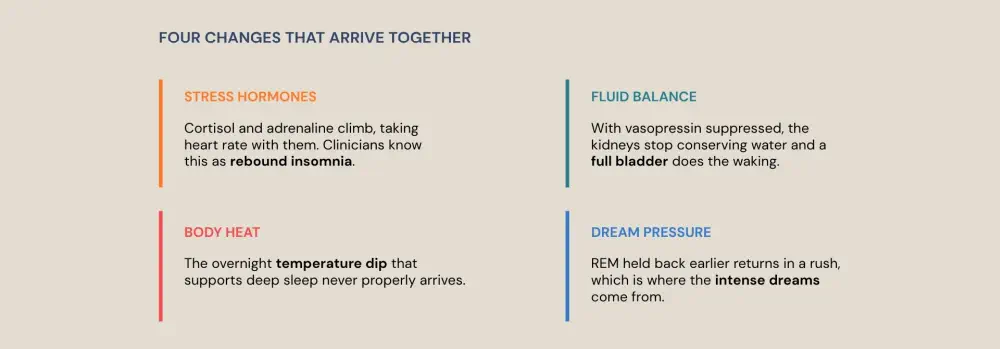
How alcohol affects sleep changes direction once the liver has done its work, which takes roughly an hour per standard drink. Sedation lifts on that schedule, and the nervous system overshoots baseline on the way back up. Heart rate climbs. Cortisol and adrenaline rise. Clinicians call the result rebound insomnia.
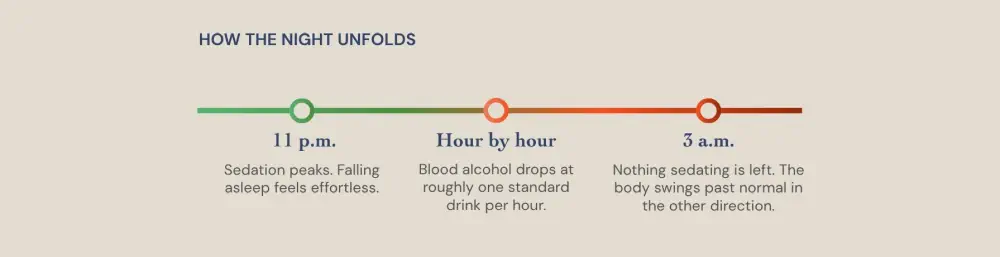
Vasopressin, the hormone telling the kidneys to hold water, gets suppressed at the same hour, which explains the bathroom trip that ends the night's last decent stretch of sleep. Core body temperature also runs higher than it should overnight, since even low doses flatten the temperature rhythm that normally dips during deep sleep. Suppressed REM discharges all at once, producing the vivid dreams that follow a heavy night.
Waking with a racing pulse and unexplained dread hits some people harder than others. For anyone already managing low mood, the overlap between alcohol and depression makes those early hours the worst stretch of the day.
How Does a Nightcap Turn Into Alcohol Insomnia?
Tolerance to the sedative effect builds after only a few consecutive nights. Two drinks stop producing two drinks' worth of drowsiness, so the amount creeps up, and every step of that escalation costs more sleep than the last.
Alcohol insomnia sustains itself once it starts. Poor sleep drives the drink, the drink degrades sleep further, and the exhaustion that follows makes the next night's drink feel non-negotiable. Insomnia rates among people entering alcohol treatment run from 36% to 72%.
Canadians reach for a range of sleep aids, and alcohol sits lower on that list than its reputation suggests. A national survey of 4,037 adults found insomnia disorder in 16.3% of respondents and mapped what they turned to:
| Sleep aid used in the past 12 months | Share of Canadian adults |
| Natural products or over-the-counter medication | 28.7% |
| Cannabis-derived products | 15.6% |
| Prescribed sleep medication | 14.7% |
| Alcohol | 9.7% |
Men used alcohol for sleep at roughly 1.7 times the rate of women, and the habit clustered among adults aged 18 to 35.
Signs the nightcap has crossed into something else:
- Falling asleep without a drink no longer happens
- The evening drink has moved from social settings to solo ones
- Nights off bring sweating or a pounding heart
- Morning fatigue persists no matter how early you went to bed
Who Loses the Most Sleep to Alcohol?
Two people drinking the same amount at the same hour record very different nights, and a few identifiable groups take the worst of it.
Snorers and people with sleep apnoea
The muscles holding the upper airway open relax under alcohol. A meta-analysis of 13 polysomnography studies recorded the apnoea-hypopnoea index climbing by roughly four events per hour after drinking, with lowest oxygen saturation falling by 2.7%. The same review found alcohol worsened snoring in people who already snored and did not turn non-snorers into snorers. Higher consumption raises the risk of sleep apnoea by 25%.
Women, particularly after menopause
Postmenopausal women in that same review lost close to half their REM sleep after drinking, falling from 18.6% of the night to 11.1%. Canadian women also report insomnia disorder at higher rates than men, so the sedative pull of an evening drink meets a population already sleeping poorly.
Anyone taking sedative medication
Sedative sleep medication and alcohol slow breathing and heart rate through the same pathways. The combination carries a danger neither carries alone, and no dose of it counts as recreational.
How Long Does Sleep Take to Recover After the Last Drink?
Sleep deteriorates before it improves, which is why the first fortnight without alcohol persuades some people that drinking had been helping all along.
- Weeks 1 to 2. Insomnia and intense dreaming peak. Disturbed sleep affects 25% to 60% of people in early recovery
- Weeks 2 to 4. Architecture starts normalizing, and circadian rhythms disrupted by drinking tend to settle within a month
- Month 2 onward. Subjective sleep quality improves, though periodic limb movements and fragmented nights can linger
- After long-term heavy drinking. Some sleep abnormalities remain measurable well beyond a year of abstinence
A study tracking 74 patients for five months after treatment found 60% of those with insomnia at intake returned to drinking, against 30% of those without it. Sleep in the first weeks of sobriety turns out to be the strongest available predictor of what happens twelve months later.
Cognitive behavioural therapy for insomnia carries the strongest evidence for treating what remains once drinking stops. For anyone whose body has come to expect alcohol nightly, stopping without medical oversight carries real risk, which is why supervised detox and structured Alcohol Addiction Treatment in Ontario handle withdrawal and sleep together.
How Late Is Too Late for the Last Drink?
Three to four hours between the final drink and bed lets the liver clear a moderate amount before the deeper cycles begin. Earlier is better. Timing softens the disruption without erasing it, since REM suppression shows up well below intoxication.
Where That Leaves the Last Drink
Alcohol delivers the part of sleep people can feel and takes the part they cannot. Ten minutes to fall asleep counts as evidence that it works, and the REM missing after 3 a.m. counts as nothing, because nobody remembers what never arrived. Anyone unsure where they stand has a cheap test available, and it costs four weeks.
FAQ
Does the type of drink change how badly I sleep?
Ethanol drives the disruption, so beer, wine, and spirits behave the same once the dose matches. What varies is how quietly each adds up. Wine poured at home, and cocktails built with unmeasured spirits land higher than people estimate.
Why do I sleep worse on nights I don't drink?
Bodies adapted to nightly alcohol treat its absence as withdrawal, and restlessness across the first few dry nights is part of that adjustment. The pattern feels like proof alcohol was helping. It signals the opposite.
Is it safe to quit drinking on my own if I need alcohol to fall asleep?
Needing a drink to sleep suggests the body has adapted to its presence, and stopping abruptly after prolonged heavy use can trigger dangerous withdrawal. A doctor or treatment centre can assess your risk before you stop. Medically supervised detox exists for this reason.
Will melatonin or an over-the-counter sleep aid help if I keep drinking?
Sleep aids taken alongside alcohol deepen sedation without restoring sleep architecture, and several combinations suppress breathing dangerously. Heavy drinking also disturbs the body's own melatonin timing, so supplements work against a moving target. Speak with a physician before layering anything on top of nightly alcohol.
My sleep tracker shows worse scores after drinking. Can I trust it?
Consumer trackers estimate sleep stages from movement and heart rate, so treat single nights loosely. Elevated resting heart rate and restlessness after midnight are what they capture well, and both follow alcohol reliably. Compare weekly averages across drinking and dry stretches for a clearer read.
Article sources
- Sleep Medicine Reviews. "The effect of alcohol on subsequent sleep in healthy adults: A systematic review and meta-analysis." ScienceDirect. https://www.sciencedirect.com/science/article/pii/S1087079224001345
- Roehrs, T. and Roth, T. "Sleep, Sleepiness, and Alcohol Use." Alcohol Research & Health, National Institute on Alcohol Abuse and Alcoholism. https://www.ncbi.nlm.nih.gov/pmc/articles/PMC6707127/
- Brower, K. "Insomnia, alcoholism and relapse." Sleep Medicine Reviews. https://www.sciencedirect.com/science/article/abs/pii/S1087079203900050
- Morin, C. et al. "Prevalence of insomnia and use of sleep aids among adults in Canada." Sleep Medicine, ScienceDirect. https://www.sciencedirect.com/science/article/pii/S1389945724004659
- Simou, E., Britton, J. and Leonardi-Bee, J. "Alcohol and the risk of sleep apnoea: a systematic review and meta-analysis." Sleep Medicine, National Library of Medicine. https://www.ncbi.nlm.nih.gov/pmc/articles/PMC5840512/
- Burgos-Sanchez, C. et al. "Impact of Alcohol Consumption on Snoring and Sleep Apnea: A Systematic Review and Meta-analysis." Otolaryngology–Head and Neck Surgery. https://aao-hnsfjournals.onlinelibrary.wiley.com/doi/10.1177/0194599820931087
- Brower, K., Aldrich, M., Robinson, E., Zucker, R. and Greden, J. "Insomnia, Self-Medication, and Relapse to Alcoholism." American Journal of Psychiatry. https://psychiatryonline.org/doi/10.1176/appi.ajp.158.3.399
- Journal of Addiction Medicine. "Treatment of Sleep Disturbance in Alcohol Recovery: A National Survey of Addiction Medicine Physicians." National Library of Medicine. https://pmc.ncbi.nlm.nih.gov/articles/PMC2761628/
- Alcohol Research & Health. "Alcohol's Effects on Sleep in Alcoholics." National Library of Medicine. https://www.ncbi.nlm.nih.gov/pmc/articles/PMC2778757/
- Progress in Neuro-Psychopharmacology and Biological Psychiatry. "Alterations in circadian rhythms following alcohol use: A systematic review." ScienceDirect. https://www.sciencedirect.com/science/article/abs/pii/S0278584619303975