
We offer medical detox and multiple addiction treatment options in our
luxury treatment centres in Port Hope, Cobourg, and Ottawa.
Does Alcohol Make ADHD Worse?

A glass of wine can quiet a brain that has been loud since seven in the morning, which explains why so many Canadians with attention deficit hyperactivity disorder reach for one after work. The relief is real, and it is short. Research on ADHD and alcohol arrives at the same conclusion from several directions, showing that alcohol amplifies the exact symptoms it appears to settle. What follows covers the neurochemistry and the medication risks, along with the point at which a nightly drink stops working as a coping tool.
Why Does the First Drink Feel Like Medicine?
Alcohol does make ADHD worse, and the reason it never feels that way in the moment comes down to sequencing. Sedation arrives first and registers as calm in someone whose baseline runs restless, so racing thoughts slow down, and social friction eases. An hour or two later, blood alcohol starts falling, and the same nervous system rebounds past where it began, leaving attention and impulse control in worse shape than before the first pour.
Attribution is what keeps the pattern alive year after year, long after the drinking has stopped being pleasant. The calm gets credited to the drink and the fog that follows gets credited to ADHD, so the evidence a person gathers over years points to alcohol as the reliable variable and the disorder as the problem.
How Does Alcohol Affect ADHD in a Brain Already Short on Dopamine?
ADHD involves weaker dopamine and noradrenaline signalling across the prefrontal cortex and striatum, the circuits responsible for sustained attention and for holding an impulse long enough to think about it. Alcohol pushes a burst of dopamine through the reward pathway, which lands harder in a brain running below baseline. That burst is the reason a first drink can feel like a dose of something therapeutic.
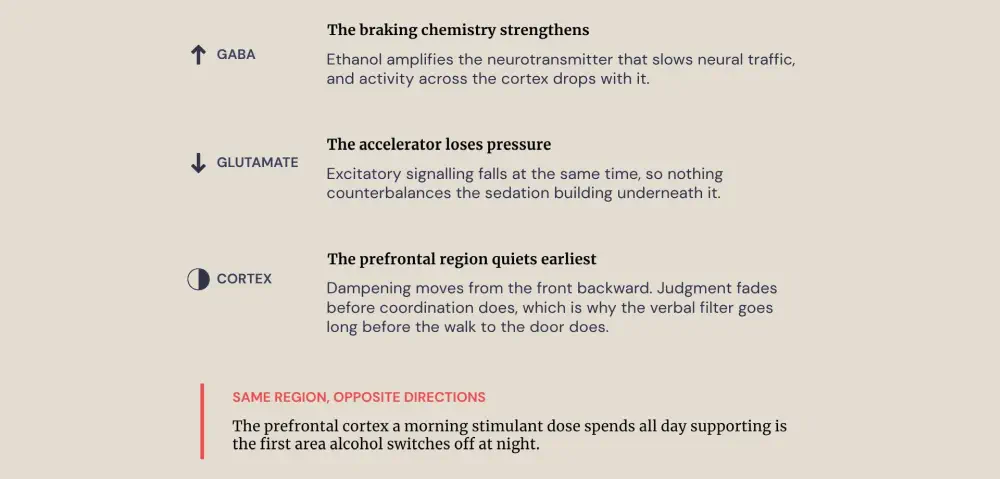
Sedation governs the rest of the evening, and the way alcohol affects ADHD during those hours runs opposite to the early lift. Ethanol boosts GABA activity and suppresses glutamate, dampening the cortex from the front backward, so judgment weakens first, and the filter that catches a sentence before it leaves the mouth goes with it. The prefrontal cortex is also the region a morning stimulant dose spends the day supporting, which puts the two substances in direct opposition inside the same tissue.
Why Do People With ADHD Start Drinking Younger and Drink Harder?
Twin research complicates the assumption that ADHD causes the drinking. Analysis of three population-based twin samples found that childhood ADHD predicts when alcohol use begins and how quickly it escalates, yet identical twins with more severe symptoms than their co-twins showed no difference in alcohol outcomes, pointing toward shared genetic and family influences behind both. The disorder and the drinking grow from overlapping soil.
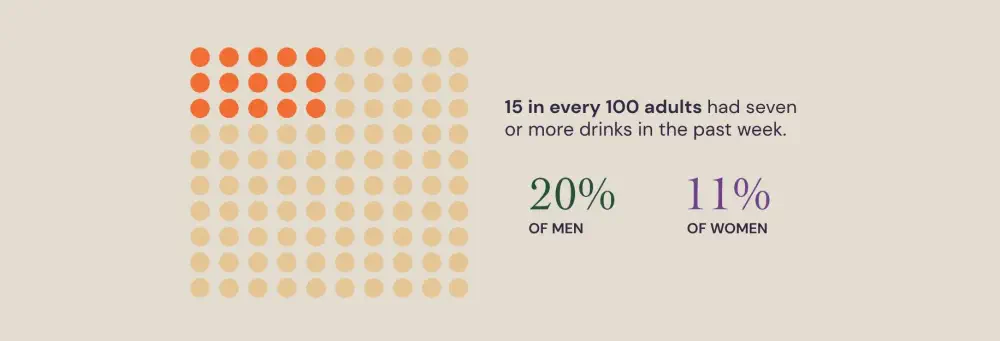
Sensitivity to the alcohol itself differs between groups in a way that changes what a single evening can do. Laboratory work comparing adults with and without ADHD found greater impairment of behavioural inhibition at the same blood alcohol concentration in the ADHD group, so identical drinks produce unequal loss of control. Add a nightcap taken to shut down a mind that refuses to power down, and the habit grows unnoticed inside Canadian drinking norms, where 15% of adults report seven or more drinks in a single week, and men report that level at nearly twice the rate of women.
Nothing about that sequence looks like a problem from inside it, which is how ADHD and drinking settle into a shared routine.
Why Is the Morning After Harder on an ADHD Brain?
The nightcap that shortens sleep onset damages everything that comes after it. Ethanol suppresses REM sleep early in the night, then, as blood alcohol clears, produces fragmented sleep, more awakenings and a rebound in REM during the second half. Someone who fell asleep quickly at eleven is surfacing repeatedly from three onward without registering any of it.
Executive function absorbs that damage directly, and the deficit stacks on top of what ADHD already imposes. Working memory, task initiation and emotional regulation all run on consolidated sleep, and all three sit among the weak points in the condition. The resulting morning is clinically indistinguishable from undertreated ADHD, which is why so many people conclude their prescription has stopped working and ask for a higher dose.

What Happens to Alcohol and ADHD Medication in the Same Bloodstream?
That dose increase carries more risk than most patients realize, because alcohol and ADHD medication change each other's pharmacology. Methylphenidate and ethanol meet in the liver, where carboxylesterase 1 converts part of the dose into ethylphenidate, a compound nobody prescribed. In a controlled crossover study, alcohol raised peak plasma concentrations of the active methylphenidate isomer by roughly 40%. A dose calibrated for a sober liver behaves like a larger one.
Stimulants create a second hazard by masking how drunk a person has become. Amphetamine keeps someone alert and articulate at a blood alcohol level that would normally end the night, so the internal signal to stop never fires and consumption climbs past the point of safety. Health authorities recommend avoiding or limiting alcohol on every class of ADHD medication for this reason. Anyone weighing prescription risks more broadly can read our full account of the hidden dangers of ADHD medications.
| Medication class | Common Canadian brands | What to watch for after drinking |
| Methylphenidate | Ritalin, Concerta, Biphentin, Foquest | Pounding heartbeat, jaw tension, sleep that never arrives |
| Amphetamine salts | Adderall XR, Vyvanse, Dexedrine | Drinking well past your usual limit without feeling it |
| Atomoxetine | Strattera | Yellowing skin, dark urine, pain under the right ribs |
| Alpha-2 agonists | Intuniv XR, generic clonidine | Dizziness on standing, fainting, unusual grogginess |
How Far Does the Overlap Between ADHD and Alcoholism Go?
Population data put the co-occurrence of these two conditions far above anything coincidence would produce. Lifetime prevalence of any alcohol use disorder among adults with ADHD runs as high as 43%, and ADHD turns up in as many as one in five people already diagnosed with an alcohol use disorder, a pairing linked to additional comorbidities and poorer treatment outcomes. Adult ADHD prevalence in Canada sits near 2.9% by comparison.
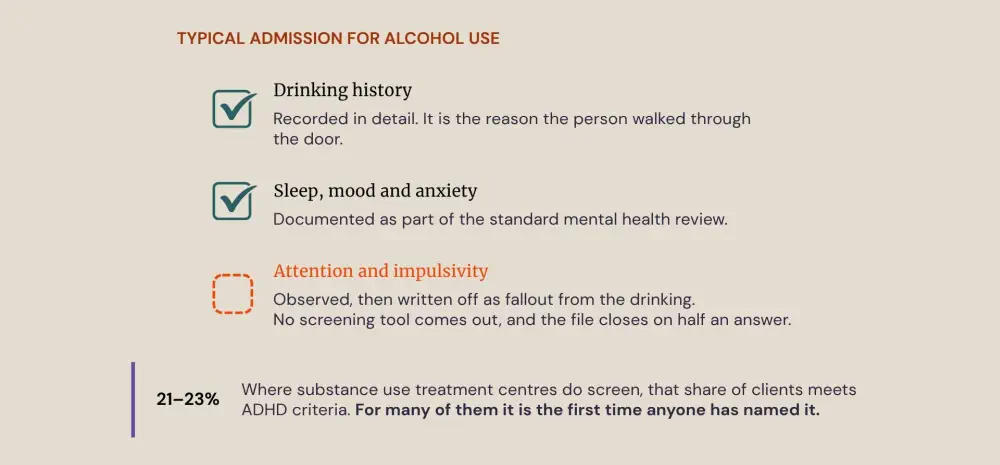
The overlap goes unrecognized inside the settings most likely to catch it. Where clinicians treat ADHD and alcoholism as a pair worth screening for, prevalence in substance use treatment centres lands between 21% and 23%, and a large share of those adults receive the diagnosis for the first time there. Attention problems get filed as consequences of drinking, the assessment closes, and the person leaves with half an answer.
How Do ADHD and Addiction Hide From a Family for Years?
Disorganization gives the drinking somewhere to hide, which is the part families never see coming. Missed appointments, unpaid bills and forgotten commitments already sit inside the household baseline, so the ones caused by alcohol raise no separate alarm and the pattern stays invisible for a decade. Volume climbs steadily because stimulant medication blunts the felt effect, meaning the amount that once worked no longer registers.
Other markers show up around the edges of an ordinary week, and each looks defensible on its own. Weekend drinking spreads into Wednesday and then Tuesday. Attempts to take a month off collapse within days, and the failure gets blamed on a hard stretch at work. Each condition covers for the other at this stage, which is what makes ADHD and addiction so hard to separate by the time anyone asks the question. Families recognizing several of these patterns can look at what structured alcohol addiction treatment in Ontario involves before the drinking sets its own terms.

What Changes When Both Conditions Get Treated at Once?
Recovery starts on the wrong footing when nobody separates the two diagnoses. At the Canadian Centre for Addictions, residential care begins with medically supervised detox and nursing coverage around the clock, because alcohol withdrawal carries genuine physical danger. Attention and impulsivity get measured after that, not during, since active drinking distorts every result.
Early sobriety is where most people lose their nerve, and knowing what sits ahead changes the odds of getting through it. Concentration and mood frequently sink for the first stretch of abstinence before recovering, and follow-up work has found ADHD symptom scores improving over a year without alcohol in the system. Cognitive behavioural work gets restructured around shorter sessions and externalized reminders, counselling runs with registered psychologists who treat both diagnoses together, and daily structure at Hillcrest Mansion in Port Hope and the Woodlawn Inn in Cobourg carries the executive load until clients can carry it themselves. Programs run 30 to 90 days, and graduates join Roots of Recovery, an alumni community built around weekly groups, one-on-one counsellor sessions and social events.
The Question a Sober Month Settles
Framing the decision as permanent abstinence is what stops most adults from testing it at all. A defined stretch without alcohol produces the only data that settles the question, which is what attention and sleep look like when nothing else is interfering.
Ready to Take the First Step?
Addiction doesn't get better on its own. Call us today for a free, confidential consultation and find out which program is right for your needs.
FAQ
I only drink on weekends. Does that still interfere with my medication?
Yes, on the days you drink. The interaction happens dose by dose, so a Saturday evening changes how that day's stimulant behaves in your system without touching Monday's.
My partner has ADHD and drinks every night. How do I raise it without a fight?
Bring one observation and one worry, not a list of every incident you have catalogued. Naming a specific change you have seen, then asking what they make of it, keeps the conversation from turning into a case against them.
Can I be assessed for ADHD if I'm still drinking heavily?
Assessment during active heavy drinking produces unreliable results, since alcohol mimics inattention and restlessness on its own. Most clinicians want a period of abstinence first, which is one reason dual-diagnosis programs sequence the two.
Does treating a child's ADHD with stimulants raise their risk of drinking later?
Meta-analysis of longitudinal studies found no association between childhood stimulant treatment and later substance outcomes in either direction. Untreated ADHD, by contrast, is associated with earlier and heavier alcohol use.
Is cannabis a safer substitute for someone with ADHD?
Cannabis carries its own attention and motivation costs, and heavy use among people with ADHD has been linked to poorer functional outcomes. Swapping one substance for another leaves the underlying symptoms untreated.
Article sources
- Elkins, I.J., Saunders, G.R.B., Malone, S.M., et al. "Associations between childhood ADHD, gender, and adolescent alcohol and marijuana involvement: A causally informative design." Drug and Alcohol Dependence. https://pmc.ncbi.nlm.nih.gov/articles/PMC5818293/
- Weafer, J., Fillmore, M.T. and Milich, R. "Increased sensitivity to the disinhibiting effects of alcohol in adults with ADHD." Experimental and Clinical Psychopharmacology. https://pubmed.ncbi.nlm.nih.gov/19331488/
- Statistics Canada. "A snapshot of alcohol consumption levels in Canada." The Daily. https://www150.statcan.gc.ca/n1/daily-quotidien/241002/dq241002a-eng.htm
- Koob, G.F. and Colrain, I.M. "Alcohol use disorder and sleep disturbances: a feed-forward allostatic framework." Neuropsychopharmacology. https://pmc.ncbi.nlm.nih.gov/articles/PMC6879503/
- Patrick, K.S., Straughn, A.B., Minhinnett, R.R., et al. "Influence of Ethanol and Gender on Methylphenidate Pharmacokinetics and Pharmacodynamics." Clinical Pharmacology & Therapeutics. https://ascpt.onlinelibrary.wiley.com/doi/abs/10.1038/sj.clpt.6100082
- Drugs.com. "ADHD Medications and Alcohol Interactions." Drugs.com. https://www.drugs.com/article/adhd-medication-alcohol.html
- Luderer, M., Ramos Quiroga, J.A., Faraone, S.V., et al. "Alcohol use disorders and ADHD." Neuroscience & Biobehavioral Reviews. https://www.sciencedirect.com/science/article/abs/pii/S0149763421003092
- Therapeutics Initiative. "ADHD in adults." University of British Columbia. https://www.ti.ubc.ca/2023/09/29/144-adhd-adults/
- Hernández, M., Levin, F.R. and Campbell, A.N.C. "ADHD and Alcohol Use Disorder: Optimizing Screening and Treatment in Co-occurring Conditions." CNS Drugs. https://link.springer.com/article/10.1007/s40263-025-01168-6