

We offer medical detox and multiple addiction treatment options in our
luxury treatment centres in Port Hope, Cobourg, and Ottawa.
Does Alcohol Affect Your Kidneys?

Alcohol reaches your kidneys within minutes of your first drink, and how much harm it does depends heavily on how much you drink and how frequently. Light drinking rarely troubles healthy kidneys, yet heavy and sustained use puts real strain on the organs that filter your blood. Kidney disease already affects millions of Canadians, and drinking makes it more likely.
You'll Learn:
- Why one drink vs. four drinks put your kidneys in different risk categories
- The hormone alcohol suppresses that quietly dries you out
- What a single heavy night of drinking does to your filtration rate
- The kidney stone claim most articles get wrong
- How much filtering power comes back after you stop
How Do Your Kidneys React to Alcohol?
Your kidneys help filter alcohol and its by-products out of your blood, and every glass adds to their workload, more so through the long, heavy sessions that push past what they handle comfortably. Fluid balance shows how alcohol affects the kidneys most quickly, shifting almost as soon as the first drink goes down.
Alcohol suppresses the antidiuretic hormone (vasopressin), which is the signal that tells your kidneys to hold water, so you pass more fluid than you replace. Dehydration follows, and a dehydrated body filters blood less efficiently. Sodium, potassium and phosphate drift out of their normal range at the same time. A review titled Alcohol's Impact on Kidney Function found low phosphate in more than half of severe cases admitted to hospital. Push the balance between alcohol and kidneys this far and nerves start to misfire, with heart rhythm turning unsteady as those minerals fall.
Can Regular Drinking Bring On Kidney Disease?
Sustained heavy drinking is tied to roughly twice the risk of long-term kidney disease, and the line for heavy drinking sits lower than many drinkers assume. A standard drink in Canada holds just under 13.5 grams of pure alcohol, the amount in a 341 mL beer, a 142 mL glass of wine, or a single shot of spirits, according to Health Canada. The National Kidney Foundation puts the heavy-drinking mark at more than three of those a day for women and more than four for men, the point where kidney risk starts to climb. Light drinkers who stay near one a day generally see no added risk to healthy kidneys, and that gap between light and heavy use sits behind almost every finding on alcohol and kidney disease.
Two kinds of damage underlie those numbers, one sudden and one slow. A single heavy night can trigger acute kidney injury, a fast drop in kidney function that sometimes clears and sometimes leaves lasting harm. Years of steady heavy drinking do the quieter damage, scarring the filtering units until chronic kidney disease sets in. People who find they cannot cut back on their own can look into alcohol addiction treatment in Ontario before the strain on their kidneys turns permanent.
How Do Alcohol and Blood Pressure Wear Down Your Kidneys?
Alcohol drives your blood pressure up, and high blood pressure ranks among the leading causes of kidney disease, so each one worsens the other. Raised pressure damages the small vessels inside the kidneys, and damaged vessels filter blood poorly, which lifts pressure further. A large review led by Canadian researchers and published in the Lancet Public Health found that cutting back on alcohol lowers blood pressure most in the heaviest drinkers, with those at six or more a day seeing systolic pressure fall by about five and a half millimetres of mercury (mm Hg) when they halved their intake. The link between alcohol and blood pressure grows stronger the more you drink, which is why the kidneys of heavy drinkers suffer the most.
Diabetes deepens the problem for many heavy drinkers, since regular drinking adds empty calories, encourages weight gain and can unsettle blood sugar control, and diabetes stands as the other main driver of kidney failure. Plenty of heavy drinkers carry raised blood pressure and blood sugar without knowing it, so the damage begins quietly before anyone thinks to look.
Can Alcohol Cause Kidney Stones?
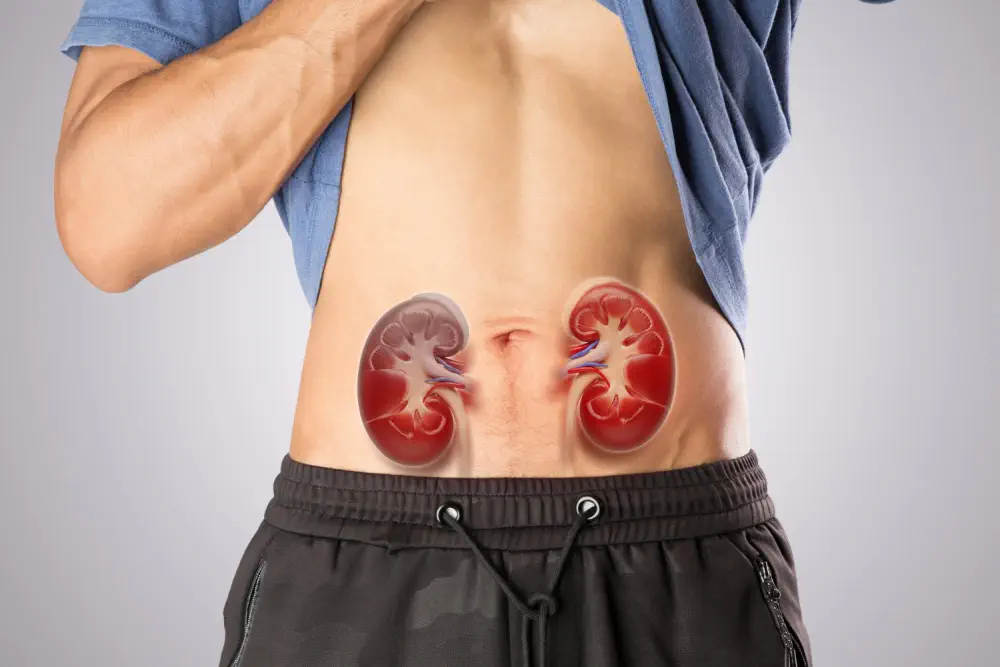
Direct evidence tying alcohol and kidney stones together remains thin, even with how commonly the two get linked. A 2007 to 2016 national health survey analysis found no meaningful association between how much people drank and how likely they were to form stones, even among heavy drinkers. Some research points the other way, hinting that moderate drinking might slightly lower stone risk through higher fluid intake.
Where alcohol does raise stone risk, the harm comes from its side effects. Dehydration is the main route, since alcohol pulls water out of you and leaves your urine concentrated, and concentrated urine lets minerals crystallize. Beer's reputation as a stone-maker rests on its purines, which raise uric acid. That load troubles the joints as gout far more than the kidneys, and large prospective studies have tied regular beer drinking to a lower stone rate. None of this means a stone is your only worry, since the damage that matters most can stay silent until it is severe.
Which Warning Signs Say Your Kidneys Are Struggling?
Kidney trouble tends to stay quiet in its early stages, which is why the warning signs deserve attention the moment they appear. More than four million Canadians live with kidney disease, and many have no idea, since the damage builds without obvious symptoms, according to the Kidney Foundation of Canada. Changes in how much you urinate, in the colour of your urine, or in how frequently you go can all point to strained kidneys. Swelling in your legs, ankles or around your eyes signals that fluid is backing up because filtering has slowed. Ongoing tiredness, poor appetite, nausea and trouble sleeping show up as waste builds in the blood.
Pain from the kidneys shows up in a spot most people do not expect, settling into the flank or lower back where the organs themselves sit. A dull ache there after heavy drinking can mean dehydration or irritation, and sharp, cramping pain that arrives in waves can point to a stone passing. Anyone noticing these signs alongside a regular drinking habit has good reason to book a kidney function test, which catches damage a person cannot feel.
Can Your Kidneys Recover Once You Stop Drinking?
Your kidneys have real capacity to recover after you quit, and the earlier you act, the more of that capacity stays intact. Acute kidney injury from a binge frequently reverses when drinking stops, fluids return to normal, and blood pressure settles. The gains show up in bloodwork over the weeks that follow, as waste clears and electrolytes steady before you feel any different.
Long-standing damage is harder to undo, since the scarring that chronic kidney disease leaves behind does not fully reverse. Stopping still pays off here, slowing the decline and sparing what function remains. Your other organs recover alongside your kidneys, and many people notice the signs your liver is healing within the same window that their kidney markers improve. Getting there usually takes support, and supervised detox makes the early days of quitting safer for anyone drinking heavily.
What Puts the Most Strain on Your Kidneys?
Kidneys rarely fail from alcohol by itself. They decline when raised blood pressure, dehydration and liver strain build at once, no single one of them act alone. Treating the drinking does more for them than chasing any one of those problems, and reaching out early tends to spare the most function.
Ready to Take the First Step?
If drinking has started to affect your health or the people around you, the Canadian Centre for Addictions can help. Our residential programs in Port Hope and Cobourg give you the space and care to stop safely and rebuild. Reach out today for a confidential conversation about where to begin.
FAQ
Can you drink alcohol if you have only one kidney?
People living with a single kidney can usually tolerate the occasional drink, but heavy use asks a lot of the one organ doing all the filtering. Staying within low-risk limits and keeping well hydrated matters more for this group than for most. Anyone with a single kidney is wise to clear their drinking habits with their own care team first.
Is it safe to drink alcohol when taking ibuprofen or other painkillers?
Mixing alcohol with ibuprofen and similar anti-inflammatory painkillers raises the strain on your kidneys and adds a risk of stomach bleeding. Taken together, they compound the danger, so spacing them out is the safer route. For regular pain relief alongside drinking, acetaminophen carries its own cautions and still warrants a chat with a pharmacist.
Which drink is hardest on the kidneys, beer, wine, or spirits?
Total alcohol matters more than the type of drink, so a night of beer, wine or spirits that adds up to the same number of standard drinks does roughly the same damage to your kidneys. Beer's purines raise uric acid, which weighs on the joints as gout more than on the kidneys. The bigger kidney risk with beer is volume, since it goes down easily in large amounts without the total registering.
Can alcohol cause a kidney infection or make a urinary tract infection worse?
Alcohol does not cause kidney or urinary tract infections on its own, but it can make an existing one feel worse. Dehydration concentrates urine and irritates the bladder, and heavy drinking dampens the immune response that fights bacteria off. Alcohol reacts badly with certain antibiotics too, so staying off it until the course is finished avoids an unpleasant interaction.
Does drinking water between drinks protect your kidneys?
Sipping water between drinks eases the dehydration that alcohol brings on, which helps your kidneys cope in the moment. It does nothing to cancel the alcohol already in your blood or the longer-term harm of heavy drinking. Water is a sensible habit on a night out, but it does not offset the harm of regular heavy use.
Article sources
- Epstein, M. "Alcohol's Impact on Kidney Function." Alcohol Health and Research World, National Institute on Alcohol Abuse and Alcoholism. https://pmc.ncbi.nlm.nih.gov/articles/PMC6826793/
- Health Canada. "Low-risk alcohol drinking guidelines." Government of Canada. https://www.canada.ca/en/health-canada/services/substance-use/alcohol/low-risk-alcohol-drinking-guidelines.html
- National Kidney Foundation. "Drinking Alcohol Affects Your Kidneys." National Kidney Foundation. https://www.kidney.org/news-stories/drinking-alcohol-affects-your-kidneys
- Roerecke, M., Kaczorowski, J., Tobe, S.W., et al. "The effect of a reduction in alcohol consumption on blood pressure: a systematic review and meta-analysis." The Lancet Public Health. https://www.thelancet.com/journals/lanpub/article/PIIS2468-2667(17)30003-8/fulltext
- "Association between alcohol consumption and kidney stones in American adults: 2007-2016 NHANES." National Library of Medicine. https://www.ncbi.nlm.nih.gov/pmc/articles/PMC10140583/
- The Kidney Foundation of Canada. "Global kidney disease data a 'wake up call for Canada'." The Kidney Foundation of Canada. https://kidney.ca/en/news-and-media/news/global-kidney-disease-data-a-wake-up-call-for-canada
- Curhan, G.C., Willett, W.C., Rimm, E.B., et al. "Prospective Study of Beverage Use and the Risk of Kidney Stones." American Journal of Epidemiology. https://pubmed.ncbi.nlm.nih.gov/8561157/