We offer medical detox and multiple addiction treatment options in our
luxury treatment centres in Port Hope, Cobourg, and Ottawa.
The Difference Between Stimulants and Depressants

Stimulants speed up central nervous system activity, raising heart rate, alertness, and energy. Depressants suppress it, producing sedation, muscle relaxation, and slowed breathing. Both drug classes carry a serious addiction risk across Canada. At the Canadian Centre for Addictions in Ontario, every intake begins with identifying which class a person has been using, because that answer shapes every clinical decision that follows.
You'll Learn
- Why does a single neurotransmitter decide how an overdose kills
- Which prescription drugs jump from ADHD treatment to the black market fastest
- The reason only one of these two drug classes can kill during withdrawal
- What a 2025 Canadian stat reveals about a second drug hiding in opioid deaths
- Why a physician's first question in detox is never about the dose
How Do Stimulants Rewire the Brain's Dopamine Supply?
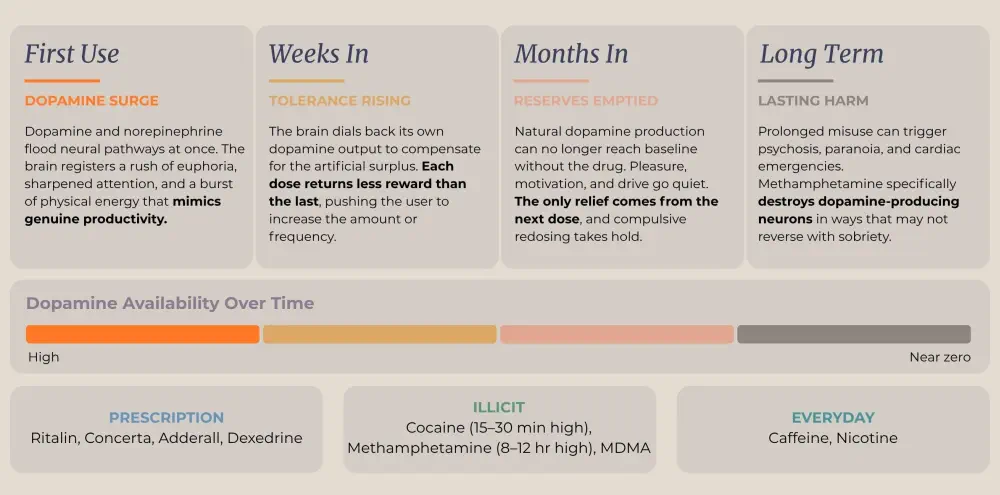
The divide between stimulants and depressants traces to different neurotransmitter targets. Stimulants flood the brain with dopamine and norepinephrine by blocking reabsorption or forcing extra release into neural pathways. Heart rate and blood pressure climb. Body temperature spikes. Appetite vanishes, and sleep becomes impossible.
That neurochemical surge is what makes stimulants feel productive, and why they attract people under pressure. University students borrow a friend's Adderall before exams. Workers pulling back-to-back overnight doubles use methamphetamine to stay awake. The drug fills a gap the person already feels, so the first few uses look like a solution.
Repeated use depletes the brain's dopamine reserves over months, leaving a person unable to feel pleasure or motivation without the drug. Stimulant effects at this stage include psychosis, paranoia, and cardiac events. Long-term methamphetamine misuse specifically can cause irreversible damage to dopamine-producing neurons.
Which Types of Stimulants Are Most Commonly Misused?
Stimulant types fall into three categories with very different risk profiles.
➧ Prescription stimulants like methylphenidate (Ritalin, Concerta) and amphetamine salts (Adderall, Dexedrine) are prescribed for ADHD and narcolepsy but rank among the most diverted medications in Canada.
➧ Illicit stimulants carry far greater danger. Cocaine blocks dopamine reuptake and wears off in 15 to 30 minutes, pushing users to redose repeatedly in a single session. Methamphetamine triggers a massive dopamine release that sustains its high for 8 to 12 hours, causing severe neurotoxicity over time.
➧ Caffeine and nicotine create milder dependence but can still reinforce habitual use of stronger substances. For anyone recognizing these patterns, private rehab provides the medical setting needed to stabilize brain chemistry.
What Do the Effects of Depressants Do to the Brain Beyond Sedation?
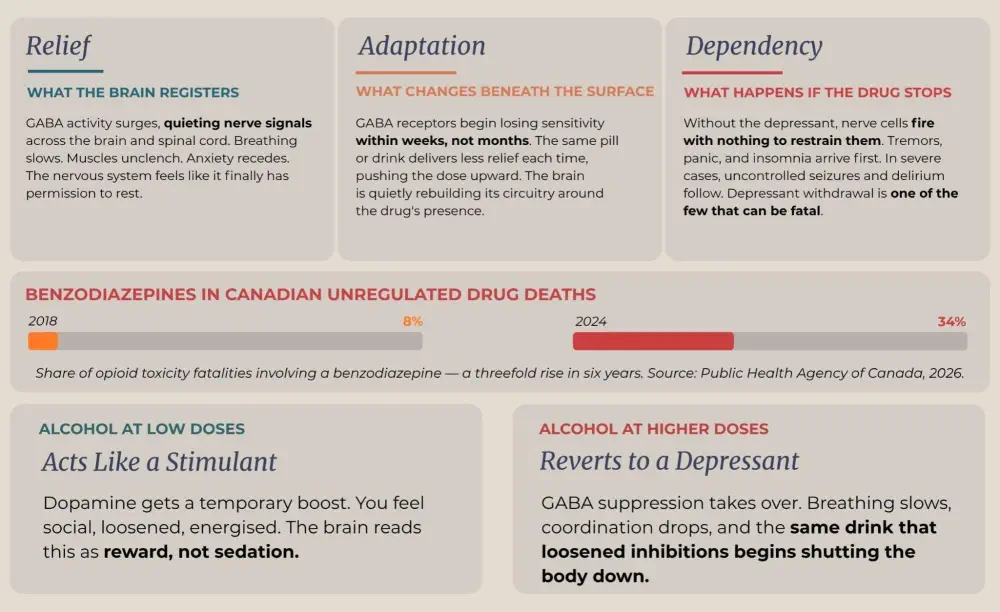
Depressants suppress CNS activity by boosting gamma-aminobutyric acid (GABA), an inhibitory neurotransmitter that quiets nerve signalling throughout the brain and spinal cord. The immediate effects of depressants include slowed breathing, a drop in heart rate and blood pressure, muscle relaxation, and impaired coordination.
That calming action is also why people reach for depressants instinctively. A glass of wine after a difficult day. A benzodiazepine to quiet a racing mind before bed. Each use trains the brain to expect GABA enhancement from an outside source, and GABA receptors lose sensitivity fast. Tolerance builds within weeks, not months.
Once the brain has reorganized its inhibitory circuitry around the drug, removing it abruptly leaves nerve cells firing without a brake. Life-threatening seizures and delirium tremens can follow. Depressant withdrawal ranks among the few drug withdrawals that can kill.
The most dangerous types of depressants share one trait. Physical dependence builds before the user recognizes it. The Public Health Agency of Canada reported that benzodiazepine involvement in unregulated drug deaths tripled between 2018 and 2024, climbing from 8% to 34% of all opioid toxicity fatalities. That rise reflects both increased prescribing and illicit benzodiazepines flooding the street supply.
How Does Alcohol Switch From Dopamine Boost to GABA Suppression?
Alcohol confuses the classification because at low doses, it temporarily boosts dopamine, producing the familiar social buzz. As blood alcohol climbs, GABA suppression takes over. Our guide on Is Alcohol a Depressant or a Stimulant explains why the same drink that loosens inhibitions at dinner can slow breathing to dangerous levels hours later.
How Do Stimulant and Depressant Risks Compare Side by Side?
From neurotransmitter targets to overdose response, depressant and stimulant effects diverge on nearly every clinical measure.
| Stimulants | Depressants | |
| Primary brain target | Dopamine, norepinephrine | GABA |
| Heart rate | Increases | Decreases |
| Breathing | Rapid, shallow | Slow, depressed |
| Overdose signs | Hyperthermia, cardiac arrest, seizures | Respiratory failure, coma, bluish skin |
| Withdrawal type | Psychological (depression, fatigue, cravings) | Physical (convulsions, delirium, potential death) |
| Medical detox required | Rarely | Almost always for heavy use |
| Prescription examples | Adderall, Ritalin, Dexedrine | Xanax, Valium, Ativan, Zopiclone |
| Illicit examples | Cocaine, methamphetamine, MDMA | GHB, illicit benzodiazepines, barbiturates |
One detail stands out in the withdrawal row. Stimulant withdrawal is miserable but almost never fatal. Depressant withdrawal can kill outright. That asymmetry is the reason emergency physicians ask about drug class before any other question.
A misconception persists about alcohol and its place among depressant types. Some people assume tequila or whisky hits differently than wine or beer. Every form of alcohol produces the same GABA-mediated depressant response. Our article on is tequila a depressant examines that question in detail.
Why Is Mixing Stimulants and Depressants a Medical Emergency?
When stimulant and depressant effects collide inside the same body, the cardiovascular and respiratory systems receive conflicting instructions. One drug drives heart rate up; the other forces it down. Neither cancels the other out. They compete, and the organ caught between them fails.
Masked overdose is the greatest danger. Stimulants suppress the sedation cues that would normally warn someone they have consumed too much of a depressant. When the stimulant wears off first, the full sedative load hits at once.
Public Health Agency of Canada data from 2025 backs this up, with 70% of all apparent opioid toxicity deaths that year also involving a stimulant. Speedballing (cocaine mixed with heroin) and cocaine paired with alcohol remain the most common polysubstance combinations in Canadian emergency departments. Substance use costs Canada nearly $40 billion annually, and polysubstance emergencies account for a growing share.
How Does Treatment for Stimulant Addiction Differ From Depressant Addiction?
Stimulant or depressant dependency dictates treatment from the first hour.
Depressant dependency requires medically supervised detox. Physicians taper the dose over days or weeks to prevent the convulsions and psychotic episodes that abrupt cessation triggers. Attempting to quit benzodiazepines or alcohol cold turkey remains one of the most dangerous choices a dependent person can make.
Stimulant dependency poses fewer physical risks but a punishing psychological withdrawal. Fatigue, anhedonia (the inability to feel pleasure), and intense cravings can persist for weeks.
No Health Canada-approved medication targets stimulant withdrawal specifically, so recovery depends on structured behavioural therapy, including CBT and contingency management.
The Canadian Centre for Addictions treats both drug classes at two historic Ontario properties, Hillcrest Mansion in Port Hope and Woodlawn Inn in Cobourg. Programs run 30 to 90 days with medical detox, individual counselling, group therapy, and wellness activities.

What Single Detail Changes the Outcome of a Detox?
Knowing which drug class a person has been using tells a physician more than almost any other detail in the first hours of treatment. That single answer determines overdose response, detox safety, and the clinical path forward.
FAQ
Can someone become dependent on a prescribed benzodiazepine without realizing it?
Yes. Prescribed doses create the same receptor changes that recreational use does; the only difference is the pace. Many patients feel normal on the medication until they miss a dose and experience rebound anxiety, insomnia, or tremors, which is the earliest signal that the nervous system has already adapted.
Is long-term ADHD medication safe, or does it lead to stimulant addiction?
When taken as prescribed and monitored by a physician, ADHD stimulants carry a low addiction risk. The danger rises sharply when doses are increased without medical guidance or when pills are crushed and snorted. Sharing medication with someone who lacks an ADHD diagnosis creates an additional layer of risk.
How can I tell if a family member is misusing stimulants or depressants?
Stimulant misuse tends to show as rapid weight loss, sleeplessness, agitation, and paranoia. Depressant misuse presents differently with slurred speech, frequent drowsiness, impaired coordination, and memory gaps. Both patterns include secrecy and mood swings alongside a declining interest in responsibilities.
Does the brain recover fully after years of stimulant or depressant misuse?
Dopamine pathways damaged by stimulant misuse may take 12 to 18 months to normalize, and GABA receptor sensitivity after prolonged depressant use can require up to two years to stabilize. Early treatment shortens both timelines.
Can caffeine or over-the-counter sleep aids create the same kind of dependency?
Caffeine produces mild physical dependence; withdrawal headaches and fatigue confirm this. Over-the-counter sleep aids containing diphenhydramine or doxylamine can lose effectiveness within days, pushing users to increase doses. Neither matches the severity of prescription stimulant or depressant dependency, but both reinforce the behavioural loop of relying on a substance to function.
Article sources
- Public Health Agency of Canada. "Statement from the Council of Chief Medical Officers of Health – Latest National Data on Substance-Related Harms." Government of Canada. https://www.canada.ca/en/public-health/news/2026/06/statement-from-the-council-of-chief-medical-officers-of-health-latest-national-data-on-substance-related-harms.html
- Centre for Addiction and Mental Health. "Mental Illness and Addiction: Facts and Statistics." CAMH. https://www.camh.ca/en/driving-change/the-crisis-is-real/mental-health-statistics