
We offer medical detox and multiple addiction treatment options in our
luxury treatment centres in Port Hope, Cobourg, and Ottawa.
Can You Drink Alcohol on Prednisone?

Medical professionals advise against mixing prednisone and alcohol. Both substances compete for the same liver enzymes and irritate the same stretch of stomach lining. They also suppress identical immune pathways. That triple overlap separates this drug-alcohol pairing from most others, and the severity depends on your dose, how long you take the medication, and how much you drink.
Key Takeaways
- When prednisone and alcohol collide in the liver, the enzymatic competition slows the clearance of both chemicals and amplifies every shared side effect
- Your GI tract, bone density, and mental health each face a specific and measurable threat when steroids and alcohol overlap
- A 5 mg daily dose and a 50 mg daily dose carry sharply different risk profiles once alcohol is added
- Clearing prednisone from your bloodstream and recovering full adrenal function are two separate timelines
- A prescription that requires you to stop drinking for a few weeks can surface a dependence you had not recognized
Why Do Doctors Single Out Alcohol When Prescribing Prednisone?
Most medications come with a generic "use caution with alcohol" warning. Prednisone earns a sharper one. This corticosteroid and ethanol collide across liver metabolism, gut integrity, and immune function all at once. Where most drug-alcohol pairings produce additive risk, prednisone's interactions with alcohol create compounding damage because each substance worsens the other's toll on shared targets.
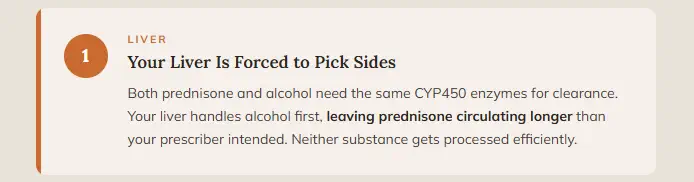
The liver converts prednisone into its active form, prednisolone, using different enzimes including the cytochrome. Ethanol relies on those same enzymes for breakdown. When both substances arrive simultaneously, the liver prioritizes alcohol, delaying prednisone conversion and leaving higher concentrations of both chemicals circulating longer than expected. The National Institute on Alcohol Abuse and Alcoholism documents this metabolic competition as a source of intensified side effects across nearly every organ system that alcohol and corticosteroids share.
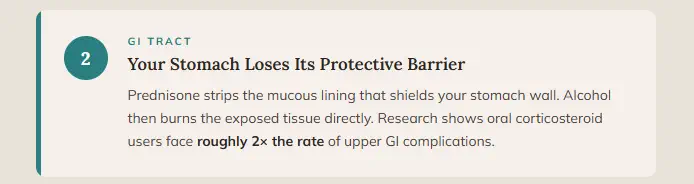
The GI tract clearly illustrates the compounding effect. Prednisone thins the protective mucous barrier of the stomach and upper intestine. Alcohol delivers direct chemical injury to that same exposed tissue. A population-level study published in the American Journal of Epidemiology measured the risk at an adjusted odds ratio of 1.8 for upper GI complications among oral corticosteroid users, roughly double the rate seen in non-users. Adding alcohol on top of that already-elevated baseline raises the danger further, particularly for anyone also taking NSAIDs or blood thinners.
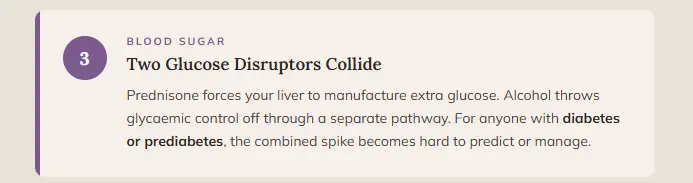
Blood sugar completes the third front. Prednisone triggers gluconeogenesis, prompting the liver to produce new glucose and thereby spiking blood sugar levels. Alcohol disrupts glycaemic control through a separate pathway. For anyone living with diabetes or prediabetes, the combination becomes especially unpredictable. If these layered risks raise concerns about your health, a treatment team at the Canadian Centre for Addictions can help you assess your options.
What Specific Damage Do Steroids and Alcohol Cause to Your Immune System, Bones, and Mental Health?
Beyond the metabolic and GI damage covered above, three organ systems absorb a distinct and separate set of injuries when steroids and alcohol overlap. Each one follows its own biological pathway, and each carries consequences that outlast the treatment course itself.
Immune Suppression From Two Directions
Prednisone dials down the immune response even at doses as low as 5 mg per day. At that level, the body's ability to fight bacterial and fungal infections drops measurably, and the risk of pneumonia, oral thrush, and urinary tract infections rises. Alcohol impairs the macrophages and neutrophils responsible for clearing bacteria from the lungs and damages the barrier tissues that keep pathogens out. The combined effect opens defensive gaps from multiple directions at once, making respiratory infections and reactivation of latent tuberculosis realistic dangers. A Medical News Today review of the clinical evidence confirms that anyone drinking regularly during prednisone therapy faces heightened infection risk from this dual suppression.
Dose-Dependent Bone Loss
Prednisone reduces osteoblast activity (the cells that build new bone) and accelerates osteoclast activity (the cells that resorb bone). A landmark UK study of over 240,000 corticosteroid users found that fracture risk climbs in a clear dose-dependent pattern. Hip fracture rates nearly doubled at daily doses of 2.5 to 7.5 mg and more than doubled above 7.5 mg. Vertebral fracture risk was even steeper, reaching 2.6 times the baseline at higher doses. Alcohol compounds this bone fragility through its own independent effects on calcium absorption and bone turnover, meaning the two substances erode skeletal strength through parallel but separate mechanisms.
Mood Destabilization and Sleep Disruption
The toll on mental health runs along a separate track. Moderate-to-high prednisone doses can trigger anxiety, irritability, insomnia, and in severe cases, steroid-induced psychosis. Alcohol's depressant properties amplify every one of these disturbances. Sleep quality deteriorates from both ends. Prednisone disrupts the circadian cortisol rhythm that regulates your sleep-wake cycle, and alcohol fragments REM sleep architecture, the phase responsible for emotional processing and memory consolidation. These mood and sleep effects do not vanish the moment you stop taking prednisone; they persist through the tapering period, which is why prednisone withdrawal requires its own careful medical management.

How Long After Taking Steroids Can You Drink Alcohol?
Prednisone's plasma half-life sits around 3 to 4 hours, meaning a single dose clears the bloodstream within roughly 16 to 22 hours. That number tells only part of the story. How long you should wait after steroids before drinking depends on more than the drug's half-life, because your stomach lining, adrenal glands, and immune system need considerably more time to recover than the drug itself takes to leave your blood.
Your dosage tier and course length determine the practical wait window.
| Dose Range | Course Length | Minimum Wait After Final Dose |
| Under 7.5 mg/day | A few days | 48 to 72 hours |
| 7.5 to 40 mg/day | Two weeks or longer | One full week |
| Above 40 mg/day | Any duration | One week or longer; consult your prescriber |
These timeframes account for more than just drug clearance. They reflect the body's need to restore gastric mucosal integrity and to begin reversing immunosuppression.
What About the Tapering Period?
The adrenal glands add another layer to this timeline. Prednisone suppresses the hypothalamic-pituitary-adrenal (HPA) axis, which controls your body's own cortisol production. During tapering, these glands slowly resume making cortisol on their own. Drinking during this window places metabolic stress on a system that is already struggling to recalibrate, and skipping the taper to "get back to normal faster" can trigger an adrenal crisis. If you are unsure how your body handles alcohol after a prednisone course, how long alcohol stays in your system is another variable worth checking before you pour a drink.
What Does Struggling to Quit Drinking During Treatment Reveal About Your Relationship With Alcohol?
A prednisone prescription lasting four to eight weeks is a time-limited, medically reasonable request to stop drinking. If honouring that request feels impossible, the difficulty itself may be the most telling health signal you receive during the entire treatment course.
Many Canadians drink at a level that feels controlled until a medical instruction to abstain removes the option. A steroid course becomes an unintentional stress test for alcohol dependence. When someone cannot pause drinking for a defined period, even with clear medical stakes, that resistance is a clinical red flag worth paying attention to.

Prednisone's mood-altering effects make the problem worse. Anxiety, restlessness, and insomnia can push people toward alcohol as a self-medication response. The steroid makes you feel worse, and alcohol provides short-lived relief. But the combination worsens both the steroid side effects and the underlying condition, and the cycle tightens with each repetition.
Raising this concern with a physician or an addiction treatment team is not an overreaction. Early recognition of alcohol dependence during a medication course can prevent years of escalating health consequences. Can you drink on prednisone if you have a complicated relationship with alcohol? The safest answer is no, and that answer may be the invitation you need to address a larger pattern.
The Signal Worth Listening To
If reading this article made you calculate how many drinks you could still "get away with" during treatment, that impulse itself is worth sitting with. The safest patients are the ones who treat the abstinence window as non-negotiable and move on. The ones who negotiate with the risk are the ones most likely to learn the hard way.
Addiction doesn't get better on its own. Call us today for a free, confidential consultation and find out which program is right for your needs. Call 1-855-499-9446.
FAQ
Does taking NSAIDs like ibuprofen alongside prednisone make alcohol even more dangerous?
Yes. NSAIDs carry their own GI bleeding risk, and adding alcohol to a prednisone-plus-NSAID regimen creates a triple layer of stomach lining damage. Your prescribing physician should know about every over-the-counter painkiller you use during steroid therapy.
Is non-alcoholic beer safe to drink on prednisone?
Non-alcoholic beer contains trace ethanol (up to 0.5% ABV), which is enough to irritate an already-vulnerable gastric lining during prednisone treatment. The carbonation can also worsen reflux and GI discomfort that steroids provoke on their own.
Does the condition being treated change how risky alcohol becomes on prednisone?
It does. Conditions like Crohn's disease or ulcerative colitis involve a GI tract that is already inflamed and fragile. Alcohol adds irritation to tissue that prednisone is actively trying to calm, which can undermine the treatment and trigger flare-ups.
Can prednisone itself cause alcohol cravings?
Prednisone raises cortisol-like activity in the body, which can increase appetite, disrupt sleep, and heighten anxiety. These physiological stressors make habitual drinkers more likely to reach for alcohol as a familiar coping response, even if the drug does not produce cravings in the pharmacological sense.
Is cannabis a safer substitute for alcohol during a prednisone course?
Cannabis carries its own set of drug interactions and is not a medically endorsed replacement. Smoked cannabis can irritate the respiratory system at a time when prednisone has already suppressed your lung defences, and edibles can compound the blood sugar instability that steroids create.
Article sources
- National Institute on Alcohol Abuse and Alcoholism. "Alcohol's Effects on the Body." NIAAA. https://www.niaaa.nih.gov/alcohols-effects-health/alcohols-effects-body
- Hernández-Díaz, S. and Rodríguez, L.A.G. "Steroids and Risk of Upper Gastrointestinal Complications." American Journal of Epidemiology. https://academic.oup.com/aje/article/153/11/1089/131674
- Yvette Brazier. "Alcohol and Prednisone: Are They Safe to Take Together?" Medical News Today. https://www.medicalnewstoday.com/articles/325112
- van Staa, T.P. et al. "Use of Oral Corticosteroids and Risk of Fractures." Journal of Bone and Mineral Research. https://pubmed.ncbi.nlm.nih.gov/11199789/