

We offer medical detox and multiple addiction treatment options in our
luxury treatment centres in Port Hope, Cobourg, and Ottawa.
Why Do I Hate Myself After Drinking?

Self-loathing the morning after alcohol builds from four sources at once, namely a chemical rebound in the brain, broken sleep, gaps in memory, and the distance between how you meant to behave and how you behaved. Each one sharpens the others, so even a quiet evening can end in a harsh verdict on yourself by breakfast. For most people, the feeling fades with the hangover. When those mornings keep repeating, the repetition itself is a signal about your drinking worth taking seriously.
If you are having thoughts of hurting yourself or ending your life, call or text 9-8-8 at any hour. If you are in immediate danger, call 911.
Key Takeaways
- Morning-after self-hatred combines chemical rebound, fragmented sleep, memory gaps and a clash between your values and last night's behaviour.
- One night without sleep makes the brain's emotional centre over 60% more reactive to upsetting images.
- The World Health Organization's AUDIT screening test asks how frequently in the past year you felt guilt or remorse after drinking.
- Among 40,708 adults in England who drink at increasing or higher-risk levels, 13.3% reported guilt or remorse after drinking in the past six months.
- Severe trembling, heavy sweating, confusion, hallucinations or seizures after drinking point to alcohol withdrawal and need medical care.
Why Do I Hate Myself After Drinking?
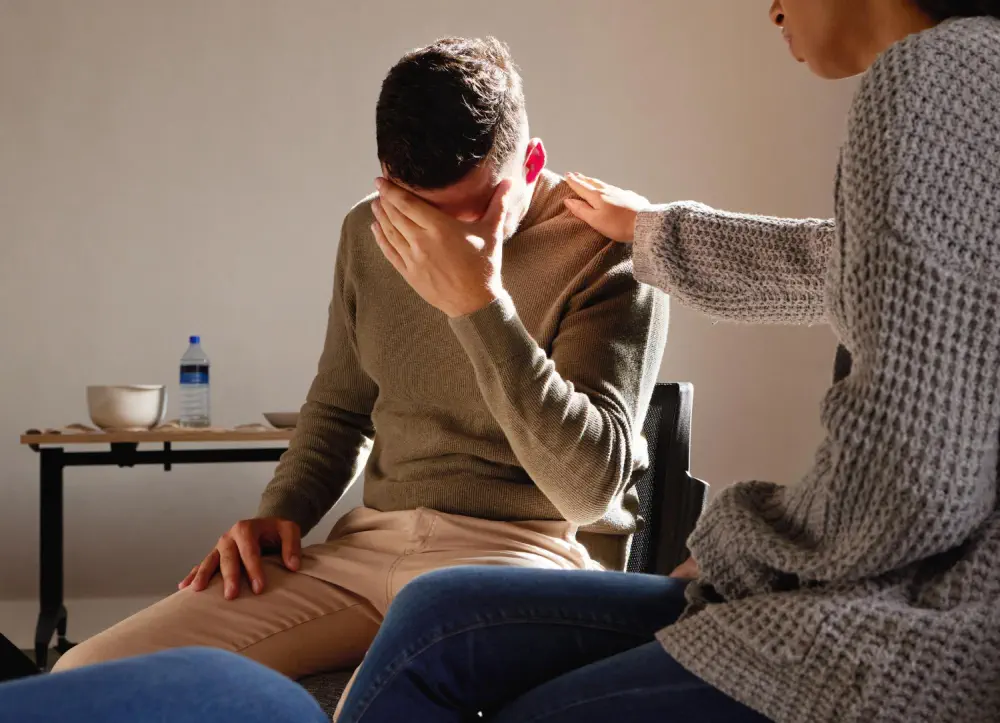
You wake up with a brain still recovering from alcohol, after a night of shallow sleep, with patchy recall of what you said and did. Those conditions make ordinary regrets feel heavier and make the gap between your values and last night's behaviour hard to face.
Six separate pressures feed that thought, and most of them start in the body long before any memory of the evening comes back.
| Pressure | Type | How it feels |
| Chemical rebound | Physical | Restlessness, dread, a racing mind |
| Fragmented sleep | Physical | Exhaustion, low patience, darker thoughts |
| Dehydration | Physical | Thirst, headache, irritability |
| Memory gaps | Physical | Anxiety about what you can't recall |
| Specific actions, such as a text, a comment, money spent or a promise broken | Psychological | Embarrassment, the urge to apologize or hide |
| A clash between last night's behaviour and the person you want to be | Psychological | Guilt, shame, harsh self-talk |
A blackout is a stretch of time you cannot recall because alcohol blocked the brain from recording new memories, even though you were awake and talking during it. With no record of those hours, the mind fills them with worst-case guesses. Frequent alcohol blackouts point to drinking heavy enough to block memory, a risk that reaches well past one rough morning.
The last row of the table is usually the hardest to shake. People asking why they feel bad after drinking tend to name a specific moment, yet the sting comes from what that moment seems to say about them. A sharp comment to a partner hurts because you value kindness.
What Happens in Your Brain and Body the Morning After
Four physical changes overlap the morning after drinking, and together they produce the flat, irritable low that many people describe as hangover depression.
The Chemical Rebound
Alcohol strengthens GABA, the brain's main calming signal, and blocks part of the activity of glutamate, its main excitatory one.
As alcohol clears, the brain can swing briefly toward an over-alert state, which the National Institute on Alcohol Abuse and Alcoholism (NIAAA) calls a mini-withdrawal 3. The rebound is mapped best in withdrawal after long-term heavy use, so its role in an ordinary hangover is less certain 4. Low mood from it, the experience behind feeling sad after drinking, usually lifts within a day, and months of heavy drinking carry a separate, longer link between alcohol and depression.

Broken Sleep
Sleep after drinking comes faster, then breaks into pieces and ends early 3. In a UC Berkeley and Harvard Medical School study, one sleepless night left the amygdala, a brain region that handles fear, over 60% more reactive to upsetting images 5. A choppy night is milder, yet part of feeling depressed after drinking may trace back to that lost rest.
Dehydration and Low Blood Sugar
Alcohol suppresses vasopressin, a hormone that tells the kidneys to hold on to water, so you lose more fluid than you take in 3. Drinking on an empty stomach or with sugary mixers can also push blood sugar up and then down, one more link between alcohol and blood sugar that leaves you shaky and foggy.
Why Your Morning-After Brain Is an Unreliable Narrator
Stack those effects together and your account of last night gets distorted, so one loud laugh starts to feel like a public disgrace. Hold off on big decisions about yourself, your relationships or your drinking until your body has recovered.
"Clients tell me the hardest part of the morning after is lying awake, replaying the night and deciding what it says about them as a person. In therapy, we separate what happened from that judgment, because an exhausted brain still recovering from alcohol is the one making it." Dr. Jonathan Siegel, BSc, M.Ed, Ed.D, Registered Psychologist, Canadian Centre for Addictions
What Is Hangxiety?

The term hangxiety describes anxiety that sets in the day after drinking. In Britain, drinkers call the same feeling beer fear.
Researchers from University College London and the University of Exeter randomly assigned 97 social drinkers to drink or stay sober at home, in a study published in Personality and Individual Differences 6. Among very shy participants, about six units of alcohol eased anxiety slightly during the evening. By the next morning, their anxiety had risen sharply, and stronger hangxiety in this group went along with higher scores on the AUDIT, the World Health Organization's 10-question screening test for risky drinking 6. With fewer than 100 participants, the findings remain tentative.
Shyness is one route into post-drinking anxiety among several. Anyone who uses a drink to quiet social nerves faces the same trade of evening relief for morning dread, and the connection between alcohol and anxiety tends to tighten the more regularly that trade gets made.
Is It Normal, or a Sign of a Drinking Problem?
An occasional morning of regret after a heavy night is common and says little on its own. Guilt that returns month after month is different, because screening tools count it as a marker of harmful drinking, alongside blackouts, broken promises and secrecy.
Question 7 of the World Health Organization's AUDIT asks, "How often during the last year have you had a feeling of guilt or remorse after drinking?" 1
Researchers analyzing 40,708 adults in England who drink at increasing and higher-risk levels found that 13.3%, roughly one in eight, reported guilt after drinking in the previous six months 2. Women and younger adults reported it more, with people aged 18 to 24 most affected. The heaviest drinkers reported it more than twice as frequently as the lightest 2.
Five markers separate a rough morning from a habit.
| Sign | One bad morning | A repeating pattern |
| Frequency | A rare event after a celebration | Several times a month |
| Promises to yourself | No pledge needed | Repeated vows to stop or cut back that don't hold |
| Memory | You remember the night | Blackouts or gaps keep happening |
| Coping | Guilt fades without alcohol | You drink again to quiet the guilt |
| Honesty | You'd share how much you drank | You hide or downplay the amount |
If the right-hand column sounds familiar, look honestly at the signs of alcohol addiction, which doctors diagnose as alcohol use disorder. A steady job does not rule it out, and many people described as functioning alcoholics carry morning guilt for years before anyone notices.
The repeating version runs as a loop.
- A drink eases stress or social nerves.
- Morning brings rebound anxiety and patchy memory.
- Guilt builds, along with a promise to cut back.
- An evening drink quiets the guilt, and the loop restarts.
As a Canadian benchmark, Canada's Guidance on Alcohol and Health places 1 to 2 standard drinks a week at low risk, 3 to 6 at moderate risk, and 7 or more in a band where each extra drink adds more risk 7. Anyone drinking more than 2 drinks a week should keep to no more than 2 on any single day 8.
How to Stop Hating Yourself After Drinking

Start with the body, then deal with the facts, then look at the pattern. Rehydrate and eat, skip the next drink, postpone big conclusions about yourself, and repair only the harm that happened. Over the following weeks, track your drinking so the guilt becomes information you can use.
What to Do the Morning After
Drink water and eat a meal with carbohydrates and protein. Another drink to take the edge off will not speed recovery and may drag the hangover out 3. If you want a painkiller, read up on Tylenol and alcohol first, since the combination can harm the liver 3.
Then sort facts from guesses. List what you know happened and what you only fear happened, and ask a trusted friend about the gaps. Apologize briefly where you caused real hurt.
Self-compassion, treating your own mistakes with the patience you would offer a friend, keeps one bad morning from turning into a week of punishment.
Turn Guilt Into Information
Sorting each morning thought into guilt or shame tells you what to do with it. Guilt tied to a specific moment from the night, such as a sharp comment or a missed plan, eases once you repair what you can and let the rest go. Shame turns the same event into a verdict on your whole self, and it loosens when you test that verdict against the plain facts of the evening.
Guilt with no wrongdoing behind it, including guilt carried after trauma or sexual abuse, is worth working through with a psychologist, because the fault was never yours.
| Morning thought | Guilt or shame | A more useful next step |
| "I was rude to my sister at dinner." | Guilt | Send a short apology today |
| "I'm a disgusting person." | Shame | Write down what happened, without labels |
| "I spent too much at the bar." | Guilt | Set a cash limit for next time |
| "Everyone must think I'm a mess." | Shame | Check with one person you trust |
| "I can't remember getting home." | Guilt mixed with fear | Record it as a blackout and keep a tally |
For one month, log how many drinks you had, what came before the first one and how you felt the next morning. Patterns show up quickly on paper.
A 30-day break from alcohol is a second test, and how hard it feels shows where your drinking stands.
Therapy That Targets Morning-After Self-Talk
Cognitive behavioural therapy (CBT), a structured talk therapy that teaches you to spot and challenge distorted thoughts, targets the harsh self-talk of the morning after. Working one-on-one with a psychologist through individual counselling gives you room to unpack the guilt and what drives the drinking.
Hearing others describe the same mornings in group counselling breaks the belief that you are the only one, and peer support groups add regular contact with people facing the same pattern.
When the Morning After Is an Emergency
Two situations need help right away, namely any thought of suicide or self-harm, and physical symptoms that point to alcohol withdrawal.
If you are thinking about ending your life or hurting yourself, call or text 9-8-8 at any hour. Call 911 if you are in immediate danger.
Alcohol withdrawal occurs when a body used to regular heavy drinking reacts to alcohol leaving it. Severe trembling, heavy sweating, confusion, hallucinations or seizures after drinking need same-day medical care, and persistent shaking after drinking alcohol is one of the earliest signs.
Stopping suddenly after long, heavy drinking can trigger seizures, so quit only under medical supervision. The different timelines for hangovers and withdrawal help you tell the two apart.
Ready to take the first step?
Addiction doesn't get better on its own. Call us today for a free, confidential consultation and find out which program is right for your needs.
Call 1-855-499-9446
Sources
- Babor TF, Higgins-Biddle JC, Saunders JB, Monteiro MG. "AUDIT: The Alcohol Use Disorders Identification Test, Guidelines for Use in Primary Care, Second Edition." World Health Organization. https://www.who.int/publications/i/item/WHO-MSD-MSB-01.6a
- Cox S, Oldham M, Tattan-Birch H, Marlow S, Robson D, Garnett C, Jackson S. "Feelings of Guilt and Remorse After Alcohol Consumption Among People Who Drink at Increasing and Higher-Risk Levels: A Population Study in England." Drug and Alcohol Review. https://doi.org/10.1111/dar.70076
- National Institute on Alcohol Abuse and Alcoholism. "Hangovers." NIAAA. https://www.niaaa.nih.gov/publications/brochures-and-fact-sheets/hangovers
- Modesto-Lowe V, Barron GC, Aronow B, Chaplin M. "Gabapentin for Alcohol Use Disorder: A Good Option, or Cause for Concern?" Cleveland Clinic Journal of Medicine. https://www.ccjm.org/content/86/12/815
- Yoo SS, Gujar N, Hu P, Jolesz FA, Walker MP. "The Human Emotional Brain Without Sleep, a Prefrontal Amygdala Disconnect." Current Biology. https://doi.org/10.1016/j.cub.2007.08.007
- Marsh B, Carlyle M, Carter E, et al. "Shyness, Alcohol Use Disorders and 'Hangxiety': A Naturalistic Study of Social Drinkers." Personality and Individual Differences. https://doi.org/10.1016/j.paid.2018.10.034
- Eastern Ontario Health Unit. "Alcohol." EOHU. https://eohu.ca/en/my-health/alcohol
- Public Health Ontario. "Drinking Less Is Best for Health: Canada's Guidance on Alcohol and Health." Public Health Ontario. https://www.publichealthontario.ca/en/about/news/2023/08/canada-guidance-alcohol-health
FAQ
Why do I hate myself after drinking even when nothing bad happened?
Alcohol's chemical rebound and a night of broken sleep can produce dread and low mood with no event behind them. Your brain then scans the evening for a reason and settles on small moments that would barely register on a rested day. Because the feeling comes from your physical state, it tends to lift as the hangover clears.
Is it normal to feel guilty after drinking?
Guilt after a heavy night is common, and a single episode says little about your relationship with alcohol. Frequency matters more, which is why the WHO's AUDIT screening test scores how frequently guilt or remorse follows drinking. Monthly or weekly guilt counts toward a higher score and is worth taking seriously.
Does feeling guilty after drinking mean I have a drinking problem?
Not necessarily. Look at the signs around the guilt, such as repeated blackouts, broken promises to cut back, drinking to quiet the feeling, and hiding how much you drink. If several apply, take a self-assessment like the AUDIT and book a free, confidential consultation to talk through what you find.
Can drinking make you feel depressed the next day?
Yes. A drop in mood commonly comes with a hangover and usually lifts as the hangover passes, within about a day. If low mood lasts longer than a few days or keeps returning between drinking episodes, see a doctor to check for depression that needs its own treatment.
How long does hangxiety last?
Hangover symptoms, anxiety included, tend to peak as blood alcohol returns to zero and can last 24 hours or longer. Anxiety that stretches well past that window, or that shows up every time you stop drinking, may reflect withdrawal or an anxiety disorder and deserves a medical opinion.