
We offer medical detox and multiple addiction treatment options in our
luxury treatment centres in Port Hope, Cobourg, and Ottawa.
The Link Between ADHD and Addiction

Adults who arrive at residential treatment for alcohol or cocaine frequently carry a second diagnosis nobody has named yet. ADHD turns up inside addiction populations at four to seven times its rate in the wider public, and most of those adults reach a treatment bed without having been assessed for it. The reasons run past impulsivity into how reward and emotion get regulated. A program built around the substance alone leaves those drivers untouched, which is where the relapse comes from.
How Many Adults Live With Both ADHD and Addiction?
Ontario supplies the strongest Canadian sample on adult ADHD, and the count changes sharply depending on where the counting happens.
Cocaine use showed up as a correlate in both Ontario men and women who screened positive, which is the finding most likely to matter at intake.
Follow the same population forward from childhood, and the link between ADHD and addiction shows up in the prospective data as well. A meta-analysis pooling 23 longitudinal samples placed the odds of a later substance use disorder at 2.61 times higher for children diagnosed with ADHD, with alcohol sitting at 2.15 and nicotine at 2.52. None of this binds any individual, and plenty of adults with ADHD never drink heavily. Across a treatment population, the arithmetic still lands somewhere specific, which is that a screen on admission catches something a general intake form misses.
Why Are People With ADHD More Prone to Addiction?
Low reward, quick boredom
A brain running on lower baseline dopamine activity leaves ordinary experience registering as flatter and less rewarding than it does for other people. Boredom arrives faster and lands harder. Alcohol, stimulants, nicotine, and cannabis all raise dopamine quickly and reliably, and people describe those first weeks as the point where ordinary life finally held their attention.
Impulse without the brake
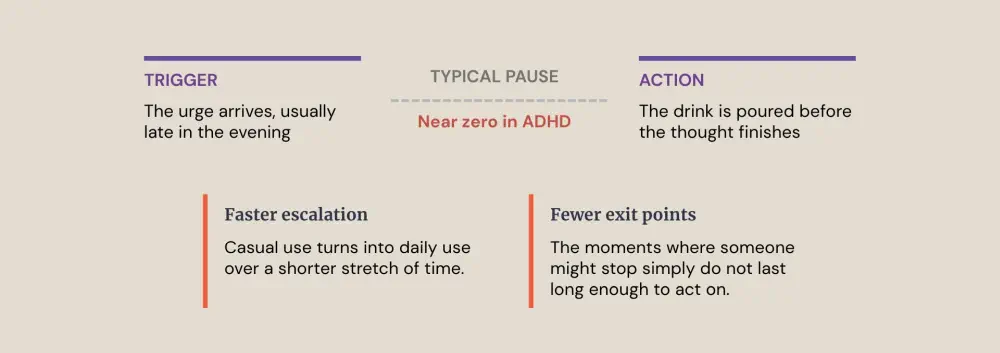
Everyone experiences the gap between wanting something and acting on it, and in ADHD that gap narrows to almost nothing, which is why the interval between first use and daily use tends to be short. Someone who would have talked themselves out of a second drink at 10 p.m. simply pours it.
The emotion-driven pattern
Frustration, rejection, and shame hit harder in ADHD and take longer to fade, and adults who have spent twenty years being told they are lazy or careless carry a store of that feeling. Substances shorten the recovery time from an emotional spike. Once that works a few times, use stops tracking parties and weekends and starts tracking bad days at work, arguments, and Sunday nights.

Which Drugs Turn Up Most in ADHD and Substance Abuse?
Case notes on ADHD and substance abuse keep returning to the same short list of drugs, and each one switches off something specific.
| Substance | What it quiets |
| Cannabis | Racing thoughts at night, and the inability to fall asleep that follows it |
| Alcohol | Social anxiety in the early evening, mental restlessness later |
| Nicotine and caffeine | Drifting attention during the working day |
| Cocaine and amphetamines | Internal noise, producing focus where others get agitation |
Why cannabis dominates the list
Cannabis stands as the most commonly used illicit substance in the ADHD population, and its presence tracks with faster progression and weaker treatment response. Legal retail sale under the Cannabis Act has operated across Canada since 2018. Reviews published since have found the evidence too thin to support cannabis as an ADHD treatment, alongside recorded costs to attention and memory.
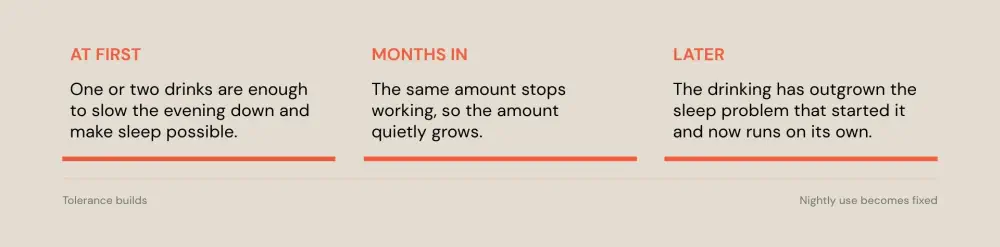
Alcohol creates a different trap. What complicates ADHD and alcohol is the dosing pattern, since the quantity needed to settle a restless mind climbs as tolerance builds, and the drinking outgrows the sleep problem it started as.
A reaction worth noting
CAMH guidance for adult ADHD treats a calming, focusing reaction to a psychostimulant, energy drink, cannabis, or cocaine as one of the signs that should prompt a clinician to consider the diagnosis at all. Clients volunteer this detail casually, usually without knowing it matters.
Do ADHD Medications Cause Addiction?
Families raise this question early in almost every intake call, and the fear behind it made clinical sense for decades. Giving amphetamine derivatives to a population already vulnerable to addiction sounded reckless, so prescriptions were withheld from exactly the children who struggled most.
Medication and later use
Caution on this scale has not held up. A meta-analysis of stimulant treatment and later substance outcomes found no association running in either direction, and CAMH goes further, describing ADHD medication as having a protective role against self-medication, with treatment occupying the reward pathways other substances would act on.
The real risk points
Diversion is real, short-acting formulations carry more misuse potential than extended-release ones, and prescribing decisions change substantially when someone has an active substance use disorder. International consensus lists long-acting methylphenidate, extended-release amphetamines, and atomoxetine titrated upward as options for patients who fail to respond at standard doses. Each formulation carries its own misuse profile, set out in Dangers of ADHD Medications.

Why Do Drug Addiction and ADHD Get Diagnosed in the Wrong Order?
For most adults, drug addiction and ADHD reach a clinician in the wrong order, because adult ADHD hides behind its consequences. Lost jobs, missed rent, unfinished courses, and a marriage that ran out of patience all get attributed to the drinking, and by the time someone reaches an assessment room, there is a decade of damage that appears fully explained by substance use.
Five misleading signs
Doctors face the same confusion from the other direction, since early abstinence generates almost the entire ADHD symptom list on its own.
| What the client reports | Why it settles nothing during early abstinence |
| Cannot hold attention through a group session | Cannabis withdrawal disrupts concentration for weeks after the last use |
| Restless, unable to stay seated | Agitation follows withdrawal from alcohol and stimulants alike |
| Forgets appointments and instructions | Memory disruption is standard in the first month off most substances |
| Snaps at small frustrations | Irritability belongs to nearly every withdrawal syndrome |
| Wakes at 3 a.m. and stays awake | Sleep takes weeks to reorganize after heavy use of anything |
A screening tool administered on day three of detox gives a clinician almost nothing to work with. International guidance recommends routine screening of everyone entering addiction treatment, followed by diagnostic work started as soon as the clinical presentation allows. Childhood history carries most of the diagnostic weight here, because symptoms have to trace back to early life, and a parent or an old report card frequently settles the question faster than any adult self-report scale.
What a missed screen costs
The bill arrives months later, long after everybody has stopped watching. A client finishes a program, leaves with genuine motivation and a relapse prevention plan, and then meets the untreated restlessness and emotional volatility that made drinking useful in the first place. The relapse gets read as a failure of willpower by everyone involved, including the person it happened to.
How Should Both Conditions Be Treated Together?
Concurrent care replaces sequential care, which is the single largest change. Treating the substance use first and promising to address ADHD later leaves the reason for use fully intact throughout the stay. Integrated treatment combining medication for ADHD with therapy aimed at both conditions carries the strongest evidence behind it, and that model sits underneath mental health and addiction treatment that runs alongside substance use programming from the first week.
The adapted daily plan:
- Therapy blocks run shorter and repeat more, since sustained attention fades well before a ninety-minute session reaches its end
- Plans get written down and handed over in hard copy, since verbal agreements reached at the end of a session rarely survive the week
- Physical activity gets a named time slot in the daily schedule and counts as symptom management
- Cognitive behavioural therapy is adapted to target executive function, planning, and emotional recovery time
- Family members learn to tell ADHD-driven behaviour apart from addiction-driven behaviour, because confusing the two after discharge damages households quickly
Residential programs at the Canadian Centre for Addictions run 30 to 90 days across our two Ontario facilities, which leaves ADHD and addiction treatment enough time for withdrawal to clear before anyone assesses what sits underneath it.
What Do Adults Get Back With the Right Diagnosis?
A second diagnosis reframes twenty years of apparent personal failure as an untreated condition nobody screened for. Recovery plans built on that recognition hold their shape after discharge better than plans built on willpower alone.
FAQ
Will a treatment centre admit me if I have a current stimulant prescription?
Yes. Bring the prescription, the prescribing doctor's contact details, and the dosing history to intake so the medical team can plan around it. Stopping ADHD medication abruptly on admission creates problems nobody needs during withdrawal from something else.
My teenager has ADHD and smokes cannabis every day. Is that an addiction?
Daily use in an adolescent with ADHD warrants a proper assessment regardless of what label fits. Watch for use continuing after clear negative consequences, tolerance climbing, and irritability or sleeplessness on days without it.
I was diagnosed with ADHD as a child and stopped medication at sixteen. Does that still count at forty?
It counts, and it belongs in your intake paperwork. Childhood ADHD frequently persists into adulthood in some form, and an old diagnosis gives clinicians the childhood-onset evidence that adult assessment requires.
Do gambling and gaming belong in this conversation, or only drugs and alcohol?
Behavioural addictions belong, though the evidence sits unevenly across them. A UK study of 346 adults recorded clearly raised problematic internet use in the ADHD groups along with higher impulsivity and compulsivity, and found no measurable difference in problem gambling scores within that sample. Impulsivity still correlated with every behaviour measured, which is why intake teams ask about screen time and betting even when substances brought the person in.
Can I be assessed for ADHD before I stop drinking?
An assessment done during active use or early withdrawal produces unreliable results, which is why most clinicians want several weeks of stability first. History gathering can begin immediately, and family members can help by locating school reports or old assessments in the meantime.
Article sources
- Vingilis, E., et al. "Attention Deficit Hyperactivity Disorder Symptoms, Comorbidities, Substance Use, and Social Outcomes among Men and Women in a Canadian Sample." Psychiatry Journal. https://www.ncbi.nlm.nih.gov/pmc/articles/PMC4433668/
- Crunelle, C.L., et al. "International Consensus Statement on Screening, Diagnosis and Treatment of Substance Use Disorder Patients with Comorbid Attention Deficit/Hyperactivity Disorder." European Addiction Research. https://karger.com/ear/article/24/1/43/134224/International-Consensus-Statement-on-Screening
- Gujska, J.H., Silczuk, A., Madejek, R., Szulc, A. "Exploring the Link Between Attention-Deficit Hyperactivity Disorder and Cannabis Use Disorders: A Review." Medical Science Monitor. https://pmc.ncbi.nlm.nih.gov/articles/PMC10171029
- Groenman, A.P., Janssen, T.W.P., Oosterlaan, J. "Childhood Psychiatric Disorders as Risk Factor for Subsequent Substance Abuse: A Meta-Analysis." Journal of the American Academy of Child & Adolescent Psychiatry. https://pubmed.ncbi.nlm.nih.gov/28647007/
- Francisco, A.P., Lethbridge, G., Patterson, B., Bergmann, C.G., Van Ameringen, M. "Cannabis Use in Attention-Deficit/Hyperactivity Disorder (ADHD): A Scoping Review." Journal of Psychiatric Research. https://www.sciencedirect.com/science/article/abs/pii/S0022395622006549
- Centre for Addiction and Mental Health. "Adult ADHD: Screening and Assessment." CAMH. https://www.camh.ca/en/professionals/treating-conditions-and-disorders/adult-adhd/adult-adhd---screening-and-assessment
- Humphreys, K.L., Eng, T., Lee, S.S. "Stimulant Medication and Substance Use Outcomes: A Meta-Analysis." JAMA Psychiatry. https://pubmed.ncbi.nlm.nih.gov/23754458/
- Centre for Addiction and Mental Health. "Adult ADHD: Pharmacotherapy." CAMH. https://www.camh.ca/en/professionals/treating-conditions-and-disorders/adult-adhd/adult-adhd---pharmacotherapy
- Findon, J.L., Muck, A., Tothpal-Davison, B., Dommett, E.J. "Investigating Behavioural Addictions in Adults with and without Attention Deficit Hyperactivity Disorder." PLOS ONE. https://www.ncbi.nlm.nih.gov/pmc/articles/PMC11798432/