
We offer medical detox and multiple addiction treatment options in our
luxury treatment centres in Port Hope, Cobourg, and Ottawa.
The Risks of Mixing Weed and Alcohol

Liquor stores and licensed cannabis retailers share the same commercial strips across most Ontario towns, and 38% of Canadians who used cannabis last year reported pairing it with a drink. Combining weed and alcohol changes blood chemistry in ways neither substance manages alone, and one of the body's defences against drinking too much stops working partway through the evening. Canadian law treats the pair as its own criminal charge at levels that would draw nothing worse than a warning for either substance by itself. What follows covers the measurable interaction, the legal exposure most drivers have never heard of, and the point where a weekend habit warrants a closer look.
Key Takeaways
- Alcohol sits at the top of the list of substances Canadians pair with cannabis, ahead of tobacco and everything else
- Drinking before cannabis drives blood THC far past what the identical dose reaches on its own
- Canada wrote a separate criminal charge for drivers carrying both, set below the limit for either substance alone
- Cannabis quiets the reflex that would otherwise force a drinking body to empty its stomach
- Three Canadians in a hundred who use cannabis have ever sought professional help for it
How Many Canadians Are Mixing Alcohol and Weed in the Same Sitting?
Alcohol tops the list of substances Canadians combine with cannabis. Among past-year consumers, 38% reported mixing alcohol and weed or using them close enough together for the effects to overlap, against 29% for tobacco and nicotine vapes. That share has drifted down from 44% in 2018.
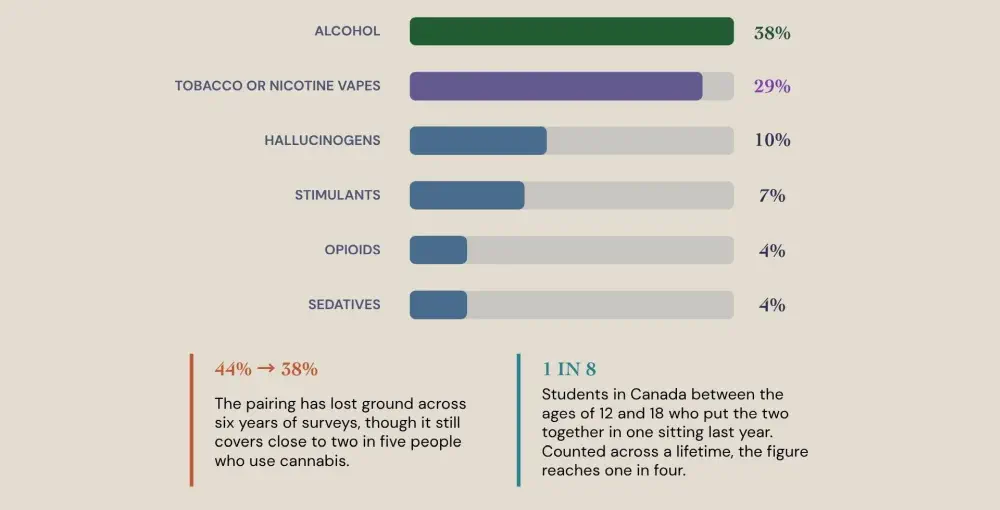
Students take up the habit early. Public Health Ontario found that 13% of Canadian students aged 12 to 18 had used both substances in one session within the past year, and 27% reported having done so at some point. Researchers separate two habits most people treat as one. Concurrent use describes drinking on Friday and using cannabis on Sunday. Simultaneous use means both circulating at once, effects overlapping, and studies tracking same-session alcohol and cannabis use link it to heavier consumption, more alcohol-related harm, and a higher rate of motor vehicle collisions.
Reasons for pairing them are less social than the party imagery suggests. Among Grade 12 students, the motives tied most strongly to frequent same-session use were taking one substance to strengthen the effect of the second, plus a personal sense of already being dependent. The drinking circumstance with the strongest link was drinking alone, which puts much of this behaviour behind closed doors, out of view of anyone who might notice that a person's regular cannabis use has become daily.
What Does Alcohol Do to THC Once Both Reach Your Bloodstream?
Alcohol raises the amount of THC that reaches the blood from an identical dose of cannabis. In a controlled study published in Clinical Chemistry, 19 participants drank a low dose of alcohol or a placebo ten minutes before inhaling vaporized cannabis. Peak blood THC on the stronger dose reached a median of 42.2 µg/L after placebo and 67.5 µg/L after alcohol, roughly 60% higher.
Blood levels of 11-hydroxy-THC climb alongside it, a metabolite the liver creates from THC and a compound at least as psychoactive as the parent molecule. Faster absorption drives most of the rise, since alcohol widens blood vessels and speeds inhaled THC into circulation. Smoked cannabis behaves the same way, so switching devices sidesteps nothing.
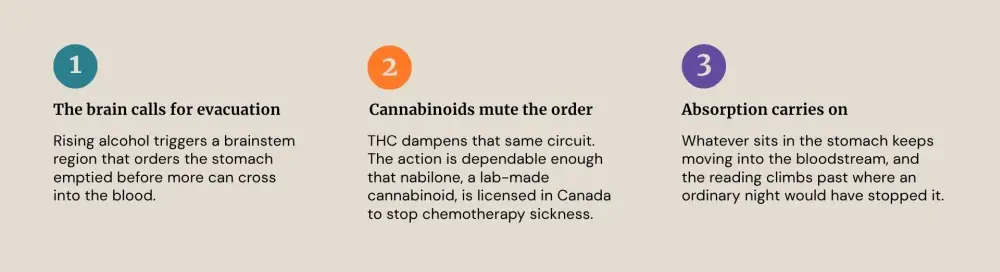
One interaction gets almost no attention outside clinical settings. Vomiting is the body's blunt defence against a dangerous quantity of alcohol, and THC suppresses that reflex well enough that synthetic versions are prescribed in Canada for chemotherapy-induced nausea. A person who has smoked and then kept drinking may feel violently ill without ever bringing anything up, which allows blood alcohol to keep climbing past the point where the stomach would normally have intervened.
Which Weed and Alcohol Effects Should Worry You?
Bad reactions to cannabis are common before anyone opens a bottle. Thirty per cent of Canadians who used cannabis last year reported an adverse health effect from it, with anxiety, panic, or a racing heart leading at 13%, followed by heavy drowsiness at 12%, dissociation at 7%, and confusion or disorientation at 5%. People choosing THC-heavy products report adverse reactions at 38%, against 21% for those using CBD-heavy ones. A drink raises blood THC further, so the weed and alcohol effects that follow tend to sit at the harsher end of that list.
| Sign | What alcohol contributes | When it needs emergency help |
| The spins, cold sweat, grey skin | Blood pressure falling as balance signals scramble | Fainting, or a person who cannot be roused |
| Heavy nausea with no vomiting | Continued absorption with the stomach's exit route shut | Confusion, slow or uneven breathing |
| Pounding or irregular heartbeat | Cardiac load stacked onto a raised heart rate | Chest pain, or a pulse that will not settle |
| Panic, paranoia, watching yourself from outside | A steeper climb in blood THC than the dose predicts | Thoughts of self-harm, total disorientation |
| Missing hours | Blackout deepened by sedation from both | Any gap the person cannot piece back together |
What a bystander should do first
Letting someone sleep it off is the usual response, and it fails badly against anything in that third column. Four steps cover what a bystander can do:
- Call 911 and say both substances are involved, since paramedics treat the combination differently
- Roll the person onto one side so vomit cannot block the airway
- Stay with them and keep checking that breathing stays steady and even
- Skip the coffee and the cold shower, neither of which lowers blood alcohol by a milligram
The cost of the nights that end fine
Dehydration compounds the rest of the list, since both substances pull fluid from the body at once, and the hangover runs longer than an equivalent volume of alcohol produces alone. Recovery stretches into the following afternoon for many people, quietly shrinking the number of clear days in a week. None of it lands the same way twice, and the reasons reach beyond how much of each went down.

What Makes Crossfaded Effects So Hard to Predict?
The word crossfaded describes being drunk and high at once, and it covers nights with almost nothing in common from one person to the next. Three things account for most of that spread, and only one of them is under anyone's control.
Which substance came first
Drinking first sets up the absorption boost described above, so the cannabis that follows lands harder and sooner. Cannabis first creates the opposite trap, since distorted time perception makes the drink count hard to follow, and it usually runs higher than the person believes.
Where tolerance stops helping
Somebody who drinks comfortably every weekend has built tolerance to ethanol alone, and none of it carries over to a bloodstream taking up more THC than usual. Heavy cannabis users hit the same wall from the other direction. Both of them can reach full crossfaded effects on doses they would have called routine the week before.
What the person cannot adjust for
- Product strength. Of the Canadians buying pre-rolled joints, 43% bought at least some infused with concentrates
- Onset speed. Half the country still does not know edibles can take four hours to reach full effect
- Prescriptions. Psychiatric medication ranks second only to vitamins among the things Canadians report taking alongside cannabis
- Personal history. Anxiety, depression, or psychosis in the family raises the odds of the panic and dissociation listed above
Timing compounds the mismatch, since alcohol clears over a few hours, inhaled THC fades across three to four, and an edible can keep someone impaired long after the drinking has stopped. Impairment nobody can measure from the inside turns into a legal problem the moment car keys come out.
What Does Canadian Law Say About Driving on Weed and Alcohol?
Canadian law sets a separate threshold for THC and alcohol found together, and it catches drivers who would clear both individual limits. Offences under the Criminal Code apply to blood levels measured within two hours of driving, so leaving early changes less than people assume.
| Blood levels within two hours of driving | Status under the Criminal Code |
| 80 mg or more of alcohol per 100 mL | Alcohol offence |
| 2 ng to under 5 ng of THC per mL | Summary conviction, $1,000 maximum fine |
| 5 ng or more of THC per mL | Drug offence |
| 50 mg of alcohol plus 2.5 ng of THC | Combination offence |
Every row above except the summary conviction carries mandatory minimum penalties.
What the combination costs in practice
A driver blowing 0.055 has committed no criminal offence and faces a short provincial licence suspension at most. Add enough THC to cross the combination line, which frequent users can sit above for hours after their last use, and the same driver picks up a criminal charge carrying a mandatory minimum $1,000 fine, rising to 30 days in custody on a second conviction and 120 days on a third.
What Canadians believe about getting caught
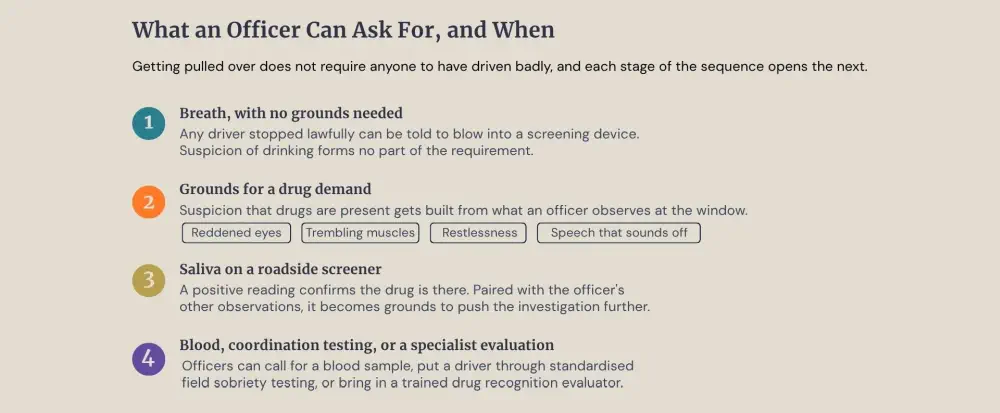
Only 23% of Canadians think a cannabis-impaired driver is likely to be caught, against 41% who say the same about alcohol. Eighteen per cent of the people using it got behind the wheel within two hours of smoking, or four hours of eating cannabis. Police need nothing more than reasonable suspicion to demand oral fluid, and red eyes or muscle tremors will support it. Drivers using cannabis alone tend to compensate by slowing down and leaving more following distance, and adding alcohol strips that compensation away entirely, producing impairment at doses that would have been unremarkable individually. Simulator reviews reach the same conclusion across dozens of trials. A criminal charge is the consequence that gets noticed, and the pattern behind it goes unremarked far longer.
When Does Alcohol and Cannabis Use Become a Problem?
Twelve per cent of past-year cannabis consumers score as having impaired control on a standard dependence scale. Same-session use travels with problems of its own. Research ties the pattern to alcohol dependence under clinical criteria, to heavy drinking days of five drinks or more, and to depression among adults. Early starts predict it too, with cannabis use beginning in Grade 7 or 8 forecasting same-session use by Grade 10.
How each substance justifies the next
Escalation happens quietly, and the substance used to manage the other is usually the one that grows. Someone who smokes to take the edge off a hangover, then drinks to come down from a high that turned uncomfortable, has built a pattern where each use justifies the next.
Signs a family member would notice first
- Needing both to feel normal after work
- Plans rearranged to protect access to one or the other
- A start time that creeps earlier on days off
- Irritability on days without either substance
- Cutting back on one and quietly using more of the other

H3: Why both substances need addressing together
Alcohol withdrawal carries real medical risk and demands supervised detox. Cannabis withdrawal runs on a slower clock of sleep disruption, appetite loss, and irritability lasting weeks. Removing one without addressing the other drives up consumption of whichever remains, which is why residential care for alcohol addiction assesses both from intake. Almost nobody gets that far, since only 3% of Canadians who have tried cannabis more than once have ever received professional help for it.
The Part Worth Taking Seriously
Two legal substances sold a block apart get treated as an ordinary pairing by almost everyone using them. That familiarity is what makes the interaction worth taking seriously, and one conversation with a clinician is enough to find out where a habit stands.
Addiction doesn't get better on its own. Call us today for a free, confidential consultation and find out which program is right for your needs.
FAQ
How long should I wait after drinking before using cannabis?
Blood alcohol falls at roughly one standard drink per hour for most adults, and the absorption boost fades once the alcohol has cleared. Waiting until the following day removes the interaction outright, which is the only gap that carries no added risk.
Does a crossfaded night change what a workplace drug test picks up?
Urine screening looks for THC metabolites, which linger for days in occasional users and for weeks in daily users, and alcohol leaves the body within hours. Combining the two changes nothing about what a cannabis panel reports, since detection depends on how frequently someone uses and how much body fat stores the metabolites.
Is it true that some people use cannabis to cut back on drinking?
Some people do report substituting one for the other, and the research on outcomes is mixed at best. Co-use more commonly raises total consumption of both, and no clinical body in Canada recommends cannabis as a tool for cutting alcohol intake.
Do edibles interact with alcohol differently than smoking?
Edibles need anywhere from 30 minutes to four hours before the full dose arrives, which makes it easy to keep drinking well past a sensible stopping point. Someone who has eaten an edible and kept pouring can hit peak effects from both at the same moment, long after deciding the night was finished.
Can someone in treatment for alcohol keep using cannabis?
Continuing cannabis during alcohol treatment raises relapse risk and clouds the assessment of what is driving mood and sleep problems in early recovery. Residential programs generally require abstinence from both substances for the length of the stay, and it is worth asking any program directly how they handle it.
Article sources
- Health Canada. "Canadian Cannabis Survey 2024: Summary." Government of Canada. https://www.canada.ca/en/health-canada/services/drugs-medication/cannabis/research-data/canadian-cannabis-survey-2024-summary.html
- Meyer, W., Leece, P. "Evidence Brief: Risk Factors for Simultaneous Use of Alcohol and Cannabis." Public Health Ontario. https://www.publichealthontario.ca/-/media/documents/E/2018/eb-risk-factors-alcohol-cannabis.pdf
- Sokolovsky, A. et al. "Alcohol and Marijuana Co-Use: Consequences, Subjective Intoxication, and the Operationalization of Simultaneous Use." Drug and Alcohol Dependence. https://pmc.ncbi.nlm.nih.gov/articles/PMC7370922/
- Hartman, R. et al. "Controlled Cannabis Vaporizer Administration: Blood and Plasma Cannabinoids With and Without Alcohol." Clinical Chemistry / Association for Diagnostics & Laboratory Medicine. https://myadlm.org/media/press-release-archive/2015/alcohol-combined-with-cannabis-significantly-increases-levels-of-thc-in-the-blood
- Department of Justice Canada. "Impaired Driving Laws." Government of Canada. https://www.justice.gc.ca/eng/cj-jp/sidl-rlcfa/
- Sewell, R.A., Poling, J., Sofuoglu, M. "The Effect of Cannabis Compared With Alcohol on Driving." The American Journal on Addictions. https://pubmed.ncbi.nlm.nih.gov/19340636/
- Simmons, S.M. et al. "Effects of Combining Alcohol and Cannabis on Driving, Breath Alcohol Level, Blood THC, Cognition, and Subjective Effects: A Narrative Review." Neuroscience and Biobehavioral Reviews. https://pubmed.ncbi.nlm.nih.gov/35049320/