
We offer medical detox and multiple addiction treatment options in our
luxury treatment centres in Port Hope, Cobourg, and Ottawa.
What’s the Difference Between Binge Drinking and Alcoholism?

Two words get traded in conversation as though they carry the same weight. One counts drinks against a clock. Its counterpart names a medical condition that has taken over a person's decisions. The distance between binge drinking and alcoholism decides what kind of help a person needs, and reading it the wrong way round costs years.
Where Does Canada Draw the Line on Binge Drinking?
Five drinks for a man, four for a woman, both inside roughly two hours. That count lifts blood alcohol concentration to 0.08%, and the National Institute on Alcohol Abuse and Alcoholism uses the number to mark an episode of binge drinking.
Canadian surveillance applies the same drink counts and attaches a frequency test. Statistics Canada records a person as a heavy drinker once they reach four or five drinks on one occasion at least monthly across a year. Among regular drinkers aged 18 to 34 in 2024, 43.5% of men and 38.9% of women met that description.
The Number That Reads Backwards
One figure suggests Canadian drinking is in retreat. Heavy drinking across all men aged 18 to 34 fell from 36% in 2015 to 24% in 2024.
That decline tracks who left the drinking population more closely than it tracks how the remaining drinkers behave. Canadians who had no alcohol at all in the previous year rose from 23% to 29% across the same decade. Subtract the people who stopped, and the group still drinking monthly returned to pre-pandemic heavy drinking levels in 2022 for men and 2023 for women. Fewer Canadians drink. The ones who kept drinking never eased off.
What Counts as One Standard Drink
Canada fixes the standard drink at:
- 341 ml of 5% beer, cider, or a ready-to-drink can
- 142 ml of 12% wine
- 43 ml of 40% spirits
Those figures describe a measured bar pour, and the glass filled at a kitchen counter rarely resembles them. A generous one carries close to two standard drinks, and a cocktail mixed by hand carries three. Plenty of Canadians clear the threshold on a Friday without counting past four glasses. Miscounting of this kind sits underneath grey area drinking, where a habit looks moderate until the millilitres are added up.

Which Alcoholism Symptoms Does a Clinician Count?
Medical charts stopped carrying the word alcoholism years ago. The diagnosis on file reads alcohol use disorder, and the renaming pulled a moral verdict out of a patient record.
Read the eleven criteria in the DSM-5-TR, and one absence stands out. Not one of them names a quantity. No weekly limit, no nightly count, no threshold of glasses. Diagnosis rests on what alcohol has taken from a person, and meeting two criteria inside twelve months is enough to make it.
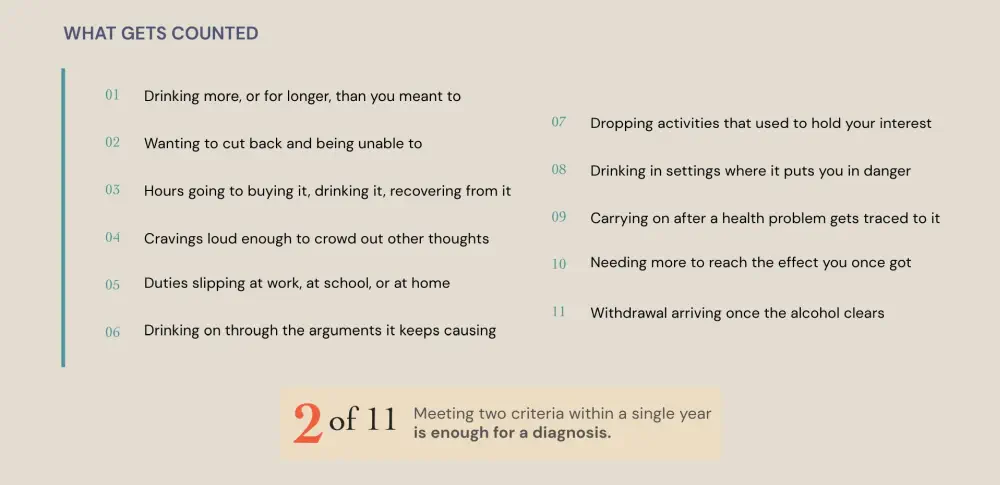
Translated into an ordinary week, the symptoms sitting behind the word alcoholism cover drinking past the amount planned, failed attempts to cut down, cravings between drinks, hours swallowed by buying alcohol and recovering from it, tolerance climbing so the old amount no longer registers, morning sweats, dropped commitments, and drinking that continues after the damage turns visible.
Long before any of that reaches a clinician, families are watching a different set of markers. Bottles moved out of the household recycling. Defensiveness the moment the subject surfaces. Those signs of alcoholism appear months before the person concerned puts a name to any of it.
How Severity Gets Banded
Two or three criteria place someone in the mild band, four or five in moderate, six or more in severe. None of them demand visible collapse, so a person can hold a mortgage, a management role, and a severe diagnosis at once. Severity measures reach into a life, not ruin.

Binge Drinking vs Alcoholism: Which Signals Tell Them Apart?
Frequency is the split most people reach for, and on its own it explains almost nothing. Two drinkers can log the same heavy nights each month and sit in entirely different clinical positions. What separates them shows up in the body before it shows up on a calendar.
Binge Drinker vs Alcoholic Side by Side
| Marker | Episodic heavy drinking | Alcohol use disorder |
| Physical dependence | Absent, no withdrawal between episodes | Present, the body reacts once alcohol leaves the system |
| Command after the first drink | Held on most occasions | Eroded, the stopping point keeps moving |
| What alcohol delivers | Euphoria and social ease | Relief from discomfort the alcohol itself created |
| Reaction to questions | Shrugged off or laughed off | Anger, deflection, or a rehearsed explanation |
| Placement across the week | Clustered around occasions | Woven into ordinary days |
Where the Two Patterns Overlap
The line between a binge drinker and an alcoholic blurs at the edges, and the edges are where most real people sit. Someone can pour four glasses of wine every evening for thirty years, never cross the binge threshold inside two hours, and meet six criteria for severe alcohol use disorder. Another drinker takes nothing Monday to Friday, empties a bottle of rum every Saturday for a decade, and meets none of them.
Sex moves the timeline too, in a way no table of markers can show. Women who reach treatment have usually been drinking fewer years than the men beside them, with medical and psychological consequences arriving faster at the same intensity, a pattern clinicians call telescoping.

Is Binge Drinking Alcoholism in Its Early Form?
No. A heavy Saturday satisfies no diagnostic criteria on its own, and treating every binge as a disorder would hand a diagnosis to millions of Canadians who do not have one. The reassurance runs out fast after that.
What repetition does to the brain is where the risk sits. NIAAA describes addiction as a three-stage cycle opening with binge and intoxication, the stretch in which the brain starts attaching motivational pull to the cues around a drink.
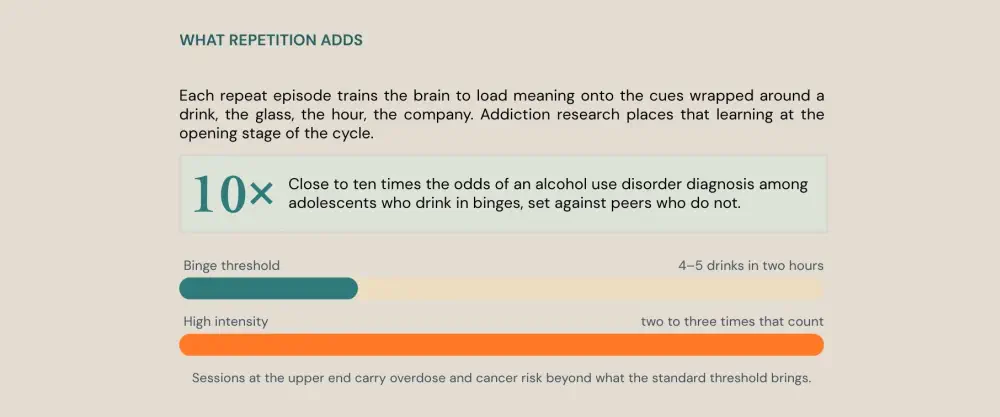
Where young drinkers have been tracked against a diagnosis, the numbers leave little room for argument. Addolorato and colleagues found that adolescents who drank in binges carried nearly ten times the odds of an alcohol use disorder diagnosis compared with peers who did not. Volume inside a single sitting matters as well. Work by Gowin and colleagues on high-intensity binge drinking, meaning two to three times the standard threshold in one occasion, ties the pattern to raised overdose and cancer risk beyond what lower levels carry.
Tolerance gets read backwards by almost everyone who has it. Holding eight drinks with no visible wobble sounds like a strong constitution. What it marks is a nervous system that has already adapted, and that same adaptation is what makes stopping hard later.
Which Effects of Binge Drinking Do People Discount?
What One Night Can Do
Blood alcohol keeps climbing for a stretch after the last drink is finished, so intoxication can deepen once someone has stopped drinking and gone home.
A blackout looks like ordinary drunkenness from the outside, and that is where it gets misread. Alcohol blocks the transfer of memory from short-term to long-term storage in the hippocampus, so a person stays awake, talks, drives, and makes decisions, recording none of it. Enough alcohol beyond that shuts down the regions running breathing, heart rate, and body temperature.
Signs of an alcohol overdose that warrant a 911 call:
- Confusion or difficulty staying conscious
- Vomiting, seizures, or trouble breathing
- Slow heart rate and clammy skin
- Dulled responses, including a missing gag reflex
- Body temperature falling
What Repetition Leaves Behind
The effects of binge drinking accumulate over years with no daily drinking at all. In 201,8 the Canadian Institute for Health Information counted 237 alcohol-related hospitalizations a day nationally, and alcohol was linked to roughly 7,000 new cancer cases in Canada in 2020, including 24% of breast cancers and 20% of colon cancers.
Alongside the cancer figures sits a quieter set of results from brain imaging. Hermens and Lagopoulos report neuroimaging changes in the hippocampal region of young binge drinkers alongside memory and executive difficulties. The claim that episodic drinking leaves no mark does not survive contact with the scans.
At What Point Does Cutting Back Stop Working?
Certain markers move the question out of self-management. Shaking hands in the morning, overnight sweating with no fever, a drink needed before a social event to settle the nerves. Anyone who has made three or four honest attempts to cut down and watched each end the same way is describing dependence.
Why Quitting Alone Carries Risk
Withdrawal surfaces within hours of the last drink in someone with a heavy drinking history. Delirium tremens arrives later, usually 48 to 72 hours out, and runs from one to eight days. Kaye and colleagues put mortality as high as 20% when it goes unrecognized, dropping to around 1% with early identification and treatment.
Each attempt after the first carries a penalty the earlier ones did not. The kindling hypothesis holds that each unsupervised detox raises brain excitability, so seizure risk climbs with the number of withdrawals already behind a person. A fourth solo attempt runs worse odds than the first did.
What Residential Care Involves
At the Canadian Centre for Addictions, alcohol rehab opens with medically supervised detox and nursing care around the clock at Hillcrest Mansion in Port Hope or Woodlawn Inn in Cobourg. Treatment moves on through individual counselling with certified addiction counsellors and psychologists, group sessions, and dual-diagnosis care for the depression, anxiety, or trauma underneath the drinking. Programs run 30, 45, 60, 75, or 90 days.
Which of the Two Words Applies to You?
People spend years arguing with themselves over which of the two words applies, and the argument becomes its own reason to pour another. Set this year's drinking beside last year's, and once the line runs upward, the label has stopped being the useful question. A free, confidential call to 1-855-499-9446 puts that question to people who weigh it every day.
FAQ
If someone gets through a sober month with no trouble, does that rule out a problem?
A month off tests willpower across a fixed stretch, and dependence reveals itself in what follows. Many people finish Dry January and return to their previous volume within a fortnight. What the drinking looks like six months on is the more revealing measure.
Does eating beforehand stop a heavy night from counting as a binge?
Food slows absorption, so blood alcohol climbs more gradually and peaks lower from the same number of drinks. The total reaching the liver stays unchanged. A full stomach softens the curve and leaves the volume where it was.
Does a parent's drinking change my own risk?
Family history raises risk without settling anything on its own. Genetics accounts for part of the vulnerability, and the drinking patterns modelled at home during childhood account for another part. Anyone carrying that history has reason to track their own volume closely.
Can someone with a mild diagnosis go back to moderate drinking?
Some people at the mild end do reduce successfully with counselling support, and results improve when the attempt is supervised against agreed limits. Moderation fails more frequently as severity climbs. A clinician can set a realistic target beforehand.
What can a family do when the person refuses help?
Intervention counselling prepares a family for one structured conversation, with a trained interventionist coaching the wording and the sequence in advance. Families who plan that conversation get further than families who raise it mid-argument. Our intake team can talk through the preparation by phone.
Article sources
- National Institute on Alcohol Abuse and Alcoholism. "Understanding Alcohol Drinking Patterns." NIAAA. https://www.niaaa.nih.gov/alcohols-effects-health/alcohol-drinking-patterns
- Fernandes, E., Lung, Y., Jhumi, M., Stephenson, E. "Changes in Alcohol Consumption from 2015 to 2024." Statistics Canada, Insights on Canadian Society. https://www150.statcan.gc.ca/n1/pub/75-006-x/2026002/article/00001-eng.htm
- National Institute on Alcohol Abuse and Alcoholism. "Alcohol Use Disorder: From Risk to Diagnosis to Recovery." NIAAA Core Resource on Alcohol. https://www.niaaa.nih.gov/health-professionals-communities/core-resource-on-alcohol/alcohol-use-disorder-risk-diagnosis-recovery
- Brienza, R.S., Stein, M.D. "Alcohol Use Disorders in Primary Care: Do Gender-specific Differences Exist?" Journal of General Internal Medicine. https://www.ncbi.nlm.nih.gov/pmc/articles/PMC1495039/
- Addolorato, G., Vassallo, G.A., Antonelli, G., et al. "Binge Drinking Among Adolescents Is Related to the Development of Alcohol Use Disorders: Results from a Cross-Sectional Study." Scientific Reports. https://www.ncbi.nlm.nih.gov/pmc/articles/PMC6105639/
- Gowin, J.L., Sloan, M.E., Morris, J.K., et al. "Characteristics Associated With High-Intensity Binge Drinking in Alcohol Use Disorder." Frontiers in Psychology. https://www.ncbi.nlm.nih.gov/pmc/articles/PMC8564144/
- National Institute on Alcohol Abuse and Alcoholism. "Alcohol and the Brain: An Overview." NIAAA. https://www.niaaa.nih.gov/publications/alcohol-and-brain-overview
- Canadian Institute for Health Information. "Heavy Drinking in Canada." CIHI. https://www.cihi.ca/en/heavy-drinking-in-canada-infographic