
We offer medical detox and multiple addiction treatment options in our
luxury treatment centres in Port Hope, Cobourg, and Ottawa.
Public Rehabs vs Private Rehabs – What Do I Do?

One of Canada's greatest features is its free healthcare. But having such a generous government often leads to accessibility problems. And having such an option brings you to ask which one you should go for? Public rehabs vs private rehabs?
If you need to go to a hospital, you can do that with relative ease. Getting into a residential public rehab centre is a different story.
People who suffer from alcohol and drug addictions may not have the money to afford an independent facility, so they turn to the public rehabs. The problem with that is that the waitlists are usually quite long, and the programs are one-size-fits-all. In many public Canadian rehab facilities, waitlists range from three to six months. Addicts don't have half a year to waste on the prospect of help. There is always outpatient therapy, but this type of treatment takes much longer. It's also geared for people who are not deeply addicted. In order to truly kick an addiction in its teeth, inpatient rehab is the best tactic.
In This Article, You'll Learn:
- How publicly funded rehab programs work in Canada – what they cover, what they don't, and how long you can realistically expect to wait for a bed
- What private addiction treatment actually delivers for the price, and the three differences that separate it most from government-run care
- Where a side-by-side comparison helps – and where the numbers hide costs that don't show up on any bill
- How to decide between public rehab and private treatment based on your budget, your timeline, and how severe your addiction has become
- What financing options like Medicard can do if you're stuck between a months-long wait list and a price tag you can't cover upfront
What's the Reality of Public Addiction Treatment in Ontario?
Public rehab programs are addiction treatment services funded through provincial health insurance plans like OHIP in Ontario. They cover detox, residential stays, and outpatient counselling through community agencies and hospital-affiliated programs – all free for Canadian residents.
No bill at the end. No insurance negotiations. You call, you get assessed, you wait your turn. For many Canadians, government-funded rehab is the only financially realistic path to treatment.
But "free" comes with trade-offs that can affect your recovery in real ways.
How Long Are the Wait Lists?
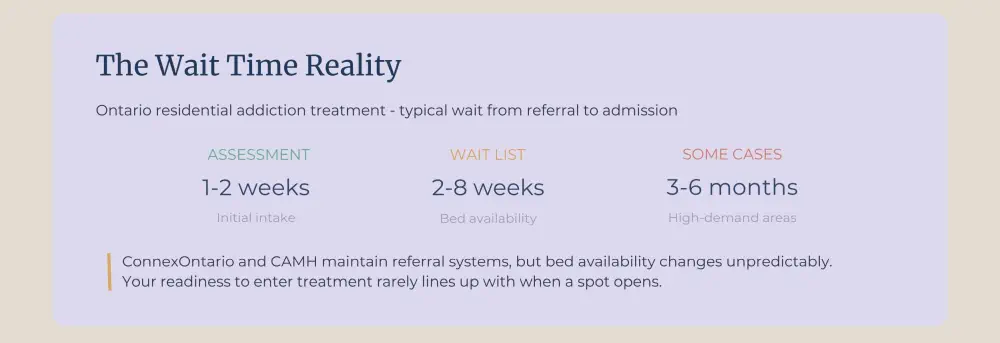
Demand overwhelms supply. In Ontario, wait times for residential addiction treatment routinely stretch from several weeks to several months. During that gap, people relapse. Some lose the motivation that pushed them to seek help. Others face worsening health crises that could have been caught earlier.
What Should You Weigh Before Choosing Public Treatment?
Strengths:
- Zero direct cost – Covered entirely by provincial health plans
- Medical oversight – Hospital-affiliated programs offer supervised detox with clinical staff
- Widespread access – Programs exist across most regions, including rural and Northern communities
- Structured group programming – Peer-based therapy, psychoeducation, and relapse prevention sessions are standard
Limitations:
- Extended wait times – Weeks to months before a bed opens, depending on your location
- Shared accommodations – Multi-bed rooms with limited personal space
- Shorter stays – Many publicly funded residential programs run 21–28 days, which may not allow enough time for deeper therapeutic work
- Group-focused care – Individual therapy sessions are limited, with one industry source noting most public centres offer roughly one session per week with a qualified therapist during a 30-day stay
- Standardized programming – Less room to tailor treatment to your specific substance, trauma history, or co-occurring mental health needs
Public programs save lives every year. That's not in question. But the structural limitations, especially the wait and the limited individualization, mean recovery can start later and receive less personal attention than the case demands.

What Sets Private Treatment Centres Apart from Public Ones?
Private rehab centres operate outside the public healthcare system. They set their own admission criteria, design their own clinical protocols, and control everything from staffing to meals. This independence allows personalization that publicly funded programs can't replicate with their current resources.
The cost is real. Private inpatient programs in Ontario range from roughly $10,000 to $30,000 per month, depending on the facility and intensity of care. For a 60 or 90-day stay, the total climbs accordingly. That figure stops many people cold.
But before ruling it out, consider what that investment actually buys. and how it differs from the public treatment experience you've just read about.
How Does Paying for Treatment Change Your Recovery?
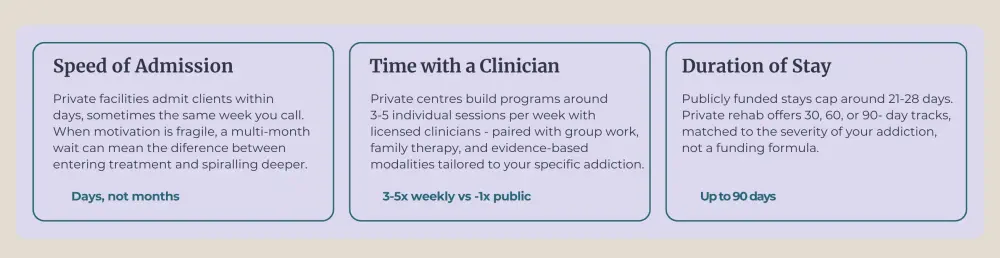
Speed is the first difference. Private treatment facilities admit clients within days, sometimes the same week you call. When someone reaches the point of asking for help, that window of motivation is fragile. A multi-month wait can mean the difference between entering treatment and spiralling deeper.
The second difference is time with a clinician. Private centres build programs around frequent one-on-one sessions, with three to five per week being common, paired with group work, family therapy, and evidence-based modalities tailored to your specific addiction. You're not fitting into a pre-set curriculum; the curriculum fits around you.
The third is duration. Publicly funded stays cap around 21–28 days. Private residential programs offer 30, 60, or 90-day tracks. The National Institute on Drug Abuse (NIDA) reports that treatment durations under 90 days show limited effectiveness for most people with established addictions, and that outcomes improve the longer a person remains engaged in care.

What Are the Advantages and Drawbacks of Private Treatment?
Strengths:
- Immediate or near-immediate admission – No months-long wait when you're ready to start
- Individualized clinical plans – Treatment designed around your substance history, mental health profile, and personal goals
- More one-on-one therapy – Multiple individual sessions per week with licensed clinicians
- Flexible program lengths – 30, 60, or 90 days based on clinical need
- Dual diagnosis treatment – Addiction and co-occurring conditions like depression, PTSD, or anxiety are addressed together under one roof
- Privacy and comfort – Private rooms, nutritious meals, and calm surroundings that reduce stress during withdrawal and early recovery
- Structured aftercare – Alumni networks, follow-up counselling, and relapse prevention planning that continue after discharge
Limitations:
- Cost – Out-of-pocket expenses can be steep without insurance or financing
- Quality varies – Not every private centre delivers evidence-based care; accreditation and clinical credentials matter before you commit
- Insurance navigation – Coverage limits and pre-authorization requirements can add friction before admission
"Where do you most prefer to be when undergoing any type of treatment? Strapped to a height-adjustable bed with tons of sensors around you, or a room that reminds you of a Four Seasons?"
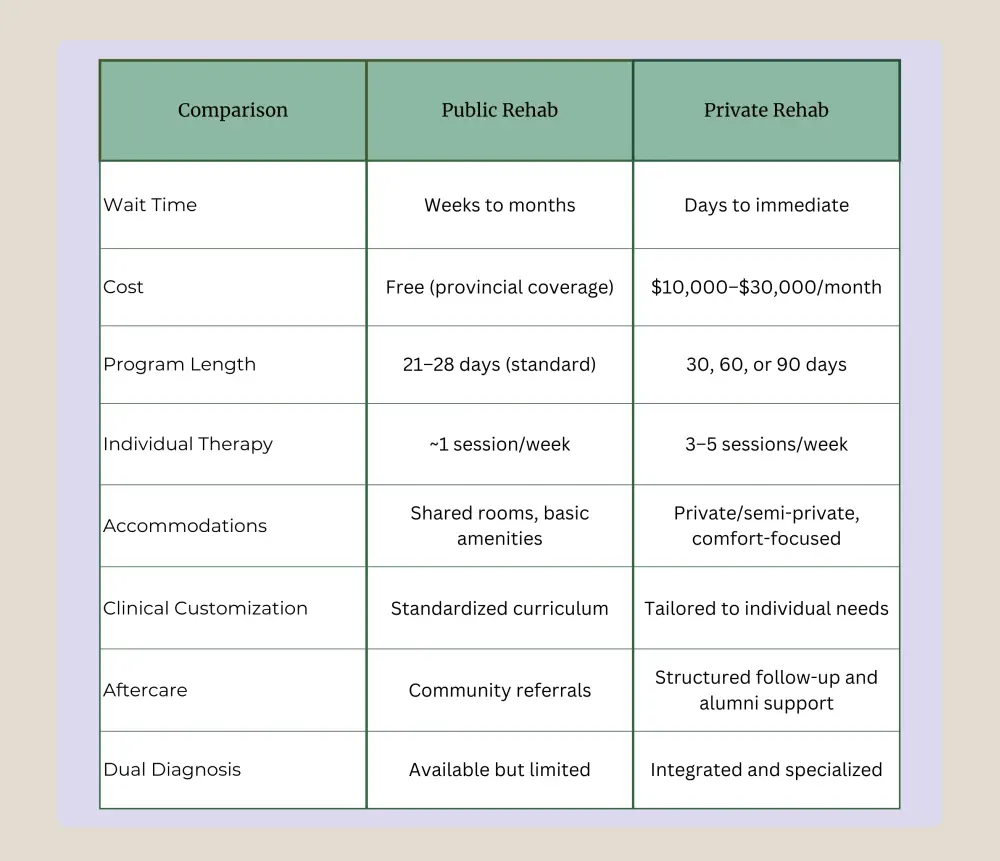
How Do Public and Private Rehabs Compare Side by Side?
When weighing private rehab vs public rehab, a direct comparison captures the structural differences. What it doesn't capture is how these gaps play out in practice – the daily reality that shapes whether someone finishes treatment or walks out early.
What Matters Beyond the Stats When Choosing Rehab?
The timing gap creates hidden costs. Someone who waits three months for a public bed may lose their job, damage relationships further, or experience a medical emergency in the interim. These downstream consequences can exceed the price of private addiction treatment many times over, costs that never show up on a bill but reshape lives permanently.
Completion rates tell a deeper story. People who feel safe and personally invested in their care stick with it longer. The physical environment, like quiet rooms versus shared wards, nutritious meals versus cafeteria food, affects how deeply someone engages with the therapeutic work that changes behaviour. Discomfort during withdrawal and early recovery drives early dropout. Comfort reduces it.
Aftercare separates short-term sobriety from lasting recovery. Public programs hand you a list of community resources at discharge. Private centres build follow-up into the treatment plan: check-in calls, alumni groups, continued therapy access, and crisis protocols. That bridge between residential treatment and independent living is where most relapses happen – and where structured support matters most.
"Recovery works best when you feel supported, not processed."
What Should Drive Your Decision Between Public and Private Treatment?
The private rehab or public rehab decision ultimately comes down to one question: what gets you into treatment fastest and keeps you there long enough for real change to take hold? That sounds simple. It isn't. That sounds simple. It isn't.
If cost is your primary barrier, government-funded rehab removes it entirely. A free program you complete beats an expensive one you never start. Contact ConnexOntario or your provincial health line to begin the intake assessment. Get your name on the list immediately; the clock starts when you call, and spots open unpredictably.
If you can manage the financial side – through savings, insurance, family support, or financing – a private recovery program stacks the odds more heavily in your favour. Faster admission, longer stays, and individualized programming mean your specific triggers, trauma, and co-occurring conditions get focused clinical attention.
If you're caught between the two, financing programs like Medicard can bridge the gap. Medicard is a Canadian medical financing company that pays treatment costs upfront, allowing you to repay through monthly installments. Several private centres in Ontario work with Medicard, making admission possible without draining your savings or waiting months for a public bed.
Questions Worth Asking Any Facility
- How many individual therapy sessions will I receive each week, and who delivers them?
- What happens after I leave? Is aftercare built into the program or handed off to community services?
- Is the facility accredited? (Look for CARF or Accreditation Canada credentials.)
- How do they handle co-occurring mental health conditions, in-house or through outside referrals?
- What is the average completion rate for their residential programs?
FAQ
Is public rehab effective for addiction recovery?
Yes. Publicly funded treatment programs provide evidence-based treatment that helps thousands of Canadians every year. The constraints are structural, long wait times and shorter stays, not clinical quality. Getting on a wait list today is far better than doing nothing.
How much does private rehab cost in Ontario?
Private inpatient programs in Ontario fall between $10,000 and $30,000 per month. A 30-day stay at a mid-range facility runs roughly $15,000–$20,000. A 90-day program at a premium private rehab centre could reach $60,000 or more. Medicard financing and private insurance can offset a substantial portion of these costs.
Can I be on a public wait list and explore private options at the same time?
Yes. Many people register for government-funded rehab and pursue private alternatives in parallel. If a private bed becomes financially feasible or your condition worsens, you can transition without losing your public referral.
What accreditation should I look for in a private rehab?
Look for CARF (Commission on Accreditation of Rehabilitation Facilities) or Accreditation Canada credentials. These bodies verify that a centre meets defined standards for clinical care, safety, and operational quality. Always confirm accreditation before committing.
Does insurance cover private rehab in Canada?
Many employer-sponsored and private plans cover portions of addiction treatment, ranging from partial to full coverage. Contact your insurer before admission to confirm specifics. The Canadian Centre for Addictions can also help you sort through insurance questions during your consultation.
How long should rehab last for the best results?
NIDA (National Institute on Drug Abuse) recommends a minimum of 90 days, noting that shorter stays show limited effectiveness for established addictions. A 28-day program can stabilize you, but 60 to 90 days allows deeper clinical work and solid relapse prevention. Your ideal length depends on the substance, addiction duration, and any co-occurring conditions.