
We offer medical detox and multiple addiction treatment options in our
luxury treatment centres in Port Hope, Cobourg, and Ottawa.
How Does Outpatient Addiction Treatment Work?

Anyone weighing outpatient addiction treatment is looking at national records that show it also delivers the weakest completion rates of any level of care. The gap between the two settings is widest for the people in the most trouble, which is the opposite of what the convenience argument suggests.
You'll Learn
- What an outpatient schedule leaves uncovered
- Which withdrawal symptoms make a home detox risky
- Why the setting where coping skills are learned changes the outcome
- How family involvement affects the odds of staying in treatment
- Why nobody has to fail at outpatient care before entering residential treatment
What Does Residential Treatment Provide That Outpatient Programs Cannot?
Scheduled sessions are the entire offer of outpatient addiction treatment, and every hour between them falls to the client. Residential programs fill those hours with care, and a 2019 systematic review of studies published from 2013 to 2018 rated the evidence as moderate that a residential stay can cut substance use and ease mental health symptoms.
Families comparing the two settings in more detail can read our guide to Inpatient vs. Outpatient Rehab, which lays out cost and scheduling for both.
Withdrawal Monitored Around the Clock
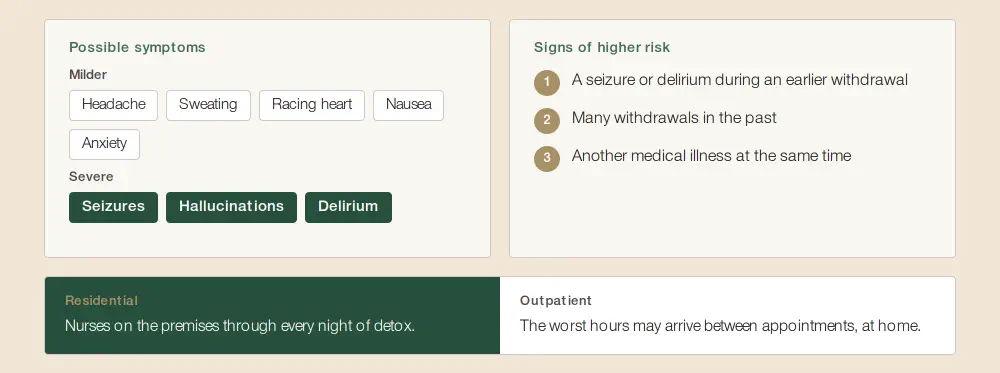
Stopping alcohol after sustained heavy use can bring on seizures, hallucinations, delirium, nausea, anxiety, and disrupted sleep, according to the American Society of Addiction Medicine's clinical guideline on alcohol withdrawal. The guideline names the conditions that raise the odds of a complicated withdrawal, among them earlier withdrawal seizures or delirium, many past withdrawal episodes, and co-occurring medical illness. Someone detoxing through an outpatient program spends the first days of withdrawal at home, and a residential client spends them with nurses on site day and night.
Coping Skills Practised Away From Old Triggers
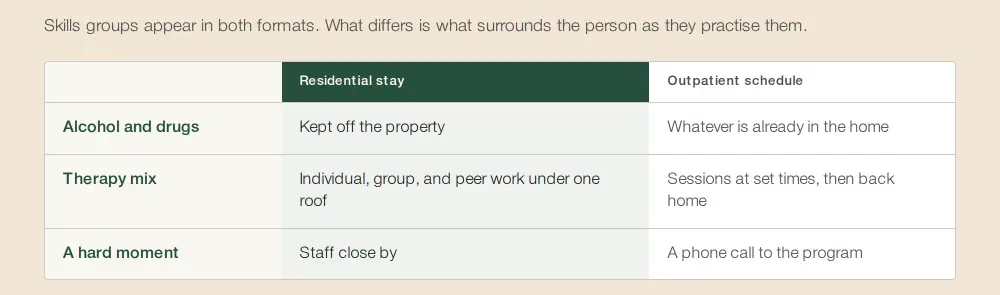
Residential programs run inside a setting kept free of alcohol and drugs, pairing individual and group therapy with peer support and mutual help. Clients rehearse new responses to stress, cravings, and conflict with the substances, people, and places tied to their use, kept out of reach. SAMHSA's own guidance on intensive outpatient care describes the reverse, with a client who found her husband drinking heavily on returning from an evening group and stayed overnight with her brother after calling her program.
Families Brought Into Treatment
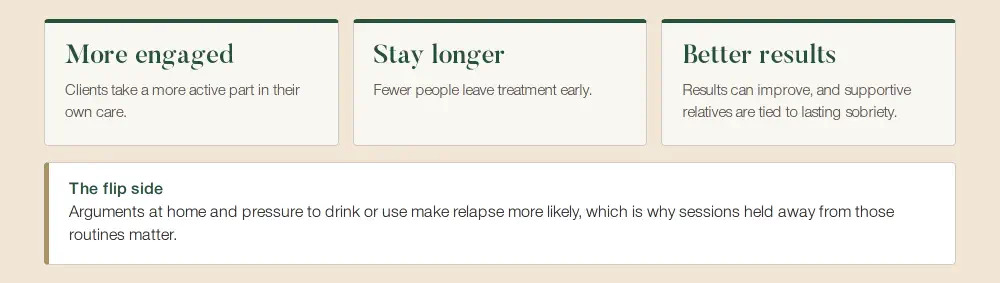
Bringing relatives into treatment can help clients stay engaged, remain in treatment longer, and do better afterward, and supportive family ties are associated with long-term abstinence, according to SAMHSA's guidance on family therapy. The same guidance links interpersonal conflict and pressure to use at home with a higher risk of relapse. Residential programs can bring relatives in for sessions led by clinicians, at a distance from the arguments and routines that surrounded the drinking or drug use.
Support That Continues After Discharge
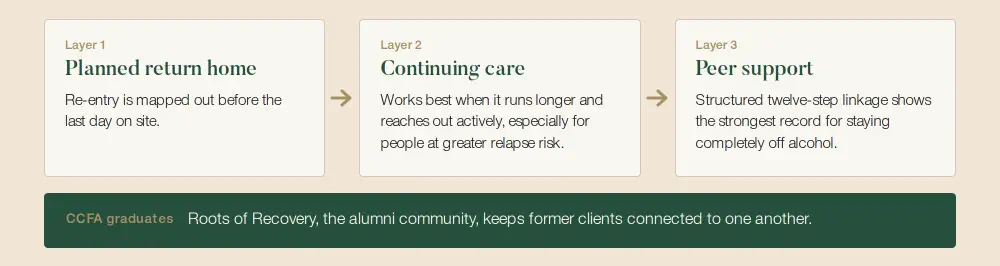
Research broadly supports continuing care after an initial treatment episode, and a 2021 review found the most consistent results from longer programs that keep patients actively engaged, with the largest benefit for people at higher risk of relapse. Peer support adds a longer-term layer, and a 2020 Cochrane review rated the evidence as strong that structured twelve-step facilitation keeps more people fully abstinent from alcohol than cognitive behavioural therapy and other proven options. Planned re-entry to home and community life is a standard part of residential care, with best practice building in continuity of care from the start.
What Is Missing From Ontario's Outpatient System?
Anyone searching for PHP drug treatment in Ontario meets a naming problem first, since the same band of care turns up as day treatment or day hospital, and ASAM's own continuum files it under high-intensity outpatient. Ontario's Auditor General reported in 2019 that the Ministry of Health set a delivery standard for withdrawal management programs alone, so non-residential providers decided for themselves how to run their services.

Scheduling limits narrow the option further for anyone holding down a job, since about 30% of non-residential providers in the audit's survey offered nothing on weeknights and 76% offered nothing on weekends.
Public residential care carries its own barrier, and a 2023 scan of Ontario's publicly funded residential programs by CAMH researchers found estimated admission waits of 1 to 382 days in streams that charge no fee. Many people land in outpatient addiction treatment because a bed was months away, not because a clinician judged it the right level of care.
Who Is Outpatient Rehab Built For?
Outpatient programs are designed for a narrow profile, covering people at low risk of acute intoxication or withdrawal, with physical and psychological symptoms that hold steady between appointments, and a home where nobody drinks or uses.
Hours alone separate one band from the next, and IOP covers 9 to 19 clinical hours a week against 20 or more at the high-intensity level under the ASAM Criteria. Both leave the rest of the week to the client.
Residential care is the safer starting point outside that profile, and the signs below each point the same way.
- Withdrawal from alcohol or benzodiazepines is expected to need medical monitoring around the clock.
- Someone in the household drinks or uses, or supplies the substance.
- Daily use has continued through counselling or a previous outpatient attempt.
- Mental health symptoms would pull attention away from any session held at home.
Waiting to fail at a lower level first is not a clinical requirement anywhere in the placement standards. ASAM's Fourth Edition bases admission on present needs and rejects arbitrary prerequisites such as a previous treatment failure, so a person who needs residential care can start there.
At the Canadian Centre for Addictions, residential programs run 30, 45, 60, 75, or 90 days at Hillcrest Mansion in Port Hope and Woodlawn Inn in Cobourg, with 24/7 nursing and treatment that addresses addiction alongside co-occurring mental health conditions. Our intake team can explain our professional addiction services and the admission timelines for each program.

Ready to Take the First Step?
Addiction doesn't get better on its own. Call us today for a free, confidential consultation and find out which program is right for your needs.
Where Outpatient Care Earns Its Place
The strongest use for an outpatient program comes after a residential stay, not in place of one, and SAMHSA counts step-down care from residential and withdrawal management settings among the routes into intensive outpatient treatment. A structured PHP recovery or IOP schedule back home keeps clinical contact in place through the months when a person is rebuilding a routine, with the hardest early weeks already behind them.
FAQ
Should I try outpatient treatment before considering residential care?
Nothing in the ASAM placement standards requires a failed attempt at a lower level before admission to residential care. The right starting point depends on withdrawal risk, health, and what home looks like, all of which an intake assessment covers.
Will I get discharged from an outpatient program if I relapse?
Each program sets its own policy at intake, and many respond to a return to use with more frequent drug screens, added sessions, or a referral to a more intensive level. Discharge is more likely to follow ongoing dishonesty about use or safety risks the program cannot manage.
Can my partner or parents take part in treatment?
Family counselling and family psychoeducation groups are part of many outpatient and residential programs, and some run evenings where clients and relatives attend together. Relatives can join only with the client's consent, since the program cannot share treatment details without it.
Will my employer find out that I'm in treatment?
Ontario's Personal Health Information Protection Act limits how health care providers collect, use, and share health information without consent, with narrow legal exceptions such as a serious risk of harm. Employers usually learn about treatment only through your own disclosure, a release you sign, or a workplace-mandated program with reporting terms agreed at intake.
How much does residential treatment cost compared with an outpatient program?
Community outpatient programs funded by the province charge no fees, and private residential programs set their own, which group health benefits may partly cover. Cost per week tells only half the story, since a program someone drops out of delivers less than the fees and weeks put into it.
Article sources
- Substance Abuse and Mental Health Services Administration. "Clinical Issues in Intensive Outpatient Treatment for Substance Use Disorders." SAMHSA. https://library.samhsa.gov/sites/default/files/pep20-02-01-021.pdf
- American Society of Addiction Medicine. "The ASAM Criteria: Fourth Edition." Colorado Department of Health Care Policy and Financing. https://hcpf.colorado.gov/sites/hcpf/files/ASAM-Fourth-Ed-Disseminate-Summary.pdf
- American Society of Addiction Medicine. "Criteria FAQ." ASAM. https://www.asam.org/asam-criteria/criteria-faq
- Stahler GJ, Mennis J, DuCette JP. "Residential and Outpatient Treatment Completion for Substance Use Disorders in the U.S." Addictive Behaviors, reviewed by the Recovery Research Institute. https://www.recoveryanswers.org/research-post/residential-versus-outpatient-treatment-in-the-us/
- Substance Abuse and Mental Health Services Administration. "Treatment Episode Data Set (TEDS): 2012 Discharges from Substance Abuse Treatment Services." SAMHSA. https://www.samhsa.gov/data/sites/default/files/2012_Treatment_Episode_Data_Set_Discharge/2012_Treatment_Episode_Data_Set_Discharge.html
- Office of the Auditor General of Ontario. "Addictions Treatment Programs." 2019 Annual Report, Volume 1, Chapter 3, Section 3.02. https://www.auditor.on.ca/en/content/annualreports/arreports/en19/v1_302en19.pdf
- Office of the Auditor General of Ontario. "Status of Audit Recommendations from the 2019 Annual Report." Annual Report 2024. https://www.auditor.on.ca/en/content/annualreports/arreports/en24/4-01FU_Continuous_en24.pdf
- Ali F, Law J, Russell C, Bozinoff N, Rush B. "An Environmental Scan of Residential Treatment Service Provision in Ontario." Substance Abuse Treatment, Prevention, and Policy. https://link.springer.com/article/10.1186/s13011-023-00586-3