

We offer medical detox and multiple addiction treatment options in our
luxury treatment centres in Port Hope, Cobourg, and Ottawa.
Codependent Relationships and Addiction

Relationships built on codependency trap millions in cycles that mirror addiction itself. When one person loses themselves completely in another's problems, behaviours, and needs, the result damages everyone involved. These patterns don't just enable substance abuse—they create their own form of psychological dependence that demands professional attention.
Research shows that codependency and addiction share striking neurological and psychological similarities. Your brain responds to relationship drama the same way it responds to chemical substances. The validation rush, the anxiety during separation, the desperate need for your next "fix" of connection—these are not merely emotional reactions. They represent genuine dependency patterns requiring specialized treatment.
Key Takeaways:
- Why codependency functions like addiction itself — Discover how your brain releases dopamine when rescuing your partner, creating the same reward loops that drive substance use, and why the cycle of obsession, temporary relief, and crash mirrors addiction patterns exactly.
- What neuroscience reveals about love addiction — See how your brain activates identical regions (including the nucleus accumbens) whether you're using cocaine or obsessing over someone, making stopping feel neurologically impossible.
- How each condition worsens the other — Learn why codependency enables substance use by preventing consequences, while active addiction creates the chaos that deepens codependent rescuing behaviors, causing both to spiral downward together.
- How childhood trauma creates the blueprint — Growing up watching addiction, experiencing emotional neglect, or being forced into caretaker roles teaches codependency as survival.
- Why half-measures guarantee failure — Understand why treating addiction without addressing codependency leads to relapse, why treating codependency without addressing substance use perpetuates enabling, and why both conditions demand simultaneous professional treatment.
What Makes a Codependent Relationship Different?
Healthy relationships involve mutual support. Partners help each other through difficult times, share responsibilities, and maintain individual identities while building something together. Codependent dynamics work differently.

Core patterns include:
- Excessive emotional reliance on one person for validation and identity
- Boundary dissolution, where you can't tell where you end and they begin
- Compulsive caretaking that feels impossible to stop, even when harmful
- Identity loss through constant focus on another person's needs
- Enabling behaviours that perpetuate destructive patterns
The cycle of addiction to love follows predictable stages. You obsess over someone, sacrifice everything to maintain the connection, experience temporary relief when they reciprocate, then crash when problems resurface. This cycle repeats endlessly, much like substance use patterns where the high never lasts, and the lows keep getting worse.
Research estimates that between 3-6% of adults experience patterns resembling love addiction. Many more struggle with codependent tendencies without recognizing them. The numbers climb higher when examining families affected by substance use disorders, where these relationship patterns become a learned survival strategy passed between generations.
A codependent relationship differs fundamentally from normal dependency. Partners in healthy relationships depend on each other for support, companionship, and shared goals. Both maintain separate interests, friendships, and identities. Neither requires constant validation nor feels responsible for fixing the other's problems.
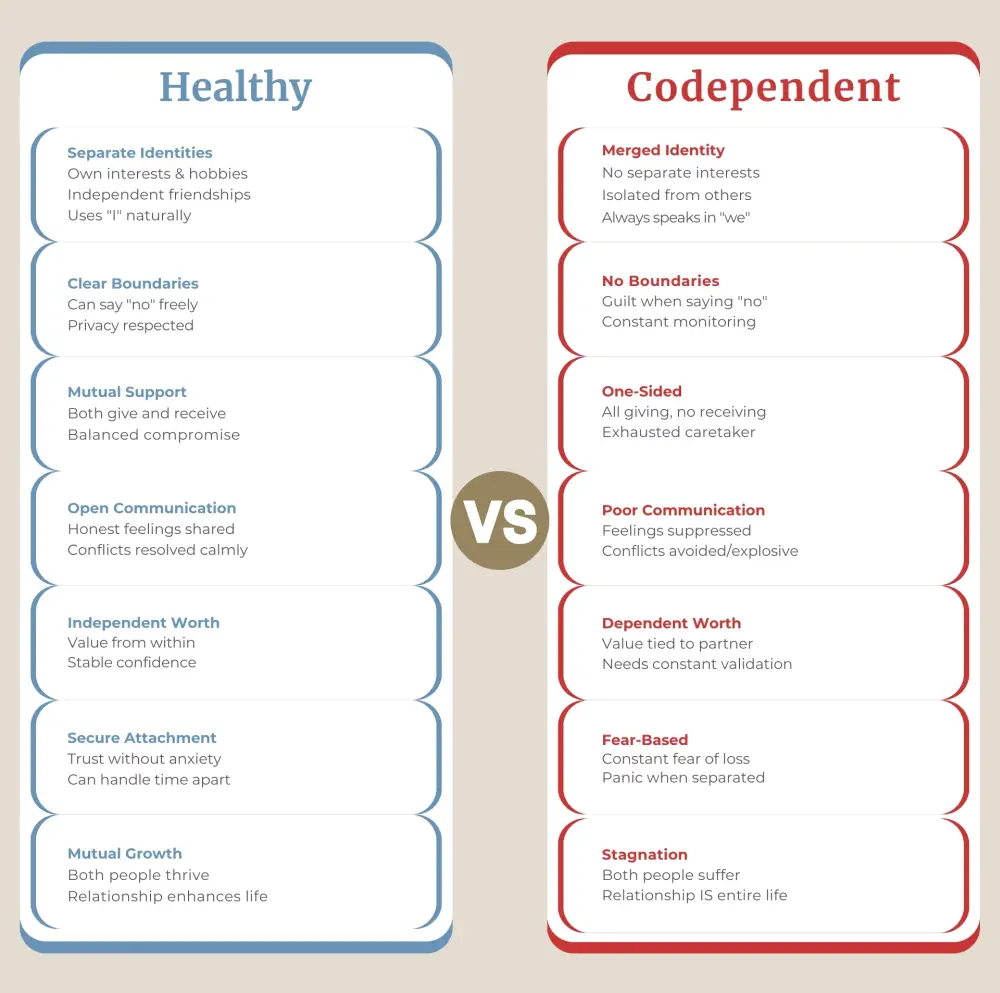
Codependency creates a toxic dynamic. The caretaker derives self-worth exclusively from helping, while the taker becomes increasingly unable to function independently. Both become trapped—the caretaker through their need to be needed, the taker through learned helplessness. Separating feels impossible because each person's identity depends entirely on maintaining this dysfunctional balance.
Are Codependent Relationships a Form of Psychological Dependence?
Your brain doesn't distinguish much between being addicted to love and being addicted to substances. Both hijack the same neurological pathways designed for bonding and reward.
When you're codependent, your brain releases dopamine (the same chemical flooding your system during substance use) whenever your partner validates you or needs your help. You literally get high from caretaking. Oxytocin, the bonding hormone, reinforces these patterns by making the relationship feel essential for survival.
Neuroscience research demonstrates that romantic attachments and substance dependencies activate identical brain regions. The nucleus accumbens lights up whether you're using cocaine or obsessing over an unavailable partner. Both experiences trigger reward learning mechanisms that make stopping feel neurologically impossible.
The psychological dependency manifests in recognizable ways:
- Withdrawal symptoms emerge during separation—anxiety spikes, depression sets in, and physical discomfort appears. You feel incomplete without your partner, even when the relationship causes obvious harm. This represents genuine psychological dependence, not simply missing someone you care about.
- Tolerance develops over time. You need increasingly exaggerated displays of need from your partner to feel that same rush of purpose. Small problems no longer satisfy your compulsion to fix things. You unconsciously create or magnify crises to feed your need to rescue.
- Craving and obsession dominate your thoughts. You can't focus on work, hobbies, or other relationships because your mind constantly circles back to your partner's problems. This mental preoccupation mirrors the obsessive thinking patterns in substance use disorders.
- Loss of control becomes evident when you keep caretaking despite promising yourself you'll stop. You know the behaviour damages your wellbeing, yet you continue anyway. The compulsion overrides rational decision-making, exactly like addiction.
Physical dependence differs from this psychological pattern. Substances create bodily adaptations requiring the chemical for normal functioning. Stopping causes measurable physiological withdrawal—tremors, sweating, and nausea. Codependent relationships don't create physical dependency in this medical sense, but the psychological component proves equally powerful and destructive.
Scientists increasingly recognize love addiction as a legitimate behavioural addiction. The brain doesn't care whether you're chasing a chemical high or an emotional one. Both create cycles of craving, temporary satisfaction, and increasing dysfunction that require professional intervention to break.

How Codependency and Addiction Feed Each Other?
When codependency and addiction collide, they create a devastating partnership. Each condition makes the other worse, trapping both people in an accelerating decline.
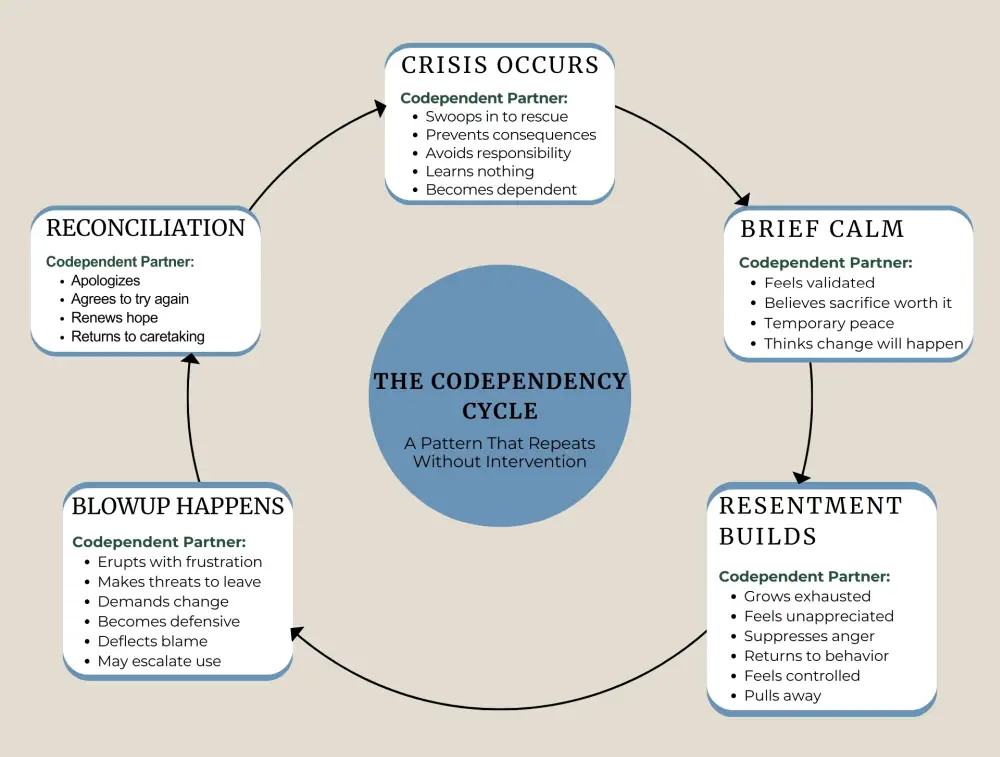
The codependent partner enables substance use through dozens of unconscious behaviours. You call their employer with fabricated excuses when they're too intoxicated to work. You loan money despite knowing it will fund their next purchase. You clean up messes, manage consequences, and provide a safety net that removes motivation for change.
This enabling feels like love. You genuinely believe you're helping. But each rescue attempt sends a clear message: "You don't need to stop because I'll handle everything." The person using substances never faces the full consequences of their choices. They sink deeper into addiction while you sink deeper into compulsive caretaking.
Where These Patterns Begin
Childhood experiences often create fertile ground for both conditions. Growing up in families where emotional needs went unmet, where parents struggled with addiction or mental illness, where survival meant anticipating others' needs—these environments teach codependency as a coping mechanism. You learned early that your value comes from managing other people's problems.
That same childhood trauma frequently drives substance use. People medicate pain from neglect, abuse, or abandonment. When two people with these backgrounds connect, they create a perfect storm. One uses substances to numb emotional wounds while the other uses caretaking for the same purpose.
Fear of abandonment drives both patterns relentlessly. The person using substances fears losing their support system, so they manipulate through guilt or promises. The codependent fears being alone or worthless without someone to fix, so they accept treatment they'd never tolerate in healthier circumstances. Both stay trapped by the terror of what life looks like without this dysfunctional connection.
The cycle perpetuates itself through predictable stages:
Does Codependency Need Professional Treatment?
Attempting to overcome codependency and addiction alone rarely succeeds. The patterns run too deep, the psychological hooks too strong. Professional treatment is a necessity.
Mental health consequences escalate without treatment. Depression becomes chronic as the relationship drains emotional resources. Anxiety disorders develop from constant crisis management and fear of abandonment. Some people turn to substances themselves, using alcohol or drugs to cope with the stress of their codependent role. Others develop stress-related physical illnesses as the body breaks down under sustained pressure.
The codependent person often loses themselves completely. Your interests, goals, friendships—everything disappears into the black hole of managing another person's life. You may not remember who you were before this relationship consumed your identity. Recovering that sense of self requires more than good intentions.
Evidence-Based Treatment Approaches
Cognitive Behavioural Therapy (CBT) helps identify the distorted thought patterns driving codependency. You learn to recognize catastrophizing ("If I don't help them, they'll die"), all-or-nothing thinking ("I'm either completely devoted or I'm selfish"), and other cognitive traps. Therapists provide tools for challenging these automatic thoughts and building healthier mental frameworks.
Psychodynamic therapy explores how childhood experiences created current relationship patterns. Understanding why you developed these behaviours helps reduce shame and creates motivation for change. You process unresolved trauma that continues driving your need to fix others.
Family therapy addresses issues when substance use involves multiple family members. Everyone learns healthier communication patterns, appropriate boundaries, and how to support recovery without enabling destructive behaviours. Family members often need help recognizing their own codependency patterns.

When Was the Last Time You Put Yourself First?
What happens when addiction treatment ignores codependency, or codependency treatment ignores substance use?
The Canadian Centre for Addictions has seen the answer repeatedly: failure. Addiction recovery crumbles when the enabling dynamic continues unchanged. Codependency recovery stalls when active substance use keeps creating emergencies requiring intervention. Successful outcomes require addressing both conditions simultaneously.
Recovery becomes possible with proper support. People break free from codependency every day, learning to build relationships based on mutual respect rather than desperate need. The process requires time, professional guidance, and commitment to facing uncomfortable truths. But the alternative—remaining trapped in cycles destroying everyone involved—demands action.
FAQ
What's the difference between codependency and healthy support?
Healthy support maintains boundaries and separate identities with mutual give-and-take. Codependency involves compulsive caretaking where your entire self-worth depends on helping another person, creating a perpetually one-sided dynamic where you sacrifice your well-being completely.
Can you be addicted to a person like you're addicted to drugs?
Yes. Research shows love addiction activates identical brain regions and neurochemicals as substance addiction, producing similar cravings, withdrawal symptoms, and loss of control. The psychological component represents genuine dependency requiring professional treatment.
How long does recovering from codependency take?
Most people spend 3-6 months in active treatment, followed by ongoing therapy and support groups. Recovery timelines vary based on pattern severity and whether substance use exists simultaneously. You're rewiring decades of learned behaviour, which requires time and consistent effort.
What happens if codependency goes untreated?
Untreated codependency worsens progressively. Mental health deteriorates through chronic stress, depression, and anxiety. The enabling dynamic perpetuates substance use. Some individuals develop their own substance dependencies or serious physical health problems. Professional intervention becomes increasingly critical.
Can you recover from codependency while staying in the relationship?
Recovery within the relationship is possible if both people commit to treatment. The person with addiction must actively work on sobriety while the codependent partner establishes boundaries and rebuilds an independent identity. Without dual commitment, one person's recovery typically threatens the relationship's stability, often leading to separation.
How do I know if I need professional help for codependency?
Seek professional help if you've tried changing patterns on your own without success, if your mental or physical health is declining, or if the relationship involves substance use. Codependency paired with addiction always requires specialized treatment—the patterns are too complex to break alone.
Article sources
- Sussman, S., et al. (2011). "Prevalence of the addictions: a problem of the majority or the minority?" Evaluation & the Health Professions, 34(1), 3-56. Available at: https://journals.sagepub.com/doi/10.1177/0163278710380124
- Fisher, H.E., et al. (2016). "Intense, passionate, romantic love: a natural addiction? How the fields that investigate romance and substance abuse can inform each other." Frontiers in Psychology, 7, 687. Available at: https://pmc.ncbi.nlm.nih.gov/articles/PMC4861725/
- Burkett, J.P., & Young, L.J. (2012). "The behavioral, anatomical and pharmacological parallels between social attachment, love and addiction." Psychopharmacology, 224(1), 1-26. Available at: https://pmc.ncbi.nlm.nih.gov/articles/PMC3469771/
- Aron, A., et al. (2005). "Reward, motivation, and emotion systems associated with early-stage intense romantic love." Journal of Neurophysiology, 94(1), 327-337. Available at: https://journals.physiology.org/doi/full/10.1152/jn.00838.2004
- Beattie, M. (2009). "Codependent no more: How to stop controlling others and start caring for yourself." Hazelden Publishing. Research compilation on codependency patterns and family systems.
- Bacon, I., et al. (2020). "The lived experience of codependency: an interpretative phenomenological analysis." International Journal of Mental Health and Addiction, 18(3), 754-771. Available at: https://link.springer.com/article/10.1007/s11469-018-9983-8
- Marks, A.D.G., et al. (2012). "An investigation of the relationship between codependency and personality." Journal of Affective Disorders, 138(1-2), 121-131. Available at: https://www.sciencedirect.com/science/article/abs/pii/S0165032711007695
- Felitti, V.J., et al. (1998). "Relationship of childhood abuse and household dysfunction to many of the leading causes of death in adults: The Adverse Childhood Experiences (ACE) Study." American Journal of Preventive Medicine, 14(4), 245-258. Available at: https://www.ajpmonline.org/article/S0749-3797(98)00017-8/fulltext
- Rotunda, R.J., et al. (2004). "Enabling behavior in a clinical sample of alcohol-dependent clients and their partners." Journal of Substance Abuse Treatment, 26(4), 269-276. Available at: https://www.sciencedirect.com/science/article/abs/pii/S0740547204000418
- O'Farrell, T.J., & Clements, K. (2012). "Review of outcome research on marital and family therapy in treatment for alcoholism." Journal of Marital and Family Therapy, 38(1), 122-144. Available at: https://onlinelibrary.wiley.com/doi/abs/10.1111/j.1752-0606.2011.00242.x