
We offer medical detox and multiple addiction treatment options in our
luxury treatment centres in Port Hope, Cobourg, and Ottawa.
Al-Anon vs Nar-Anon for Addiction Support

Someone you love is struggling with addiction. You've spent months, maybe years, managing the fallout. The broken promises, the financial strain, the conversations that go nowhere. You need help. But when you search for a support group for families of addicts, two names keep showing up. Al-Anon and Nar-Anon. They sound almost identical. So which one do you need?
You'll Learn:
- Why one in three Al-Anon attendees were never there because of alcohol, and what that means for your first meeting.
- Why drug families and alcohol families carry different brands of shame into a meeting, and how the wrong room can deepen isolation instead of breaking it.
- Where to find meetings across Canada when Nar-Anon's footprint is a fraction of Al-Anon's.
- Three alternatives to 12-step family programs, including one that teaches specific communication techniques designed to encourage a loved one toward treatment without confrontation.
- Where peer support hits its ceiling and when professional family counselling picks up what group meetings can't carry.
What's the Difference Between Al-Anon and Nar-Anon?
➨Al-Anon was built for families and friends affected by someone's drinking.
➨Nar-Anon was built for families and friends affected by someone's drug use.
That's the core split, and on paper, it seems straightforward.Al-Anon traces back to 1951, when Lois Wilson and Anne B. unified scattered family groups into a single fellowship for spouses and relatives of alcoholics. Nar-Anon came later, revived in 1968 on the Palos Verdes Peninsula in California after an earlier attempt failed, then formally incorporated in 1971. It's modelled on the same 12-step principles but tailored to families dealing with narcotics and other drug dependencies.
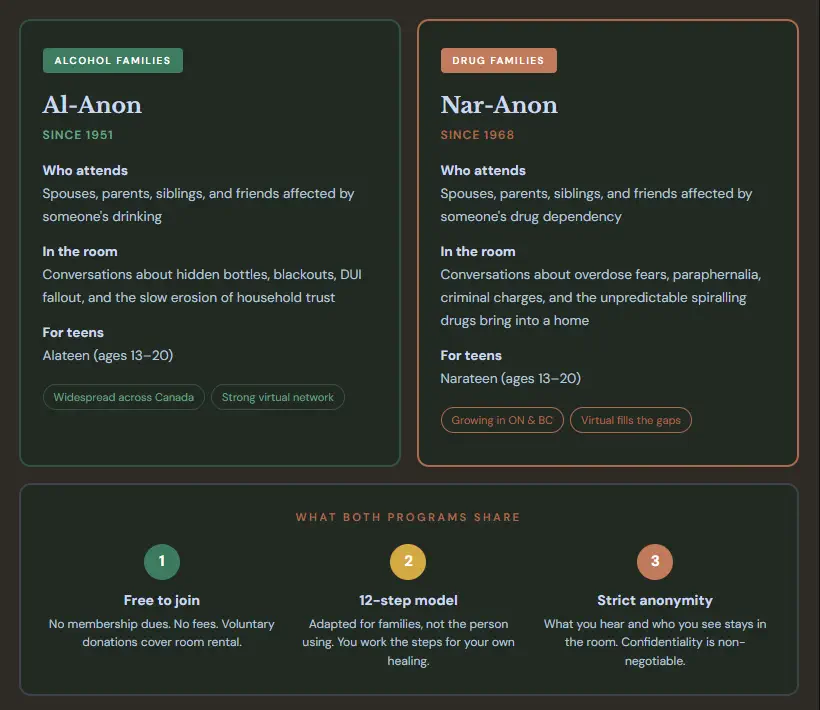
Both programs teach the same core lesson. You didn't cause it, you can't control it, you can't cure it. Both are free. Both maintain strict anonymity. Both run on the 12 steps adapted for family members, not the person using substances.
So if they're so alike, why does the distinction matter? Because the conversations inside those rooms are different. Al-Anon centres on experiences with a drinker. Hiding bottles, DUI arrests, blackout behaviour, the particular chaos alcohol creates in a household. Nar-Anon deals with overdose fears, drug paraphernalia, criminal charges, and the unpredictable escalation patterns that come with illicit substance use. When you're terrified your adult child will die from fentanyl, a room full of people describing wine-fuelled arguments might not feel like home.
That said, the lines have blurred considerably. Al-Anon's own 2018 membership survey revealed that 35% of members first attended because of a loved one's drug problem, not alcohol. Many discovered that how addiction affects the family follows strikingly similar patterns regardless of the substance involved.
Who Should Attend Al-Anon Meetings?
Al-Anon meetings serve anyone whose life has been disrupted by another person's drinking. Spouses, parents, adult children, siblings, close friends, coworkers. The only requirement is that someone else's alcohol use has affected you.
You don't need proof. You don't need a diagnosis. You don't even need the drinker to admit they have a problem. Al-Anon focuses entirely on your recovery, on learning to stop managing someone else's behaviour and start rebuilding your own emotional stability.
Meetings run weekly in most Canadian cities, with virtual options expanding access for rural and northern communities. Some feature a single speaker sharing their story, others centre on a reading from Al-Anon literature followed by group discussion. Newcomers can sit and listen without saying a word.Alateen, a branch of the Al-Anon family, exists for teenagers affected by a parent's or family member's drinking. These groups pair young people with adult sponsors who've passed background checks, creating a safer space for adolescents to work through what's happening at home.

Who Should Attend Nar-Anon Meetings?
Nar-Anon meetings are designed for anyone affected by a loved one's drug addiction. The program mirrors Al-Anon's structure (12 steps, 12 traditions, sponsor relationships, anonymity), but the shared language and lived experience inside the room revolve around drug use specifically.
Parents are wondering if their child is alive. Partners searching jacket pockets for needles. Siblings watching someone they grew up with become unrecognizable. These are the stories you'll hear at Nar-Anon. The program also runs Narateen for young people under 21 dealing with a family member's drug dependency.
Nar-Anon has fewer meeting locations than Al-Anon, particularly across Canada. Ontario has a growing network through the Nar-Anon Ontario region, and British Columbia maintains active groups, but smaller provinces may have limited in-person options. Virtual meetings through Nar-Anon's world service have helped close this gap.
Because drug addiction carries a heavier social stigma than alcohol misuse in many communities, Nar-Anon members frequently describe deeper shame about what they're living through. Hearing someone else say "I lied to my boss about why my son missed Thanksgiving" can crack open years of isolation in a way that a pamphlet never could.
Can You Attend Both Programs, and Should You?
Absolutely. No rule prevents you from sitting in both rooms and deciding which fits. The Al-Anon vs Nar-Anon question doesn't have to end with a single answer. Many people whose loved one uses alcohol and drugs attend both fellowships. Each support group for families of addicts runs on the same 12-step bones, so the transition feels seamless.
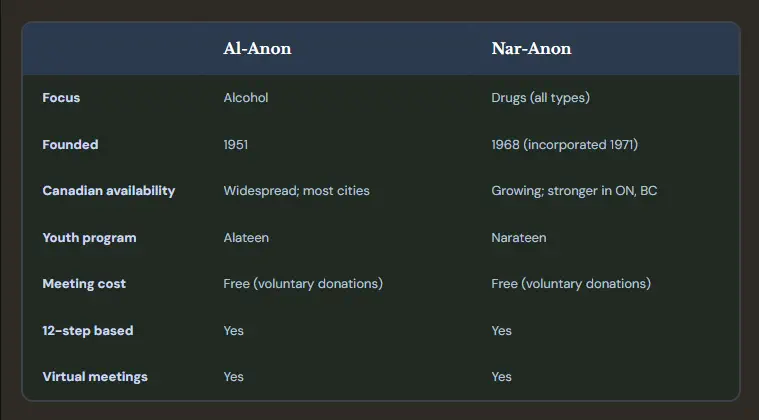
If your family member's substance of choice is alcohol, Al-Anon is the natural starting point. If drugs are involved (prescription opioids, cocaine, methamphetamine, fentanyl), Nar-Anon will likely resonate more. And if addiction has fractured your family in ways that feel beyond what peer support alone can address, professional counselling for families of addicts provides clinical tools that complement what you'll learn in either fellowship.
What If 12-Step Programs Don't Feel Right for You?
Not everyone connects with the spiritual framework that underpins both Al-Anon and Nar-Anon. The "Higher Power" concept, even loosely defined, pushes some people away before they give the program a real chance.
SMART Recovery Family & Friends uses cognitive behavioural tools and the CRAFT (Community Reinforcement and Family Training) model. Meetings run both online and in-person across several Canadian cities, and the program teaches specific communication strategies designed to encourage a loved one toward treatment without confrontation.
Families Anonymous operates as a broader 12-step fellowship covering drug use, alcohol, and related behavioural problems, without restricting its scope to a single substance category.
Private family therapy with a registered psychotherapist who specializes in addiction offers individualized attention that group meetings can't replicate. At the Canadian Centre for Addictions, the Lifetime Family Program gives graduates' families ongoing therapeutic support at no additional cost, recognizing that the person in treatment isn't the only one who needs to heal.
Each of these options fills a different need. Some families layer multiple resources. Nar-Anon on Tuesday nights, a therapist every other week, SMART Recovery tools for the moments in between. Recovery belongs to you as much as it belongs to the person using substances.
When Does Your Family Need More Than a Support Group?
Peer support groups do powerful work. They break isolation, normalize the emotional chaos of living with addiction, and teach coping strategies honed by people who've survived similar experiences. They're also free and widely accessible.
But they have limits. Drug addicts anonymous, family programs, and 12-step fellowships are led by peers, not clinicians. They don't offer crisis intervention. They can't treat the anxiety, depression, or trauma that accumulates in family members after years of living with active addiction. And they aren't designed to help you stage an intervention or convince a loved one to enter treatment.
When your family's needs demand clinical support, when you're not sleeping, when your own mental health has deteriorated, professional care becomes necessary. Weighing Al-Anon vs Nar-Anon is a good first step, but a private rehab that includes family programming bridges the gap between peer fellowship and clinical care, providing medical and therapeutic resources alongside the connections that groups offer.
The Canadian Centre for Addictions runs intervention counselling for families still struggling to support an addict who refuses help, as well as ongoing family therapy during and after a loved one's residential treatment. You can reach the intake team at 1-855-499-9446 to talk through your options.
FAQ
How long should I commit to Al-Anon meetings or Nar-Anon before deciding if it works?
Most members recommend attending at least six meetings before making a judgment. The first one or two can feel awkward, and it takes time to hear enough stories to know if the room's focus matches your experience.
Do I have to believe in God to participate in either program?
No. Both programs reference a "Higher Power," but each member defines that for themselves. Some interpret it as the group itself, the natural order, or a personal sense of purpose, and neither fellowship requires religious belief.
Can my teenager attend Nar-Anon meetings with me?
Teenagers have their own branch. Alateen (for alcohol-related concerns) and Narateen (for drug-related concerns) run meetings specifically for young people under 21, facilitated by screened adult sponsors. Some families attend their respective programs on the same night.
What's the difference between drug addicts anonymous programs and family support groups?
Drug addicts anonymous programs and Narcotics Anonymous serve the person using substances. Al-Anon, Nar-Anon, and Families Anonymous serve the people around them. The two tracks are separate and confidential, so your loved one won't know what you shared, and you won't know what they discussed.
Are meetings confidential if I know other people in the room?
Both programs operate on strict anonymity traditions. What you hear and who you see stays in the room. Members who violate this expectation risk losing the group's trust, and most take the commitment seriously.
Article sources
- Al-Anon Family Group Headquarters, Inc. "2018 Al-Anon Membership Survey." Al-Anon Family Groups. https://al-anon.org/pdf/2018MembershipSurvey.pdf
- Nar-Anon Family Group Headquarters, Inc. "About Nar-Anon." Nar-Anon Family Groups. https://nar-anon.org/
- Timko, C. et al. "Al-Anon Family Groups: Newcomers and Members." Journal of Studies on Alcohol and Drugs, 2013. https://pubmed.ncbi.nlm.nih.gov/23739025/
- SMART Recovery. "Family & Friends Program." SMART Recovery. https://smartrecovery.org/family/
- Canadian Centre on Substance Use and Addiction. "Community Reinforcement and Family Training." CCSA, 2017. https://www.ccsa.ca/sites/default/files/2019-04/CCSA-Community-Reinforcement-Family-Training-Summary-2017-en.pdf
- Families Anonymous. "About FA: What Is Families Anonymous?" Families Anonymous, Inc. https://familiesanonymous.org/about-fa/
- Timko, C. et al. "Al-Anon Newcomers: Benefits of Continuing Attendance for Six Months." Journal of Studies on Alcohol and Drugs, 2016. https://pmc.ncbi.nlm.nih.gov/articles/PMC4976777/