

We offer medical detox and multiple addiction treatment options in our
luxury treatment centres in Port Hope, Cobourg, and Ottawa.
How long does brain fog after quitting weed last?

Most people experience brain fog after quitting weed for two to four weeks. Heavy, long-term users sometimes deal with mental cloudiness lasting two to three months before their thinking sharpens again. The timeline depends on how much you used, how potent the products were, and how long the habit lasted, but the fog does lift.
Brain fog during cannabis withdrawal shows up as real cognitive disruption: forgetting mid-sentence what you were saying, reading the same paragraph three times without absorbing it, struggling to make a basic decision about dinner. These aren't signs of permanent damage. Your brain is recalibrating after months or years of external chemical input, and that recalibration takes time.
Key Takeaways:
- Why your brain stalls after quitting — the specific receptor and dopamine changes that make thinking feel impossibly slow, and the fat-solubility problem that keeps THC circulating long after your last hit.
- What the fog actually does to your daily life — how it sabotages work performance, strains relationships, and creates a frustration cycle that becomes a relapse trigger on its own.
- When you can realistically expect clarity to return — a week-by-week breakdown of recovery, plus the personal variables that push your timeline shorter or longer.
- Five habits that shave weeks off your recovery — backed by research on over 1.2 million adults, with specific targets for exercise, sleep, nutrition, cognitive load, and stress.
Why Does Brain Fog Happen When You Stop Using Cannabis?
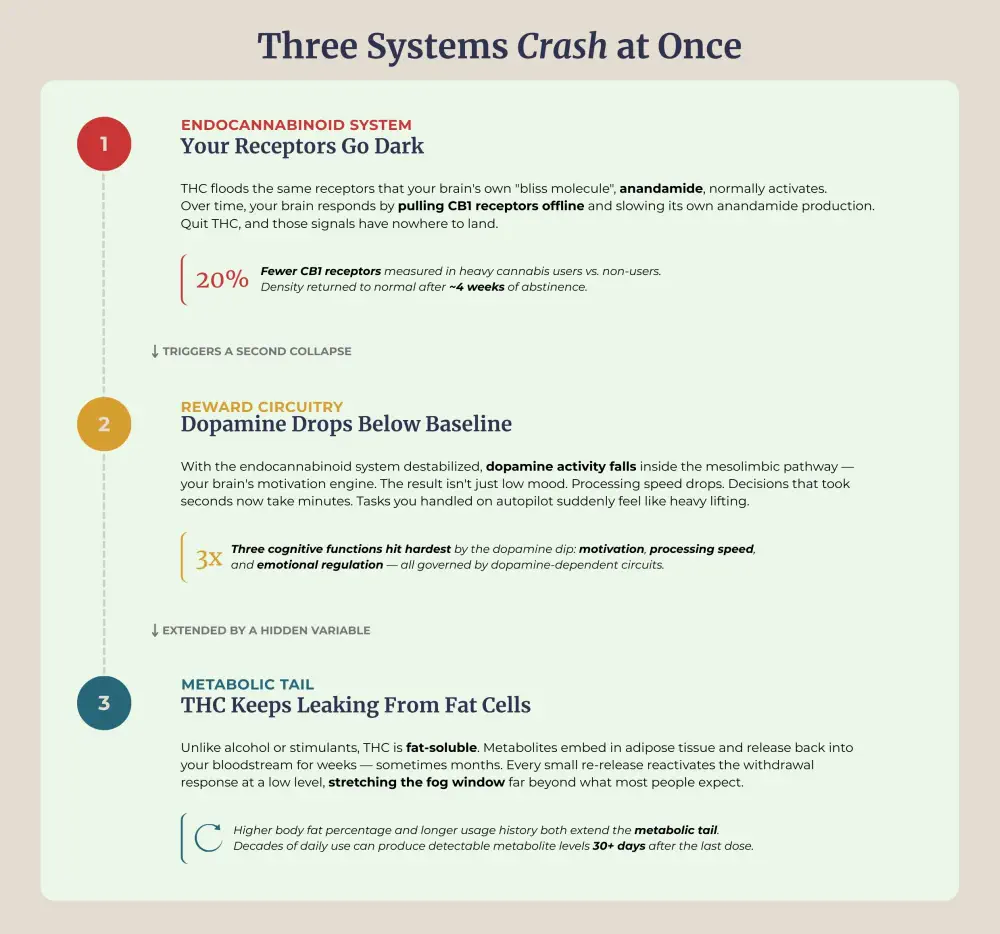
THC hijacks a system your brain already runs on its own. The endocannabinoid system regulates mood, memory, appetite, and sleep through natural chemicals like anandamide, sometimes called the "bliss molecule." When you flood that system with THC regularly, your brain dials down its own production and reduces the number of CB1 receptors available to receive those signals.
Stop the THC supply, and your brain finds itself short-staffed. CB1 receptors need time to bounce back. Research found that CB1 receptor density in heavy cannabis users was roughly 20% lower than in non-users, but normalized after approximately four weeks of monitored abstinence. That four-week mark aligns closely with when many people report their thinking starting to clear.Dopamine takes a hit too. The dip in dopamine activity that accompanies THC withdrawal disrupts your brain's reward circuitry, according to preclinical research published. Less dopamine means less motivation, slower mental processing, and a flat emotional state that makes even familiar tasks feel unreasonably difficult.
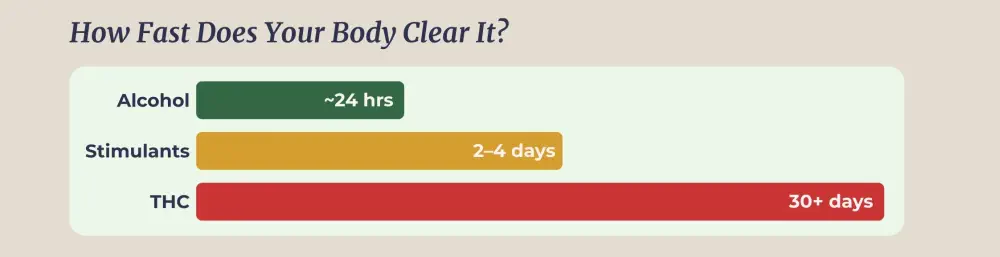
THC is fat-soluble. Unlike alcohol or stimulants that clear your system within days, THC metabolites lodge in fat tissue and are released gradually. Someone with higher body fat or decades of daily use carries a longer metabolic tail, which can stretch the withdrawal window, and the fog along with it.
What Does Cannabis Withdrawal Brain Fog Feel Like?
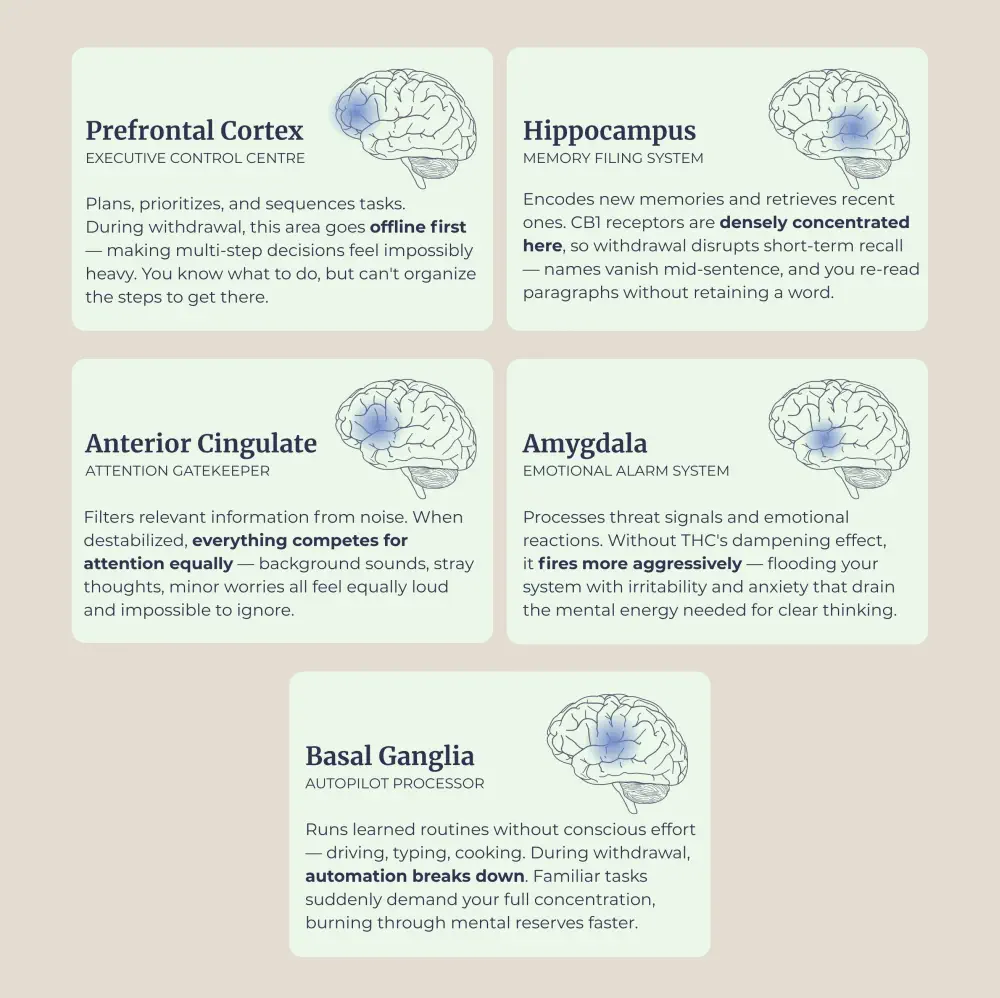
Most people expect a few forgetful moments. What they don't expect is to feel fundamentally slower, as if someone had dialled their processing speed down by half. Conversations move too fast. Instructions at work don't land the first time. You stare at a grocery list and can't prioritize what to grab first. The fog doesn't just dull your memory; it blunts your ability to sequence, plan, and switch between tasks.Work takes the biggest hit. Tasks that once took twenty minutes now eat up an hour because you keep losing your place. Emails sit unfinished. Meetings feel like they're happening in a language you half-understand. Job performance dips sharply during the first two weeks, especially in roles that demand sustained focus or rapid decision-making.
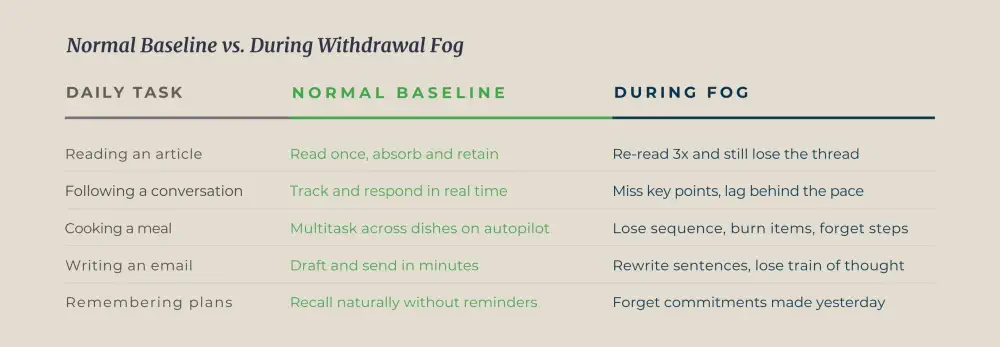
Relationships take hits, too. You zone out during conversations with your partner. You forget plans you made yesterday. Friends start noticing you seem "off." The disconnect creates friction right when you need support most.
The relentless fatigue after quitting weed piles onto every one of these problems. Sleep disruption during the first two weeks of mental clarity after quitting weed is almost universal – vivid dreams, night sweats, and trouble falling asleep leave you running on broken rest. Bad sleep makes fog dramatically worse. The two feed each other in a cycle that can feel inescapable.
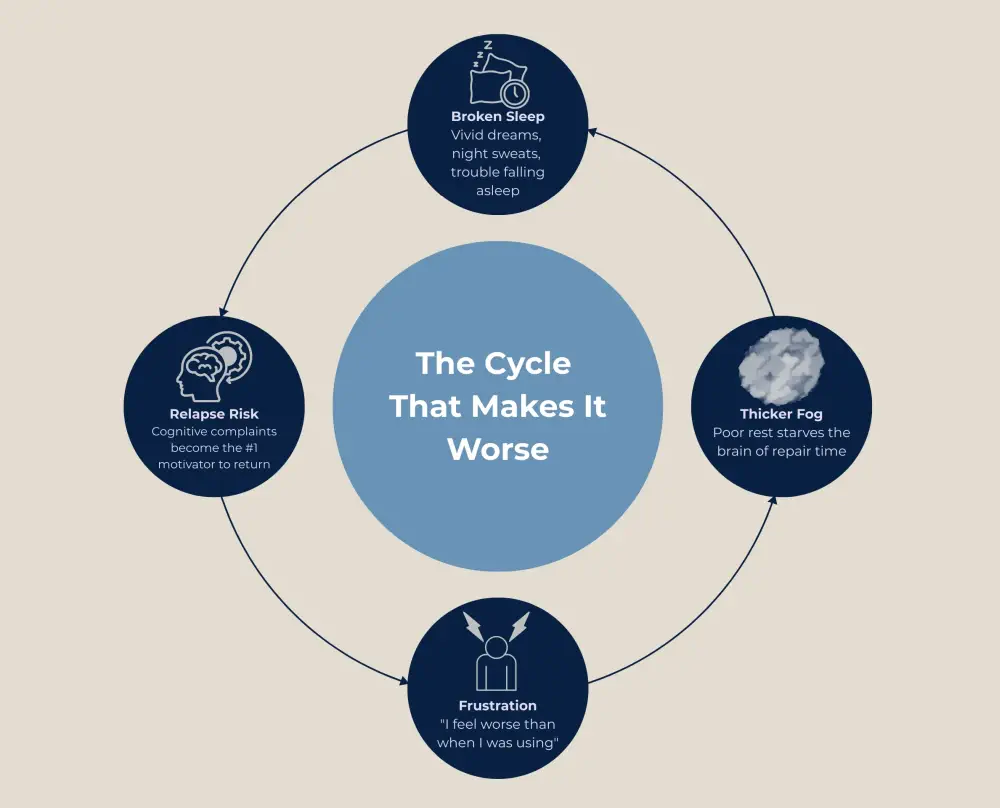
Here's what makes this particularly dangerous: the frustration itself becomes a relapse trigger. "Why do I feel worse than when I was using?" is a question addiction counsellors hear constantly. Research on cannabis relapse consistently identifies negative mood states and cognitive complaints as primary motivators for returning to use, not physical withdrawal symptoms, which are comparatively mild. That mismatch between expecting clarity and getting haze catches people off guard at their most vulnerable.
How Long Should You Expect the Fog to Stick Around?
Your recovery timeline is shaped by your usage history, but patterns do emerge.
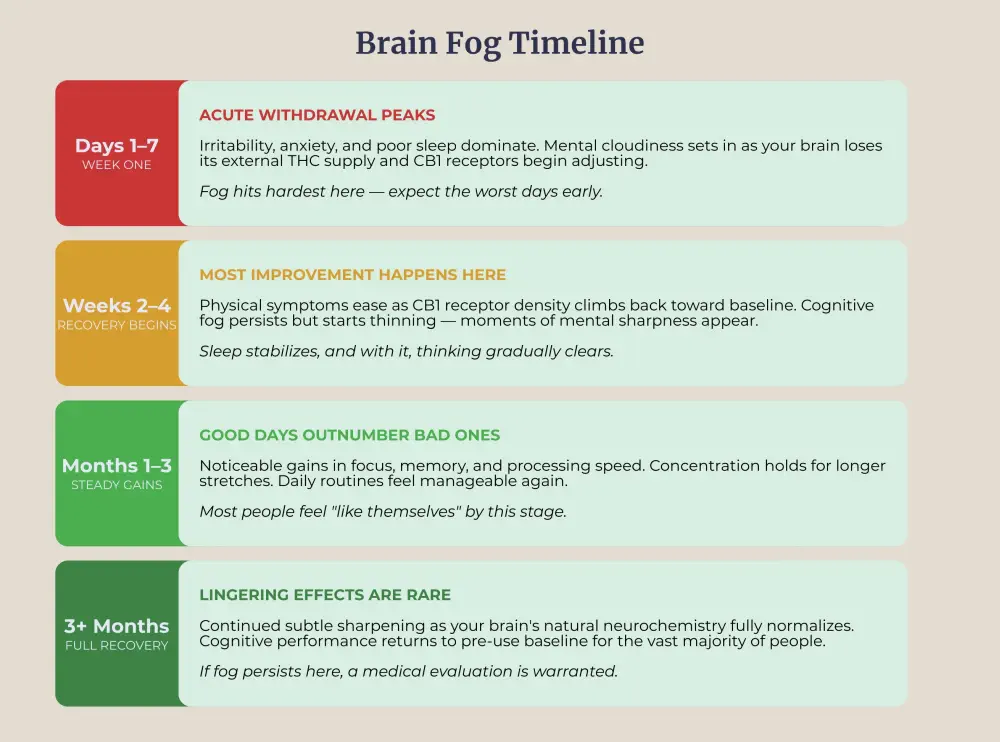
Several personal variables push the timeline longer or shorter. Daily users of high-potency concentrates (above 70% THC) face steeper receptor downregulation than someone who smoked moderate-strength flower a few times per week. Age matters; younger brains tend to bounce back faster. And co-occurring conditions like depression or anxiety can mimic and worsen fog symptoms, making it harder to tell where weed withdrawal symptoms end and a mental health condition begins.
What Can You Do to Clear Brain Fog Faster?
Passive recovery works – your brain will heal on its own timeline. But five targeted habits can shave weeks off that window.
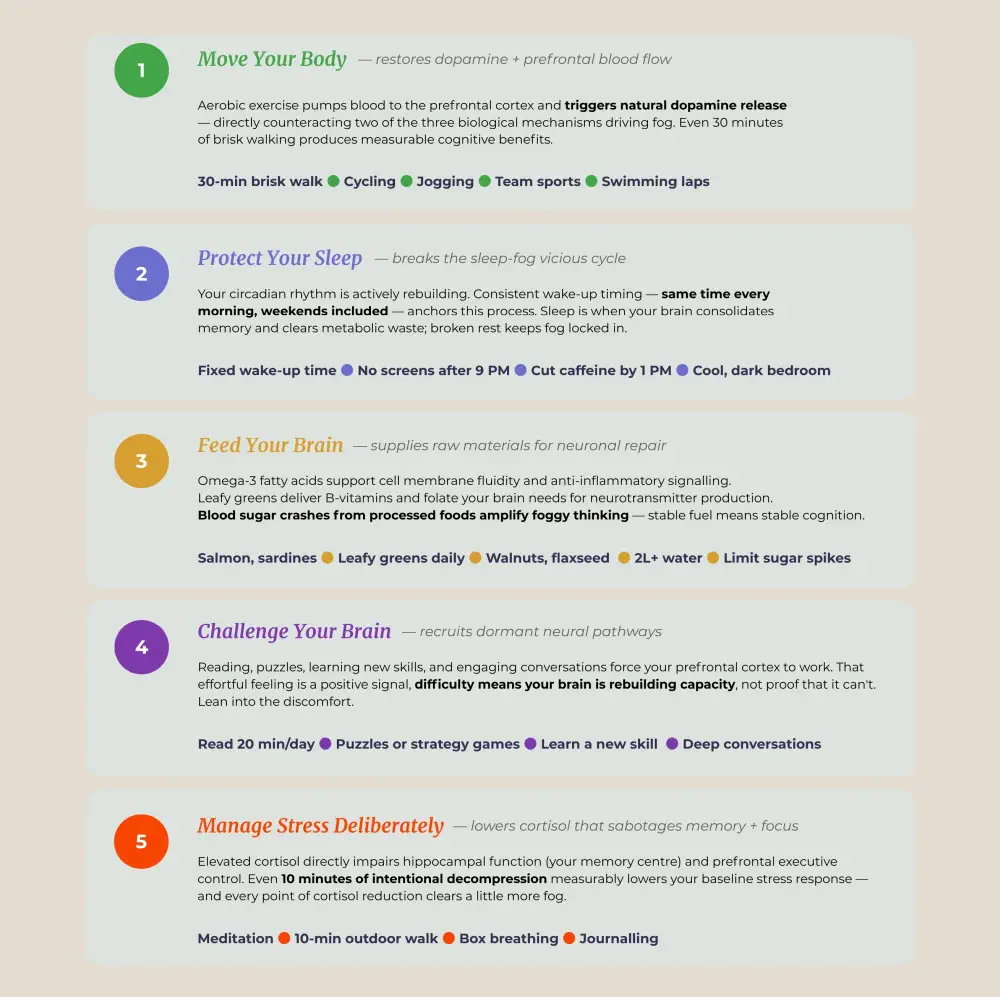
Get moving daily. A large-scale study published in The Lancet Psychiatry analysed over 1.2 million adults and found that team sports reduced the mental health burden by 22.3%, cycling by 21.6%, and aerobic gym sessions by 20.1%. You don't need intensity. Thirty minutes at a pace that gets you slightly breathless is enough. The key is showing up every day — sporadic weekend runs won't produce the same neurochemical shift that daily walks will.
Lock your wake-up time and guard it ruthlessly. Sleeping in on weekends feels like recovery, but it resets the clock your brain is trying to calibrate. Pick a time, set it in stone, and hold it even after rough nights. Screen light past 9 PM signals daytime to your brain, so swap the phone for something printed. And push your last coffee to before 1 PM, caffeine's half-life is longer than most people assume, and it competes directly with the sleep architecture your body is trying to restore.

Prioritize fats and greens over supplements. Salmon, sardines, walnuts, and flaxseed deliver omega-3s in a form your body absorbs far better than capsules. Load half your plate with leafy greens at lunch and dinner. Drink enough water that you rarely feel thirsty. One thing to cut: processed sugar. Glucose spikes and crashes mirror and worsen the cognitive instability withdrawal already creates.
Force mental effort, then sit with the discomfort. Pick up a book you've been avoiding. Work on a crossword. Start learning something new – an instrument, a language, a coding tutorial. The first ten minutes will feel like wading through concrete. That resistance is the point. Your cognitive muscles atrophied under THC; the strain means they're bearing weight again. Push through short daily sessions rather than long occasional ones.
Build a decompression ritual, small and non-negotiable. Ten minutes of box breathing after work. A short walk with no headphones. Five minutes of journalling before bed. The specific method matters less than the consistency. Your nervous system needs a predictable signal that the day's demands are over, and that signal has to come from you; it won't arrive on its own during withdrawal.

When Should You Stop Waiting and Talk to a Doctor About Post-Cannabis Fog?
Suppose brain fog after quitting weed hasn't improved after three months of abstinence, that deserves a medical conversation. So does fog accompanied by severe depression, panic attacks, or thoughts of self-harm. At that stage, the question shifts from "when will withdrawal end?" to "is something else going on?" – thyroid dysfunction, nutritional deficiencies, undiagnosed ADHD, and clinical depression can all produce cognitive cloudiness that overlaps with withdrawal but requires separate treatment.
Fatigue after quitting weed, persistent confusion, and emotional instability don't have to define your recovery. If you're worried about relapsing just to feel functional again – that's the exact moment to reach out. Contact the Canadian Centre for Addictions at 1-855-499-9446 for a free consultation. You don't have to wait for clarity alone.
FAQ
Is brain fog a normal part of cannabis withdrawal?
Yes. The DSM-5 lists "difficulty concentrating" as a diagnostic criterion for cannabis withdrawal syndrome. Fog is one of the most common cognitive complaints during withdrawal and signals your nervous system is readjusting, not malfunctioning.
Can brain fog from quitting weed cause permanent damage?
No. A meta-analysis found that cognitive deficits became statistically non-significant in studies requiring more than 72 hours of abstinence. CB1 receptor density also returns to baseline within roughly four weeks. Recovery timelines vary, but the evidence points firmly toward reversibility.
Does the type of cannabis product affect how long brain fog lasts?
Yes. Concentrates (70%+ THC) cause deeper receptor downregulation than flower. Edibles add a separate wrinkle; THC converts to 11-hydroxy-THC in the liver, a more potent and longer-lasting metabolite. Daily edible users can carry a heavier metabolite load at the point of quitting, which may stretch the fog window.
What's the difference between brain fog and fatigue after quitting weed?
Fog is a prefrontal cortex problem characterized by impaired working memory, scattered attention, and slow decision-making. Fatigue after quitting weed is a whole-body energy deficit tied to disrupted sleep architecture. Fog peaks in weeks one and two and tapers steadily. Fatigue can linger longer because sleep cycles need extra time to normalize.
Should I see a doctor about brain fog during cannabis withdrawal?
Suppose cloudiness hasn't improved well past the two-month mark, yes. Your doctor can run bloodwork for metabolic causes, screen for attention disorders that cannabis may have been masking, and assess whether depression is driving the fog on its own. Bring a written timeline of your usage and specific symptoms to make the visit more productive.
Can caffeine or supplements help clear brain fog faster?
Caffeine can temporarily sharpen focus, but overdoing it backfires, especially during withdrawal, when sleep is already fragile. Limit intake to mornings only. As for supplements, omega-3 fatty acids and magnesium have supporting evidence for general cognitive function, but no supplement has been clinically tested to speed the recovery of cannabis side effects specifically. Prioritize whole foods over pills.
Does exercise intensity matter, or is any movement helpful?
Moderate aerobic exercise(brisk walking, swimming, cycling) delivers the clearest cognitive benefits. High-intensity training can spike cortisol, which may worsen fog in the early weeks when your stress response is already heightened. Start with 30 minutes of movement you can sustain daily and gradually increase intensity as your sleep and energy stabilize.
Article sources
- Hirvonen, J., et al. (2012). "Reversible and regionally selective downregulation of brain cannabinoid CB1 receptors in chronic daily cannabis smokers." Molecular Psychiatry, 17(6), 642–649. Available at: https://pmc.ncbi.nlm.nih.gov/articles/PMC3223558/
- Diana, M., et al. (1998). "Mesolimbic dopaminergic decline after cannabinoid withdrawal." Proceedings of the National Academy of Sciences, 95(17), 10269–10273. Available at: https://pubmed.ncbi.nlm.nih.gov/9707636/
- Scott, J.C., et al. (2018). "Association of Cannabis With Cognitive Functioning in Adolescents and Young Adults: A Systematic Review and Meta-analysis." JAMA Psychiatry, 75(6), 585–595. Available at: https://pmc.ncbi.nlm.nih.gov/articles/PMC6137521/
- Chekroud, S.R., et al. (2018). "Association between physical exercise and mental health in 1.2 million individuals in the USA between 2011 and 2015: a cross-sectional study." The Lancet Psychiatry, 5(9), 739–746. Available at: https://pubmed.ncbi.nlm.nih.gov/30099000/
- Huestis, M.A., et al. (2009). "Extended urinary Δ9-tetrahydrocannabinol excretion in chronic cannabis users precludes use as a biomarker of new drug exposure." Drug and Alcohol Dependence, 118(2-3), 2011. Available at: https://pmc.ncbi.nlm.nih.gov/articles/PMC2763020/
- Sharma, P., Murthy, P., & Bharath, M.M.S. (2012). "Chemistry, metabolism, and toxicology of cannabis: clinical implications." Iranian Journal of Psychiatry, 7(4), 149–156. Available at: https://pmc.ncbi.nlm.nih.gov/articles/PMC3570572/