

We offer medical detox and multiple addiction treatment options in our
luxury treatment centres in Port Hope, Cobourg, and Ottawa.
Can Weed Cause Derealization? Effects on Mental Health

Can weed cause derealization? Absolutely. Cannabis triggers this unsettling disconnection in thousands of Canadians, leaving many wondering if they've permanently damaged their brain or lost their grip on reality.
Weed derealization happens because THC temporarily alters how your brain processes sensory information. For most people, these strange sensations fade once the high wears off. But some individuals, particularly those dealing with stress or anxiety, find these effects linger for days, weeks, or even months.
Key Takeaway:
- What derealization actually is and the crucial difference between feeling unreal and losing your grip on reality entirely—one keeps you grounded, the other doesn't
- How cannabis triggers dissociative symptoms in your brain, why some people experience lasting effects while others don't, and which specific factors increase your vulnerability
- The connection between panic attacks and derealization creates a vicious cycle where fear about symptoms makes the symptoms worse, and how to recognize this pattern
- Timeline expectations for both acute reactions (hours) and persistent symptoms (weeks to months), plus the specific warning signs that mean you need professional help immediately
- Treatment approaches that actually work, from practical grounding techniques you can use right now to therapy options with proven success rates for cannabis-induced derealization
What Is Derealization Disorder?
Derealization disorder makes the world around you feel unreal or distorted. People describe it as living in a dream, watching life through thick glass, or feeling like everything has gone flat and lifeless. Faces might look strange. Familiar places suddenly seem foreign. Time speeds up or crawls at an unnatural pace.

Here's what sets this condition apart from psychosis: you know something is wrong. People experiencing derealization maintain their grip on what's real versus what they're perceiving. They recognize the strangeness of their experience, which actually makes it more frightening. Someone with psychosis can't distinguish between reality and delusion. You can.
How Common Is This Condition?
Between 26% and 74% of people experience brief derealization episodes at some point in their lives. These temporary moments occur during extreme stress or anxiety. When these feelings persist—lasting weeks, months, or constantly recurring—it crosses into derealization disorder territory, affecting 1-2% of the population.
The condition appears alongside anxiety disorders, depression, or following traumatic experiences. Your brain creates distance from overwhelming emotions or situations. Think of it as a faulty circuit breaker that keeps tripping even after the electrical surge has passed.
How Does Cannabis Trigger Derealization Symptoms?
Cannabis precipitates derealization during intoxication for many users. THC, the psychoactive compound in weed, alters how your brain processes sensory information. Controlled studies demonstrate this effect clearly, particularly with higher-potency products flooding Canadian dispensaries today.
Most people experience weed derealization that peaks around 30 minutes after consumption, then gradually fades over the next few hours. Your perception returns to normal. No lasting effects.
A small group develops ongoing reactions. Research published in the American Journal of Psychiatry found that among 89 individuals who experienced prolonged derealization following cannabis use, 28% had used marijuana between 100 and 500 times before these sensations appeared.
Even regular users aren't immune. Sudden onset correlates with periods of intense life stress like divorce, job loss, or relationship problems.
Several factors increase your vulnerability to persistent weed derealization:
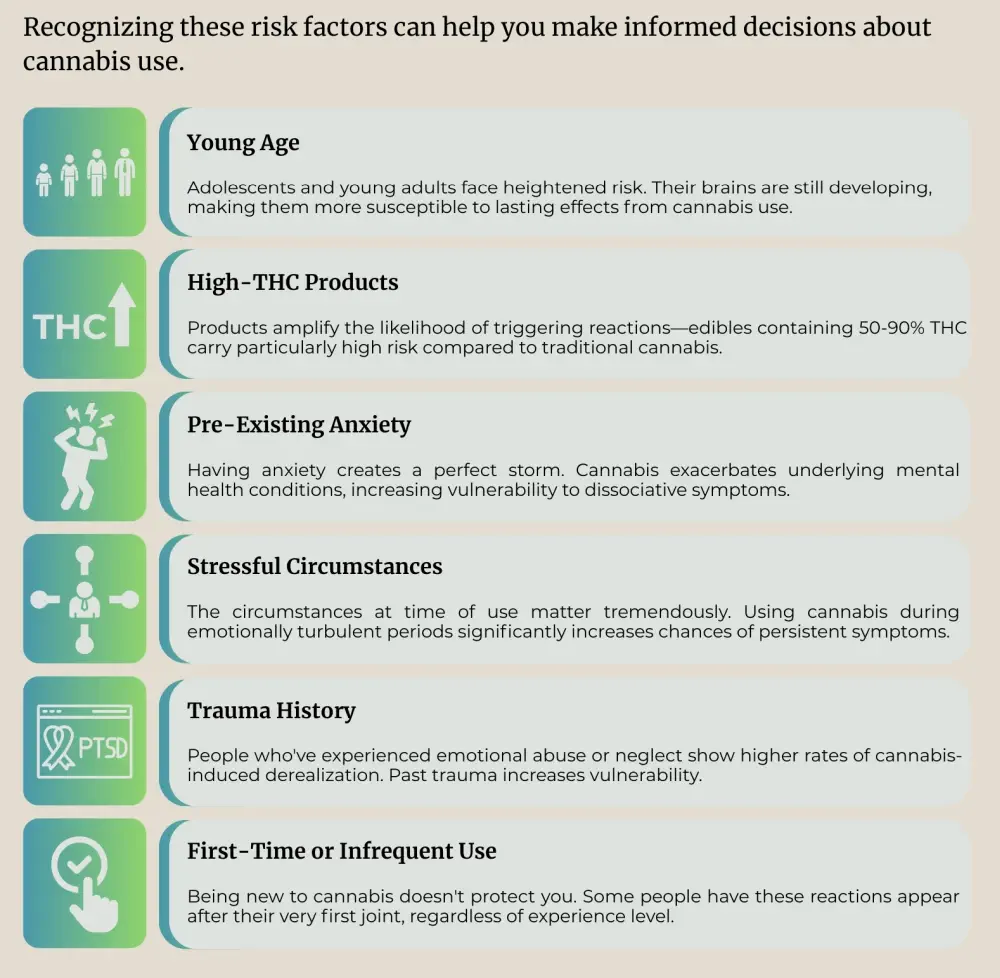
Trigger vs. Universal Cause
Cannabis acts as a trigger for vulnerable individuals, not a universal cause affecting everyone who uses it. Your mental state, stress levels, and genetic predisposition all influence whether you'll experience lasting reactions.
How Do Panic Attacks Make Derealization Worse?
Between 3.3% and 20% of people living with anxiety disorders experience dissociative sensations. If you've ever had a panic attack, you know how terrifying the physical reactions feel—racing heart, difficulty breathing, chest tightness, tingling in your extremities.
Add derealization panic attack sensations to that mix, and the experience becomes exponentially more frightening. The world suddenly feels unreal during your body's danger response. You can't distinguish whether you're having a medical emergency or losing your mind.
The Vicious Cycle
Derealization appears during panic attacks because both stem from the same root: your nervous system's stress response gone haywire. When anxiety peaks, your brain sometimes creates psychological distance from the overwhelming experience. You feel detached from your surroundings as a protective mechanism.
This creates a vicious cycle. The panic attack triggers derealization. The strange, unreal sensations intensify your fear. You become more anxious about experiencing derealization, which makes panic attacks more likely. Round and round it goes, each episode reinforcing the pattern.
What to Expect During an Episode
Most derealization panic attack episodes peak within 10 minutes and last 5-20 minutes total. During those minutes, time distorts. Five minutes can feel like an hour. The physical reactions (rapid heartbeat, sweating, trembling) combine with the psychological sensation of unreality to create an experience people describe as "soul-crushing" or "existential terror."
These sensations won't cause permanent brain damage. They feel catastrophic but aren't dangerous to your physical or mental health. Recognizing this distinction helps break the fear cycle that perpetuates both panic attacks and derealization.

How Long Does Weed-Induced Derealization Last?
Derealization after weed usually follows a predictable timeline for most users. Sensations start 15-30 minutes following consumption, matching when THC peaks in your bloodstream. The strange feelings intensify over the next 30-60 minutes, then gradually subside over 2-4 hours as the high wears off. Your perception returns to baseline. Life feels normal again.
For individuals who have ongoing reactions, the story unfolds differently. Their initial cannabis-induced derealization occurs (usually during a period of high stress), and the sensations stick around. Days pass. Weeks. Sometimes months.
The persistent form presents as episodic more than constant. You'll have good days when the world feels mostly normal, then wake up to find everything slightly off again. Severity fluctuates unpredictably. Some mornings you feel clear-headed. Other times, the fog descends without warning.
Patterns emerge. Stress, lack of sleep, caffeine, or even thinking about the sensations can bring on episodes. Many people have intense fear around their reactions, constantly checking whether they still feel "real," which ironically makes the experience worse.
Several warning signs indicate you need professional help immediately:
- Effects persist beyond two weeks after stopping cannabis use.
- Your daily functioning takes a hit—you can't concentrate at work, maintain relationships, or handle routine tasks.
- Severe distress or suicidal thoughts appear.
- You avoid activities or places because they initiate derealization episodes.
Recovery Is Possible
Most people experiencing persistent weed derealization do recover, especially when they get early treatment. Waiting months or years before seeking help makes recovery longer and more difficult. Your brain has reinforced the dissociative patterns, creating deeper neural pathways that require more effort to rewire.
Statistics provide hope: controlled trials show that people who engage with cognitive behavioural therapy and stop using cannabis see substantial improvement. The timeline varies by individual, but many people notice meaningful changes within a few months. Some residual sensations may linger longer, but the overwhelming distress and functional impairment generally resolve with appropriate support.
What Are Your Options for Managing Derealization?
Cognitive Behavioural Therapy stands out as the most effective treatment for cannabis-induced derealization. CBT helps you reframe catastrophic thoughts about your reactions. Instead of "I've permanently damaged my brain" or "I'll never feel normal again," you learn to recognize these experiences as temporary, treatable responses.Therapy teaches practical grounding techniques that pull you back into your body and the present moment. When an episode hits, try the 5-4-3-2-1 method: Name five things you see, four things you can touch, three sounds you hear, two things you smell, one thing you taste. Run cold water over your hands. Hold ice cubes. Play music loud enough to feel the vibrations.

Physical movement interrupts the dissociative state. Walk outside. Do jumping jacks. The goal is to force your brain to pay attention to concrete, physical sensations that anchor you in reality.
Mindfulness practice helps, though it feels counterintuitive when you're desperate to stop focusing on how you feel. Regular meditation builds your capacity to observe sensations without spiralling into panic about them. You notice "I'm experiencing derealization" without the catastrophic interpretation that amplifies distress.
Medication doesn't cure derealization directly. SSRIs address underlying anxiety and depression that accompany or trigger dissociative reactions. Some people find that managing their baseline anxiety reduces the frequency and intensity of derealization episodes. Your doctor can discuss whether medication might help your specific situation.
FAQ
Can weed cause permanent derealization?
Most cannabis-induced derealization is temporary and treatable. Some individuals experience lingering sensations for months, but research shows the condition responds well to therapy. Most people recover fully with appropriate support and treatment.
How long does derealization last after smoking weed?
For the majority, sensations fade within 2-4 hours as THC leaves the system. Vulnerable individuals—particularly those under stress or with anxiety disorders—may experience lingering effects for days, weeks, or longer, requiring professional intervention.
What should I do during a derealization episode?
Use immediate grounding techniques: Hold something cold, listen to loud music, or name objects around you. Deep breathing helps regulate your nervous system. These sensations are temporary and not dangerous, despite how frightening they feel.
Is derealization the same as psychosis?
No. Derealization leaves your reality testing intact; you recognize that something feels wrong. People experiencing psychosis lose the ability to distinguish between what's real and what isn't. This difference matters for both diagnosis and treatment.
Should I stop using cannabis if I experience derealization?
Yes. Continued cannabis use worsens or prolongs these reactions. Stopping marijuana allows your brain's natural recovery processes to function. If you've experienced derealization after weed, avoiding cannabis significantly reduces the likelihood of recurring episodes and supports healing.
Article sources
- Sierra, M., & David, A.S. (2011). "Depersonalization: A selective impairment of self-awareness." Consciousness and Cognition, 20(1), 99-108. Available at: https://pmc.ncbi.nlm.nih.gov/articles/PMC11910194/
- Hürlimann, F., et al. (2012). "Cannabis-induced depersonalization disorder in adolescence." Neuropsychobiology, 65(3), 141-146. Available at: https://psychiatryonline.org/doi/10.1176/appi.ajp-rj.2018.130202
- Hunter, E.C.M., et al. (2004). "The epidemiology of depersonalisation and derealisation: A systematic review." Social Psychiatry and Psychiatric Epidemiology, 39(1), 9-18. Available at: https://pmc.ncbi.nlm.nih.gov/articles/PMC10132272/
- Simeon, D., et al. (2003). "Depersonalisation disorder: a contemporary overview." CNS Drugs, 17(5), 343-354. Available at: https://pubmed.ncbi.nlm.nih.gov/12665391/
- Medford, N., et al. (2005). "Understanding and treating depersonalisation disorder." Advances in Psychiatric Treatment, 11(2), 92-100. Available at: https://www.cambridge.org/core/journals/advances-in-psychiatric-treatment
- Freeman, D., et al. (2015). "Cannabis use predicts psychotic symptoms in young people: A longitudinal study." Psychological Medicine, 45(1), 1-11. Available at: https://dc.etsu.edu/asrf/2022/schedule/47/
- Hunter, E.C.M., et al. (2003). "Depersonalisation disorder: A cognitive-behavioural conceptualisation." Behaviour Research and Therapy, 41(12), 1451-1467. Available at: https://pmc.ncbi.nlm.nih.gov/articles/PMC10132272/
- National Institute on Drug Abuse. (2023). "Cannabis (Marijuana) Research Report: What are marijuana's effects?" U.S. Department of Health and Human Services. Available at: https://nida.nih.gov/publications/research-reports/marijuana