
We offer medical detox and multiple addiction treatment options in our
luxury treatment centres in Port Hope, Cobourg, and Ottawa.
What is Dopamine Addiction?

The term "dopamine addiction" floods wellness blogs and self-help forums. People blame this brain chemical for everything from phone obsession to gambling problems.
But here's what most sources get wrong: you can't actually become addicted to dopamine itself.
The real issue involves how certain behaviours hijack your brain's dopamine reward system, creating compulsive behaviour patterns that feel impossible to break.

Key Takeaway:
- Why "dopamine addiction" is a misleading term — the scientific truth about what you're actually addicted to and why this distinction matters for recovery
- How your "want" system hijacks your behaviour — Why dopamine drives you to seek rewards before you even experience pleasure, and how this creates compulsive patterns
- The real reason you can't stop despite knowing better — How drugs, gambling, social media, and sex all exploit the same brain mechanism through different pathways
- Which warning signs separate enjoyment from true addiction — Recognize the four critical indicators that your behaviour has crossed from occasional indulgence into problematic territory
- Why tolerance makes everything feel hollow — The neurological changes that force you to need more stimulation just to feel normal
- How the pleasure-pain balance traps you in deficit — Why withdrawal feels worse than before you started, and what recovery actually requires
What Role Does Dopamine Play in Your Brain?
Dopamine functions as a motivational neurotransmitter that drives you to seek rewards, not a pleasure chemical that creates happiness. This distinction matters enormously. Dopamine is released when anticipating something rewarding, not during the reward itself. Think of it as your "want" system rather than your "like" system.
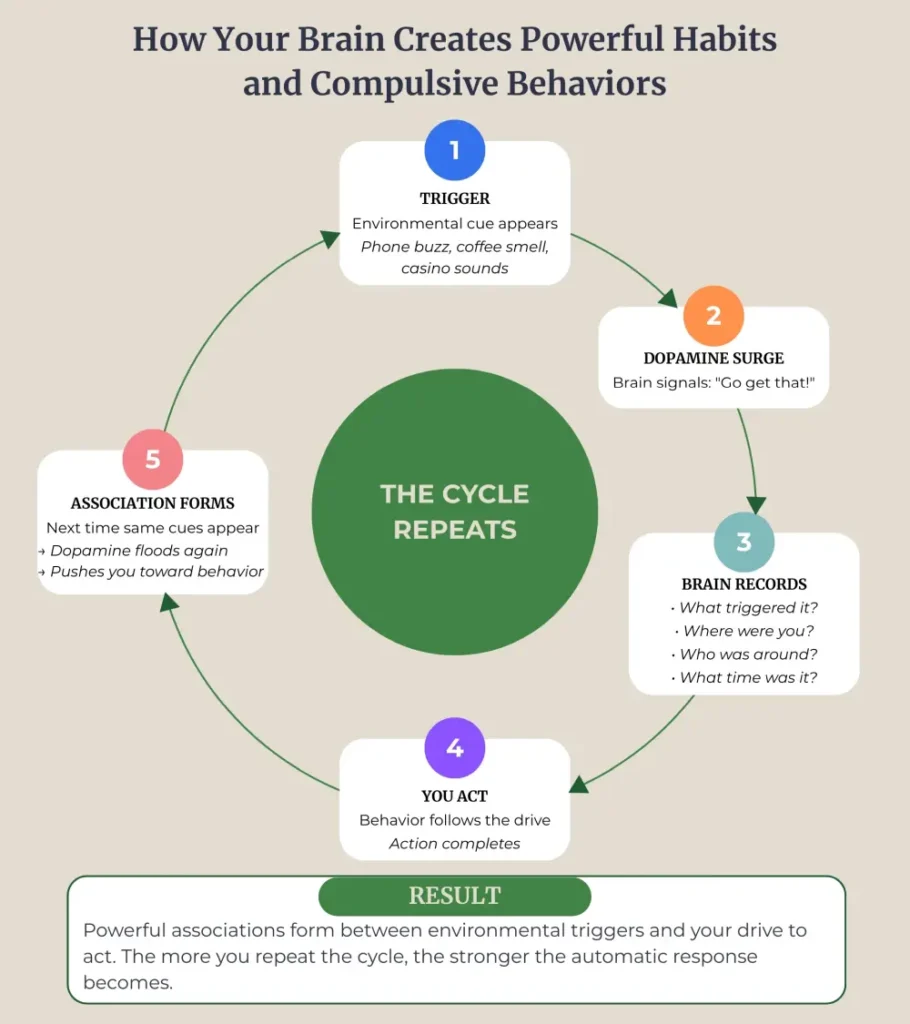
When you smell fresh coffee brewing or hear your phone notification, dopamine surges. Your mind says, "Go get that." This neurotransmitter helped our ancestors survive. It motivated them to search for food, seek shelter, and form social bonds. Today, that same system responds to text messages, likes on social media, and the ding of slot machines.
How Your Brain Learns and Remembers Rewards
Research published in the Journal of Biomedical Science shows dopamine enables "long-term potentiation", basically, it helps your brain remember and repeat rewarding experiences. Without dopamine, animals lose the ability to learn which actions lead to rewards. They can still enjoy food placed in their mouths, but they won't search for it.
Dopamine doesn't work alone. Endorphins, serotonin, and oxytocin actually create feelings. Dopamine just reinforces behaviours by linking actions with anticipated rewards. When people talk about dopamine addiction, they really mean becoming dependent on activities that trigger this anticipation-reward cycle.
Modern Technology Hijacks Your Reward System
Modern life bombards you with dopamine triggers constantly. Social media platforms engineer their feeds to deliver unpredictable rewards, exactly like slot machines. Video games offer achievement systems that tap into your brain's reward circuits. Even shopping apps use notifications timed to maximize your response. These aren't accidents. Tech companies employ neuroscientists specifically to make their products more "sticky" by exploiting how dopamine motivates behaviour.
Natural vs. Supernormal Stimulation
Natural rewards (eating nutritious food, connecting with friends, exercising) increase dopamine by 50-100%. Addictive substances trigger much larger spikes: cocaine produces about three times that effect, while methamphetamine can cause twelve times more dopamine release than food or social connection. Evolution designed our brains for moderate rewards, not this level of overstimulation.

Can You Actually Be Addicted to Dopamine?
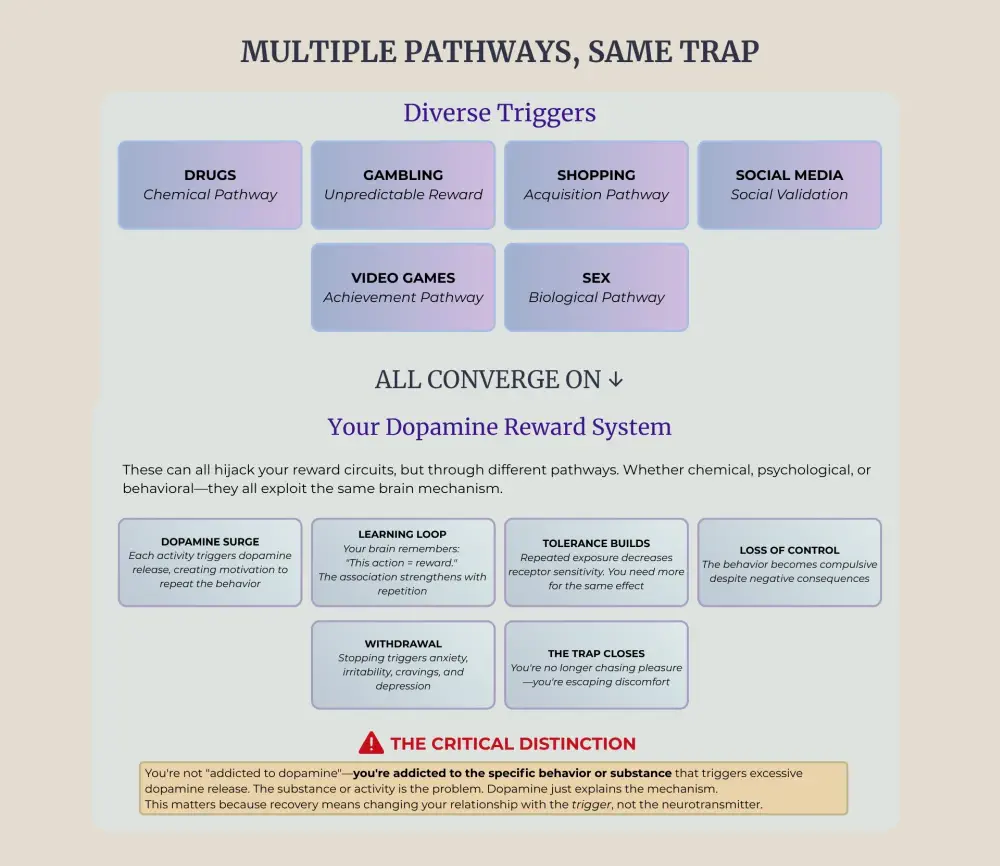
No, you cannot be addicted to dopamine itself since it's a naturally occurring brain chemical. However, you can become dependent on activities or substances that overstimulate your brain's dopamine pathways, leading to compulsive behaviour despite negative consequences.
This terminology matters more than semantics suggest. Recognizing you're not "addicted to dopamine" but rather to specific triggers helps you identify what actually needs changing. A person isn't dependent on the neurotransmitter—they're hooked on scrolling Instagram, playing online poker, or using cocaine. The substance or behaviour remains the problem; dopamine just explains how it works.
How Compulsive Behaviour Develops
Compulsive behaviour emerges when reward systems are repeatedly overstimulated. First, you discover something that feels rewarding. Dopamine releases, creating motivation to repeat the experience. You do it again. And again. Eventually, dopamine receptor sensitivity decreases or natural production drops. Now you need more stimulation just to feel normal.
Dr. Anna Lembke, Stanford psychiatrist and addiction specialist, describes this as a "dopamine deficit state." When repeatedly exposed to pleasure-producing stimuli, your brain adjusts, and you eventually need more just to feel baseline. That's when your "drug of choice", actual drugs or behaviours, stops getting you high and just makes you feel normal.
Medical Definition of Addiction
The American Society of Addiction Medicine defines addiction as a chronic brain disease involving reward, memory, and motivation systems. Addiction involves dysfunction in these systems, not simply enjoying something. True addiction includes several components:
- Craving or a strong urge to engage in the behaviour
- Loss of control over the behaviour
- Continuing despite negative consequences
- Tolerance—needing more for the same effect
- Withdrawal symptoms when stopping
Addiction symptoms involving dopamine pathways manifest differently depending on what triggers the response. Someone who compulsively shops faces different challenges than someone gaming excessively or using stimulants. Yet the underlying brain systems show remarkable similarities.
Research from the Frontiers in Neural Circuits journal reveals that dopamine circuits in the brain create both the "pull" toward seeking rewards and the "push" toward rigid, feedback-insensitive actions. Early in addiction, dopamine signals the value of substances or behaviours. Later, it drives compulsive seeking regardless of consequences.
What Are the Warning Signs of Behavioural Addiction?
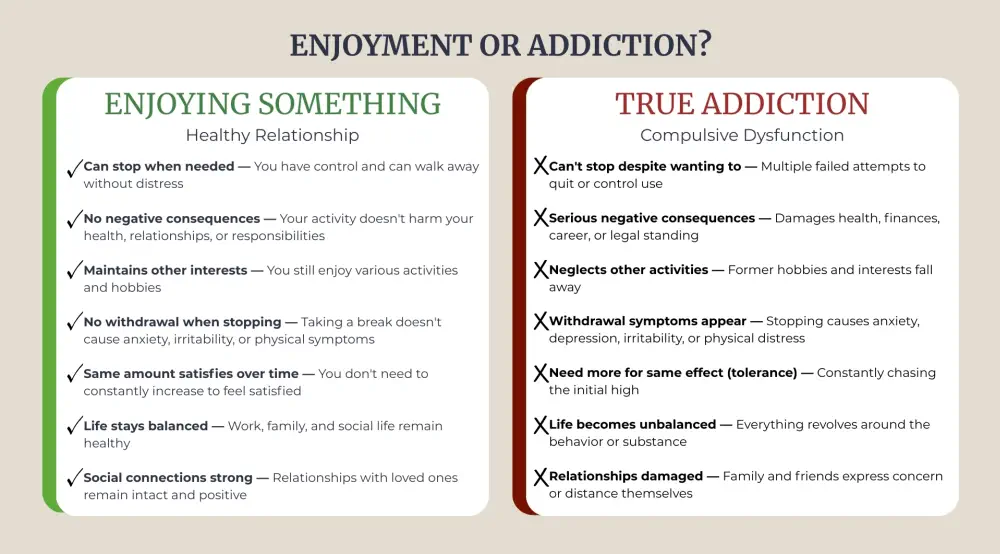
Key warning signs include intense cravings for specific activities, inability to control urges, continuing harmful behaviours despite consequences, and withdrawal symptoms like irritability or depression when unable to engage.
Recognizing symptoms of dopamine dysregulation helps you determine if patterns have crossed from occasional indulgence into problematic territory. Not everyone who enjoys social media or video games has an addiction. The difference lies in control, consequences, and compulsion.
Specific compulsive behaviour manifestations vary:
- Digital/social media addiction: Checking your phone hundreds of times daily, panicking when the battery dies, choosing screens over face-to-face interaction, sleep deprivation from late-night scrolling, and anxiety about missing updates.
- Gaming disorder: Playing despite work/school/relationship consequences, lying about time spent gaming, using games to escape negative emotions, withdrawal symptoms when unable to play, and tolerance requiring more playing time.
- Shopping addiction: Buying things you don't need or can't afford, hiding purchases from family, feeling temporary euphoria followed by guilt, financial problems from overspending, and shopping to manage stress or sadness.
- Food-related issues: Using highly palatable foods for emotional regulation, eating beyond physical hunger, feeling out of control around certain foods, eating in secret, and weight fluctuations affecting health.
- Substance-related patterns: Needing substances to feel normal, using more than intended, unsuccessful attempts to cut down, spending significant time obtaining or recovering from use, giving up activities due to use.
Physical and Psychological Symptoms
Physical and psychological symptoms often overlap. Depression frequently accompanies compulsive behaviour patterns because overstimulated reward circuits stop responding to normal pleasures. You can't enjoy a sunset, a good conversation, or a meal with friends because your brain only responds to intense stimulation.
Research published in Frontiers in Psychiatry found that anxiety affects 53.9% and depression affects 58.1% of people with reward-system-related disorders. The constant worry about others' perceptions creates chronic stress, which ironically drives more compulsive seeking of dopamine-triggering activities.
Anhedonia (the inability to feel pleasure from normally enjoyable activities) stands out as a hallmark symptom. You go through motions of hobbies, socializing, or exercise, but nothing clicks. Only your problematic behaviour provides that spark. This creates a vicious cycle: the more you rely on one dopamine source, the less everything else satisfies you.
How Does the Dopamine Reward System Create Compulsive Behaviour?
The dopamine reward system creates compulsive behaviour through a learning loop that associates environmental cues with anticipated rewards, then strengthens those associations each time you repeat the pattern. Over time, these learned behaviours take priority over healthier activities.
Certain situations trigger overwhelming cravings for this reason. Walking past a casino, opening your laptop at night, feeling stressed at work—these cues activate dopamine pathways linked to habitual responses. Thinking hasn't caught up, but reward systems are already pushing toward action.
How Tolerance Builds in Your Brain
Tolerance builds as adaptation to repeated overstimulation occurs. Two changes happen:
- First, dopamine receptor availability decreases. Think of receptors as parking spots for dopamine molecules. Constant flooding means the brain removes parking spots to prevent overload. Fewer receptors mean regular dopamine releases produce weaker effects. More stimulation becomes necessary for the same response.
- Second, natural dopamine production drops. Why manufacture what's coming from external sources? This creates a deficit state. Without the behaviour or substance, dopamine levels drop below baseline. You don't just miss the high; you feel worse than before starting.
The Pleasure-Pain Balance
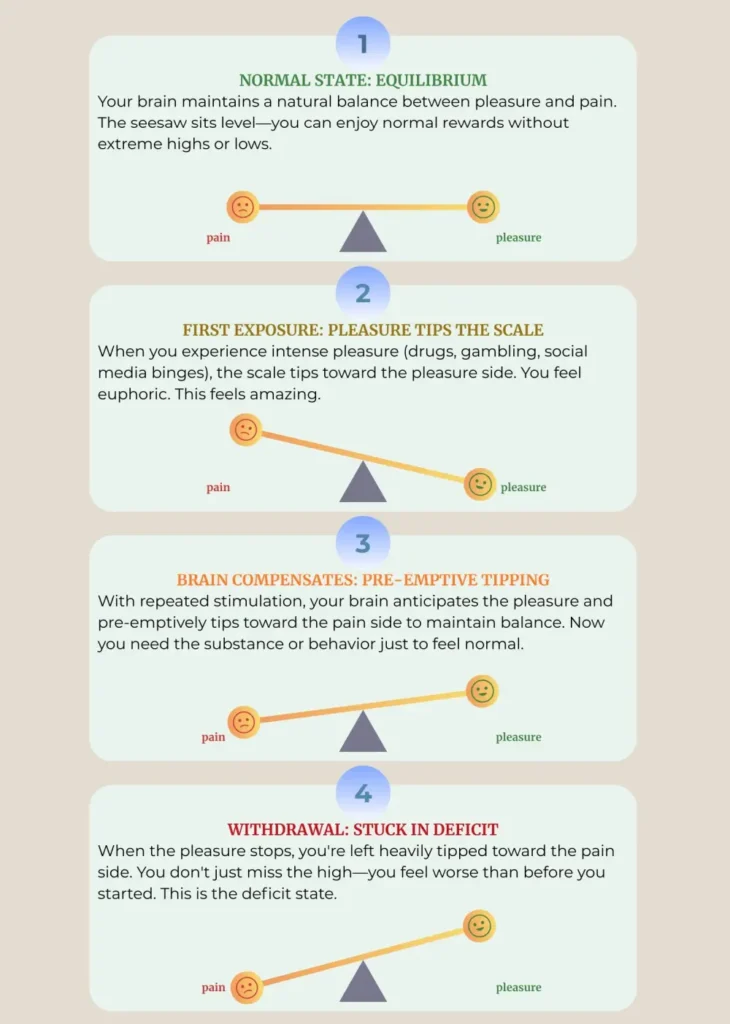
Dr. Lembke's research shows this pleasure-pain balance at work. The brain maintains equilibrium. Pleasure tips the scale one direction, triggering countermeasures that tip it back. With repeated stimulation, pre-emptive tipping toward the pain side occurs, anticipating pleasure's arrival. When pleasure stops, you're left in deficit—experiencing anxiety, irritability, insomnia, and intense cravings.
Different Substances, Same System
Research in addiction neuroscience reveals how different substances and behaviours exploit this system at different intensities. Amphetamines and cocaine cause massive dopamine surges. Nicotine and alcohol produce moderate increases. Cannabis, caffeine, and behavioural addictions show weaker but still substantial effects. Yet all can create problematic patterns because the core principle (learned associations strengthened by dopamine) stays the same.
Compulsive behaviour intensifies because dopamine also affects your prefrontal cortex(the brain region controlling decision-making, impulse control, and judgment). Chronic overstimulation impairs this "braking system." You recognize harmful patterns but struggle to stop because neural circuits controlling impulses aren't functioning normally.
Can You Manage Dopamine Addiction on Your Own?
Self-management can work for mild to moderate behavioural patterns, but substance-related issues and severe compulsive behaviours usually require professional treatment. Many people successfully modify problematic behaviours through self-directed changes, while others delay necessary intervention by trying alone repeatedly.
Many people successfully modify problematic behaviours through self-directed changes. Others try repeatedly and fail, making their situation worse by delaying professional intervention. Figuring out which category you fall into determines your best path forward.

Good Candidates for Self-Management
Mild behavioural patterns caught early respond best to personal intervention. If you've noticed you're spending too much time on your phone but it hasn't derailed your job or relationships yet, implementing boundaries might suffice. If online shopping has become a bit much, but you're not facing bankruptcy, self-imposed limits could help.
Dr. Cameron Sepah's dopamine fasting method(despite its misleading name) offers a structured framework. Take 30 days completely away from your problematic behaviour. This doesn't permanently eliminate it, but the initial break helps reset your brain's reward response. Your dopamine receptors begin recovering sensitivity. You start enjoying simpler pleasures again.
Practical Self-Management Techniques
- Create distance from temptation: Delete apps, remove credit cards from shopping sites, and block gaming websites during work hours.
- Set strict time limits: Social media only between 8-9 PM. Video games maximum of two hours on weekends. Time constraints provide structure.
- Eliminate problematic versions only: Instagram destroys productivity, but LinkedIn doesn't? Keep LinkedIn, delete Instagram.
- Change your environment: Study at the library instead of at home. Keep your phone in another room while working. Take different routes, avoiding gambling establishments.
- Build accountability: Tell trusted friends your goals. Use apps that track screen time and send reports to accountability partners.
The first two weeks prove hardest. Cravings intensify. Everything feels boring. Around the three-to-four week mark, most people notice real shifts. Modest rewards start satisfying again, cravings decrease, and life feels more balanced.
Red Flags That Require Professional Help
Substance dependencies almost always require professional treatment due to dangerous withdrawal symptoms. Attempting detox alone from benzodiazepines or alcohol can cause life-threatening seizures. Severe behavioural addictions causing job loss, relationship damage, or financial crisis need professional intervention too.
Seek help if you experience:
- Multiple failed quit attempts
- Severe withdrawal symptoms
- Using behaviours to cope with trauma or mental health conditions
- Suicidal thoughts
- Physical health problems or legal issues
- Seriously impaired family or work life
Addiction involves brain chemistry and learned behaviours—not willpower. Professional guidance provides tools that dramatically improve success rates.
Can You Reclaim Control of Your Reward System?
Dopamine addiction (more accurately, addiction to behaviours and substances that overstimulate dopamine pathways) affects millions of Canadians daily. From social media scrolling to substance dependencies, these patterns share common roots in how your brain handles reward and motivation.
Recognizing that you're not "addicted to dopamine" itself but to specific triggers empowers you to target what actually needs changing. Spotting compulsive behaviour patterns early improves outcomes through self-directed methods or professional treatment.
Mild behavioural patterns might respond to dopamine fasting, environmental changes, and accountability systems. But don't let pride or stigma prevent you from seeking help when needed. Substance dependencies, severe behavioural addictions, and patterns rooted in mental health conditions usually require professional support.
The Canadian Centre for Addictions offers comprehensive assessment and treatment for all forms of addictive behaviours and substance dependencies. Our team understands the neuroscience behind compulsive behaviour while providing compassionate, individualized care. Whether you need guidance managing digital dependencies or intensive treatment for substance use, we're here to help.
FAQ
Is dopamine addiction a real medical diagnosis?
No, "dopamine addiction" isn't an official medical diagnosis. You can't be addicted to dopamine itself since it's a naturally occurring neurotransmitter. However, people can become dependent on activities or substances that overstimulate dopamine pathways, creating patterns that mirror traditional addiction.
How long does it take to reset your dopamine levels?
Recovery timelines vary based on the severity and type of addiction, but most people notice improvements after 3-4 weeks of abstinence from problematic behaviours. Dr. Lembke's research shows that about 30 days allows dopamine pathways to reset, with continued improvement over several months of sustained behaviour change.
Can you have behavioural addiction symptoms without using drugs?
Absolutely. Behavioural addictions to social media, gaming, gambling, shopping, or food can create the same dopamine dysregulation patterns as substance use. These behaviours may not involve chemicals, but they still overstimulate your brain's reward system and create compulsive patterns.
What's the difference between liking something and being addicted to it?
Liking involves enjoying an activity without loss of control or negative consequences. Addiction includes intense cravings, inability to stop despite harm, tolerance requiring more for the same effect, and withdrawal symptoms when stopping. True addiction disrupts your life significantly.
Does dopamine fasting actually work?
Modified dopamine fasting and taking breaks from overstimulating behaviours can help reset your brain's reward sensitivity for mild to moderate patterns. However, the concept is somewhat misleading since you can't actually fast from dopamine. The technique works by reducing overstimulation rather than depleting dopamine levels.
When should I seek professional help for compulsive behaviour?
Seek professional help if you've tried stopping multiple times unsuccessfully, if the behaviour causes serious life problems (job loss, relationship damage, financial crisis), if you experience severe withdrawal symptoms, or if you're using the behaviour to cope with mental health conditions like depression or trauma.
Article sources
- Bromberg-Martin, E.S., Matsumoto, M., & Hikosaka, O. (2010). "Dopamine in motivational control: rewarding, aversive, and alerting." Neuron, 68(5), 815-834. Available at: https://pmc.ncbi.nlm.nih.gov/articles/PMC3032992/
- American Society of Addiction Medicine. (2019). "Definition of Addiction." Available at: https://www.asam.org/quality-care/definition-of-addiction
- Volkow, N.D., Michaelides, M., & Baler, R. (2019). "The Neuroscience of Drug Reward and Addiction." Physiological Reviews, 99(4), 2115-2140. Available at: https://journals.physiology.org/doi/full/10.1152/physrev.00014.2018
- Juarez Olguín, H., Calderon Guzmán, D., Hernández García, E., & Barragán Mejía, G. (2016). "The Role of Dopamine and Its Dysfunction as a Consequence of Oxidative Stress." Oxidative Medicine and Cellular Longevity, 2016:9730467. Available at: https://pmc.ncbi.nlm.nih.gov/articles/PMC4684895/
- Paulus, M.P., & Stewart, J.L. (2014). "Interoception and drug addiction." Neuropharmacology, 76 Pt B, 342-350. Available at: https://pmc.ncbi.nlm.nih.gov/articles/PMC3906142/
- Di Chiara, G., & Imperato, A. (1988). "Drugs abused by humans preferentially increase synaptic dopamine concentrations in the mesolimbic system of freely moving rats." Proceedings of the National Academy of Sciences, 85(14), 5274-5278. Available at: https://www.pnas.org/doi/10.1073/pnas.85.14.5274
- Berridge, K.C., & Robinson, T.E. (2016). "Liking, wanting, and the incentive-sensitization theory of addiction." American Psychologist, 71(8), 670-679. Available at: https://pubmed.ncbi.nlm.nih.gov/27977239/
- Koob, G.F., & Volkow, N.D. (2016). "Neurobiology of addiction: a neurocircuitry analysis." The Lancet Psychiatry, 3(8), 760-773. Available at: https://www.thelancet.com/journals/lanpsy/article/PIIS2215-0366(16)00104-8/fulltext
- Nutt, D.J., Lingford-Hughes, A., Erritzoe, D., & Stokes, P.R. (2015). "The dopamine theory of addiction: 40 years of highs and lows." Nature Reviews Neuroscience, 16(5), 305-312. Available at: https://pubmed.ncbi.nlm.nih.gov/25873042/