

We offer medical detox and multiple addiction treatment options in our
luxury treatment centres in Port Hope, Cobourg, and Ottawa.
How Enabling Someone Can Hinder Recovery?

The person you love struggles with addiction, and you scramble to keep their life from falling apart. Each rescue feels necessary. Each excuse sounds reasonable in the moment. But here's what most people don't realize: your well-intentioned actions might be the very thing stopping your loved one from getting better.
Enabling someone doesn't make you a bad person. You care deeply. You want to protect someone you love from pain. That instinct runs deep in all of us. However, when addiction enters the picture, traditional helping strategies backfire in ways that feel counterintuitive and cruel.
Key Takeaway:
- Which everyday behaviours count as enabling — and why actions that feel like normal family support might be preventing your loved one from seeking the help they desperately need.
- The hidden emotional forces driving your enabling patterns — including the specific fears and guilt that keep you trapped in behaviours you know aren't working.
- The exact distinction between helping and enabling — so you can finally tell whether your actions create accountability that motivates change or remove consequences that allow addiction to continue.
- The measurable damage enabling causes over time, including how families typically waste 3-7 years before seeking treatment, while their loved one's condition progressively worsens.
What Does Enabling an Addict Mean?
Enabling means doing things for someone that they can and should handle themselves. The definition sounds simple until you're living it. Enabling behaviour takes many forms. Some are obvious. Others hide behind what looks like normal family support:
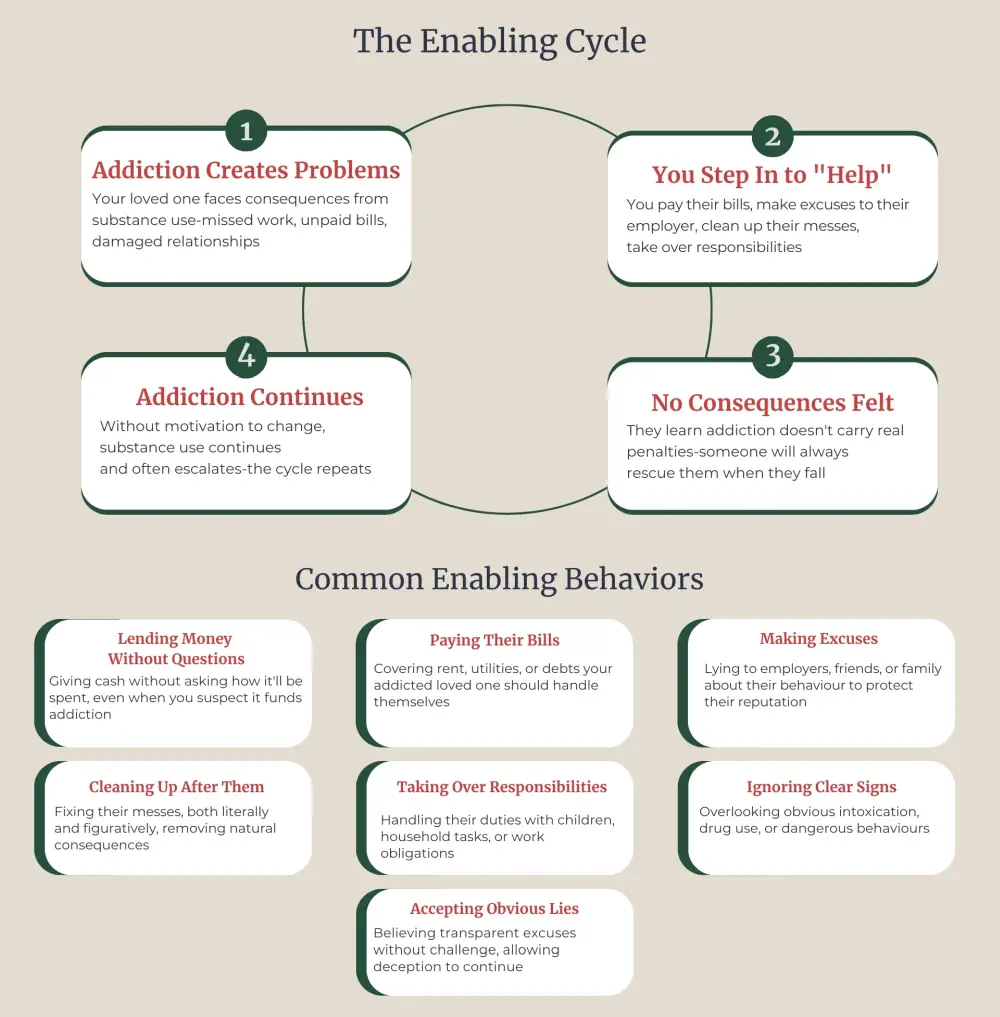
Each action removes one more reason for them to face reality. Anything you do that allows the addicted person to keep using substances without consequences counts as enabling.
Why Do Loved Ones Enable?
Most enablers would never describe themselves that way. They see themselves as supportive, caring, protective—everything a good parent or partner should be. So what drives these patterns?
Fear sits at the centre. Many family members enable because they believe that helping keeps their loved one safe and helps them know where they are. Watching them hit rock bottom instead feels like it would be too much to handle. Parents especially struggle with this. Every instinct screams at you to protect your child, regardless of their age.
Guilt plays a powerful role. Did you miss warning signs? Were you too strict or too lenient during their childhood? These questions haunt enablers, driving them to "make up for" perceived failures through excessive caretaking.
Denial works both ways. Sometimes enablers can't admit the problem exists. Perhaps you focus on the positive things your loved one does to forget about their negative habits. If you don't acknowledge the addiction, you don't have to deal with it. Enabling lets you maintain this comfortable fiction a little longer.
Control feels achievable. Your reaction may be trying to gain control and get them back to normal. You think that if you just manage things correctly—pay this bill, smooth over that situation, you can stabilize their life enough for recovery to happen naturally. It doesn't work that way.
Family members may even fear having the truth exposed about their loved one's addiction and related family dysfunction. Enabling keeps everyone's secrets buried. Your child maintains their reputation. Your family appears functional. Nobody has to confront the painful reality that professional help is needed.
What Separates True Help from Enabling Behaviour?
This question torments family members trying to support an addicted loved one. The line blurs easily because both actions spring from the same source: love. But the outcomes couldn't be more different.
Enabling removes consequences. It shields someone from the results of their actions, allowing addiction to continue without discomfort. You become a buffer between your loved one and reality.
Helping promotes accountability. It supports someone while requiring them to face the natural results of their choices. You stand beside them through difficulties rather than rescuing them from those difficulties.
Consider these contrasts:
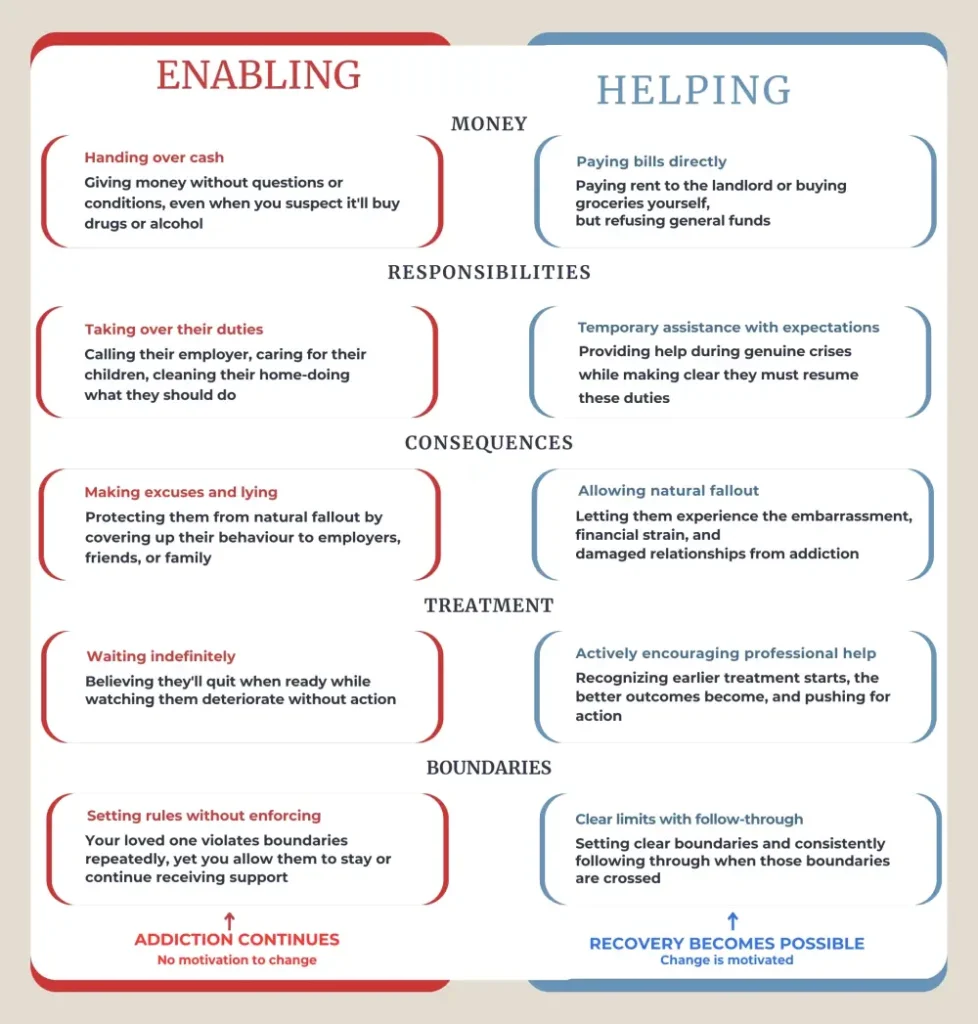
The fundamental difference? Enabling makes an addict's struggle harder by removing any urgency to change. Helping creates discomfort that motivates genuine change.
This distinction feels brutal when you're living it. Watching someone you love struggle cuts deep. Every fibre of your being wants to make their pain stop. But addiction doesn't respond to kindness alone. It requires consequences.
What Damage Does Enabling Cause to Recovery?
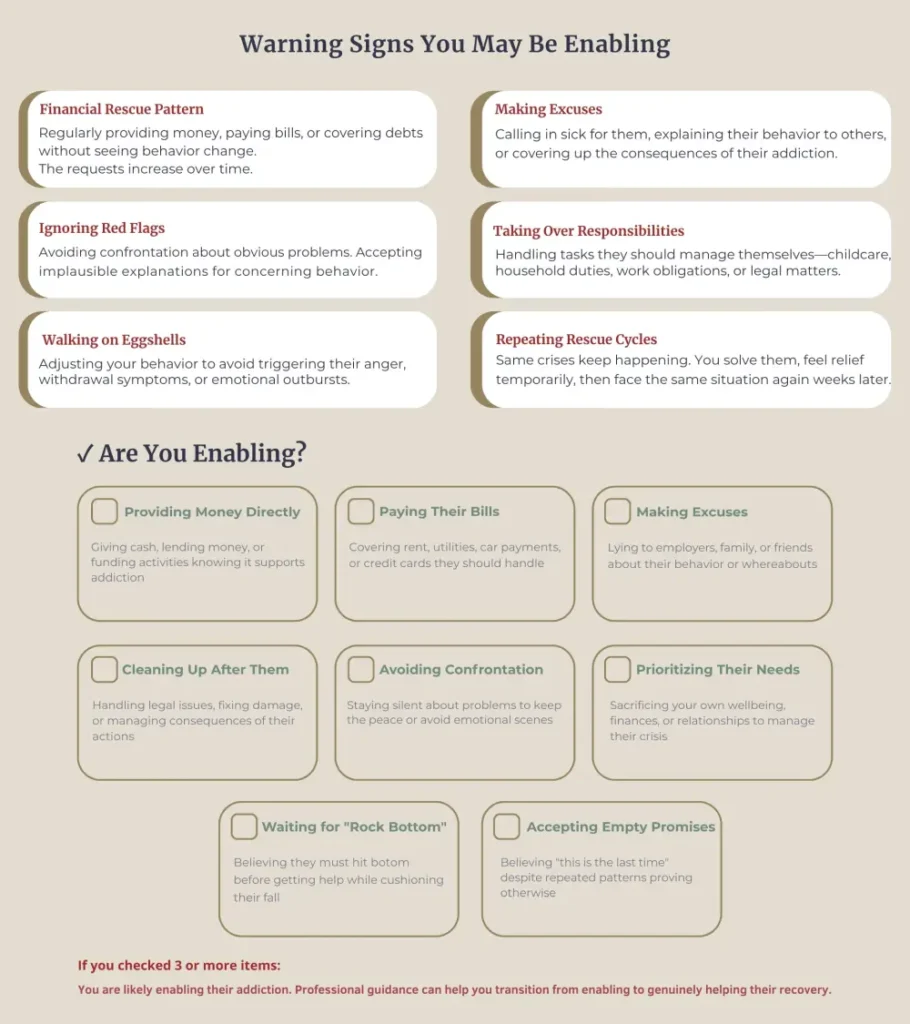
Time gets wasted. Months and years pass while you maintain this charade. Your loved one's addiction progresses. Their brains change. Physical damage accumulates. Each day without proper treatment is a day their condition worsens—time you can never get back. Three years of enabling means three years of missed opportunities for recovery, three years of physical deterioration, three years closer to irreversible damage or death.
The problem escalates in ways that sneak up on you. The longer the enabling continues, the more entitled the loved one becomes. Your sacrifices become expectations. What started as occasionally covering rent becomes a full-time job of managing someone else's life. They learn that addiction doesn't carry real costs because you absorb all the consequences. The amounts increase. The demands grow more frequent. What you once did monthly becomes weekly, then daily. They expect your intervention because you've trained them to rely on it.
Your family suffers under this arrangement. The overwhelming stress on the primary enabler takes a tremendous toll on themselves and others in the family. Other children watch their sibling receive all your attention and resources. They learn that a crisis earns priority while responsible behaviour gets ignored. Partners feel neglected as every conversation circles back to managing the addicted person's latest emergency. Your own health deteriorates under the constant crisis management—sleep disrupted by 2 AM phone calls, stomach churning with worry, and blood pressure climbing from chronic stress. Resentment builds among family members who feel abandoned while you focus solely on the addicted person.
Recovery becomes less likely with each passing month. Here's the harsh truth: the comfort provided by enabling makes it nearly impossible for the addict to experience the consequences of their own actions and behaviours. Why would they seek treatment when their current situation remains manageable? You've removed every motivation to change. Their rent gets paid. Their job stays secure through your lies. Their children are in care. Food appears in their fridge. From their perspective, addiction works just fine. The motivation to change only arrives when maintaining addiction becomes harder than seeking recovery.
Professional intervention gets delayed while you maintain this holding pattern. The addiction treatment that could save their life keeps getting pushed back. "Not yet," you think. "They're not ready." Meanwhile, the disease strengthens its grip. Physical dependence deepens. Psychological patterns become more entrenched. The dangerous idea that we should wait for the disease to get worse before seeking treatment has trapped countless families in this limbo. Each month you wait represents another month of missed recovery.
Everyone loses dignity in this arrangement. Your loved one becomes dependent on your rescues rather than developing real coping skills. They never learn to handle life's challenges sober because you handle them instead. You become a servant to their addiction, organizing your entire existence around managing their crises. Neither of you grows. Neither of you heals. The relationship transforms into something unhealthy for both parties.
This assistance does not align with your stated purpose. You intended to act as a lifeline. Rather, you transformed into an anchor, submerging them beneath the surface.

How Can Professional Treatment Replace Enabling?
Enabling someone you love creates an illusion of control while actually allowing their disease to progress unchecked. The months and years spent managing their addiction represent time that professional treatment could have used to build lasting recovery.
Addiction doesn't respond to good intentions. It requires structured intervention, medical support, and full-spectrum rehabilitation. The Canadian Centre for Addictions provides this specialized care at our Ontario facilities in Port Hope and Cobourg.
Our programs address the underlying causes driving addiction while teaching practical skills for maintaining long-term sobriety. We work with families to break enabling patterns and establish healthy boundaries that support rather than sabotage recovery efforts.
FAQ
How do I know if I'm enabling someone or helping them?
Ask yourself: "Does this action remove natural consequences or teach responsibility?" Enabling occurs when you do something for someone that they are able to do on their own. Helping provides support while requiring them to face the results of their choices.
Can I ever give my addicted loved one money?
Direct payment for specific, verified needs (rent paid to landlord, groceries you purchase) differs from handing over cash. Money given without accountability almost always funds addiction rather than genuine necessities.
What if my loved one becomes homeless or faces legal trouble when I stop enabling?
These painful consequences often serve as the wake-up call that finally motivates treatment. Decades of research prove that the earlier treatment starts, the better the outcomes become. Delaying help to prevent short-term discomfort typically causes more damage in the long term.
How long does it take to break enabling patterns?
Changing ingrained behaviours requires consistent effort over months. You'll face intense pressure to return to old patterns. Support groups and individual therapy provide crucial accountability during this difficult transition period.
Will my loved one hate me for setting boundaries?
Initially, they'll likely express anger and resentment. Addicts act like professional victims and can be emotional bullies. Their addiction benefits from your enabling, so changing the dynamics threatens their continued use. Their anger confirms you're doing something right.
Article sources
- Rotunda, R.J., & Doman, K. (2021). "Partner enabling of substance use disorders: Critical review and future directions." Addictive Behaviors, 112, 106595. Available at: https://pubmed.ncbi.nlm.nih.gov/33129052/
- Meyers, R.J., et al. (2020). "Community Reinforcement and Family Training: Effectiveness as measured by significant other reports and clinical case examples." Journal of Substance Abuse Treatment, 108, 65-71. Available at: https://www.sciencedirect.com/science/article/abs/pii/S0740547219303180
- Copello, A.G., et al. (2021). "The relative efficacy of two levels of a primary care intervention for family members affected by the addiction problem of a close relative: A randomized trial." Addiction, 104(1), 49-58. Available at: https://pubmed.ncbi.nlm.nih.gov/19133888/
- Lander, L., et al. (2013). "The impact of substance use disorders on families and children: From theory to practice." Social Work in Public Health, 28(3-4), 194-205. Available at: https://www.tandfonline.com/doi/abs/10.1080/19371918.2013.759005
- O'Farrell, T.J., & Clements, K. (2022). "Review of outcome research on marital and family therapy in treatment for alcoholism." Journal of Marital and Family Therapy, 38(1), 122-144. Available at: https://onlinelibrary.wiley.com/doi/abs/10.1111/j.1752-0606.2011.00242.x
- Miller, W.R., et al. (2019). "Motivational interviewing and the clinical science of Carl Rogers." Journal of Consulting and Clinical Psychology, 87(5), 445-456. Available at: https://psycnet.apa.org/record/2019-28258-001