
We offer medical detox and multiple addiction treatment options in our
luxury treatment centres in Port Hope, Cobourg, and Ottawa.
What Happens in Rehab? What to Expect at Each Stage

A stay in residential rehab moves through four stages (assessment, detox, therapy and discharge planning), and each stage has its own goal, timeline and clinical staff. Knowing what happens in rehab at every step helps you arrange time away from work, prepare family members and come to the intake call with specific questions. The sections below follow the stages in order, with research from Canadian and U.S. health agencies behind each one.
You'll Learn
- Why admission doesn't have to be the client's own idea
- How a stable job can change your intake assessment
- The one stage researchers say can't count as treatment on its own
- What CCFA uses to measure your gains during a stay
- How rehab prepares you for a slip after discharge
What Is a Drug Rehab Centre, and Who Is It Built For?
A drug rehab centre is a facility built to help people stop using alcohol or drugs through structured programs and professional care, away from the triggers of daily life. Residential centres go further by housing clients on-site, with medical monitoring at all hours and distance from the people and places tied to past use.
A 2021 evidence review by the Canadian Agency for Drugs and Technologies in Health (now Canada's Drug Agency) found that patients who received residential treatment were more likely than outpatients to complete their program and to be considered abstinent. Residential services in the reviewed studies also improved substance use, mental health and social outcomes, and reduced criminal activity. The same report summarizes guidance from the American Society of Addiction Medicine (ASAM), which asks clinicians to weigh a patient's risk of severe or complicated withdrawal when choosing the level of care.
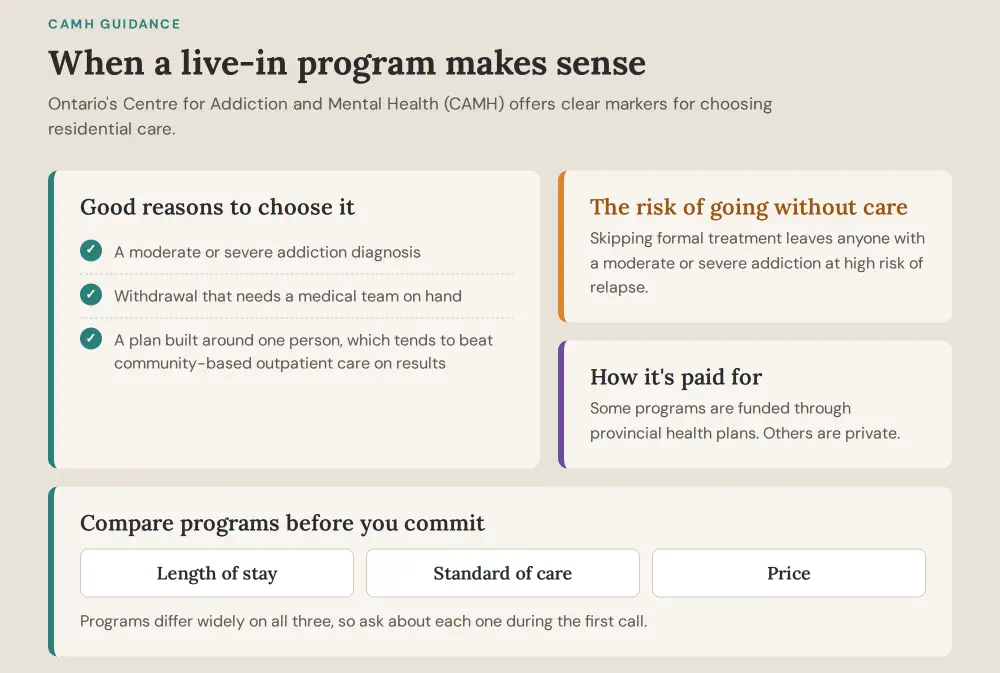
A relative's reluctance does not rule out treatment, since NIDA's research-based principles state that treatment does not need to be voluntary to be effective. Pressure from family, an employer or the justice system can raise both entry and retention rates, according to the same guide.
At a private luxury rehab, how rehab works for any one client depends on an admission assessment, which sets the intensity of care before treatment begins.
How Does the Addiction Rehabilitation Process Begin?
The American Society of Addiction Medicine (ASAM) publishes the most widely used standard for placing patients in addiction care, and it calls for a multidimensional assessment of biomedical, psychological and social needs across six dimensions. First published in 1991, the criteria reached their fourth edition in 2023. Strengths count alongside risks in that model. A stable job, a supportive partner or a safe place to live enters the plan next to a history of heavy use, and regular reassessment during treatment lets the level of care change with the patient.
At CCFA, the addiction rehabilitation process opens with a medical and psychological evaluation that reviews substance use history, withdrawal risk, mental health and physical condition. From those results, clinicians build an individual treatment plan and recommend a stay of 30, 45, 60, 75 or 90 days in the inpatient rehab program. Longer stays leave more time for therapeutic work and for practising sober routines before the return home.
What Happens During Medical Detox?
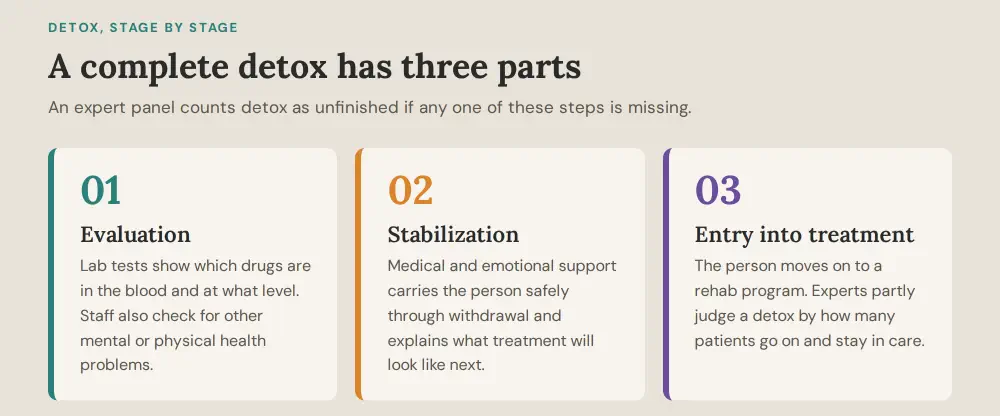
Detox, the first clinical stage after assessment, clears the substance from the body under supervision and treats the withdrawal symptoms that come with stopping. A consensus panel convened by the U.S. Substance Abuse and Mental Health Services Administration (SAMHSA) divides this stage into three parts (evaluation, stabilization and fostering the patient's entry into treatment) and calls any detox that skips one of them incomplete. Evaluation under that model includes testing for substances in the bloodstream and screening for co-occurring mental and physical conditions. Stabilization covers the psychosocial side too, including preparing patients for what the rest of treatment will involve. The panel measures detox success partly by the number of patients who go on to enter and stay in a treatment program.
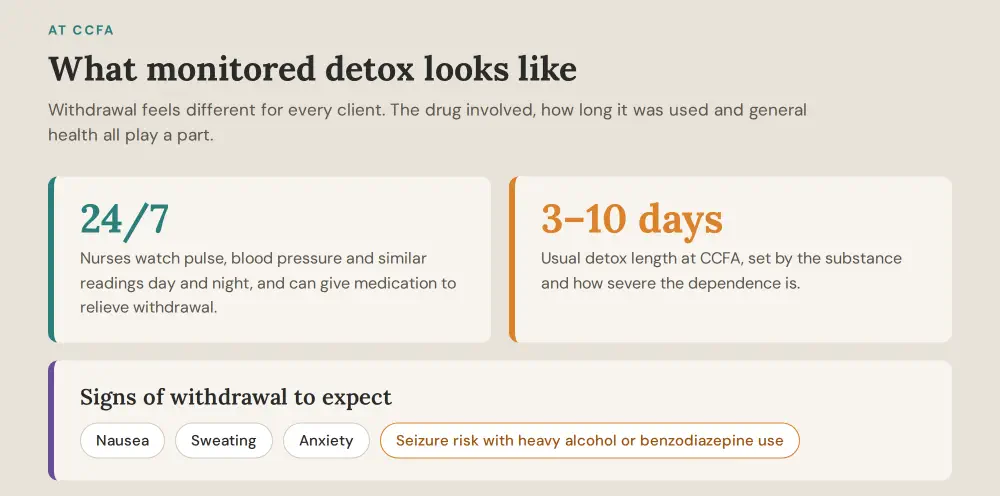
Symptoms vary with the substance, the length of use and the person's overall health. Nausea, sweating and anxiety are common; severe alcohol or benzodiazepine withdrawal can cause seizures. Inside CCFA's medically monitored detox, nursing staff track blood pressure, heart rate and other indicators 24 hours a day and can give medications to ease withdrawal. Depending on the substance and the severity of dependence, detox at CCFA lasts three to ten days.
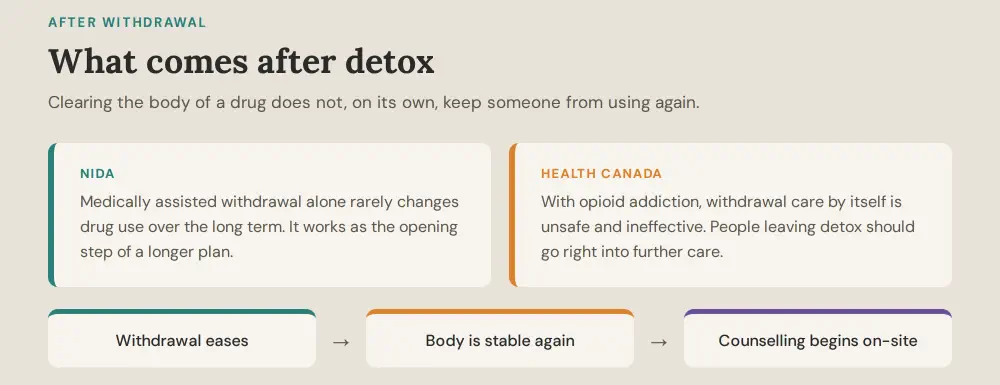
NIDA lists medically assisted detoxification as only the first stage of addiction treatment and notes that, by itself, it does little to change long-term drug use. Health Canada goes further for opioids, stating that withdrawal management alone is neither effective nor safe for opioid use disorder, and it advises anyone leaving withdrawal management to move straight into mental health and substance use services. At CCFA, counselling begins in the same residence once a client is medically stable, so what happens in rehab moves from medical care to therapy without a transfer.
Which Therapies Fill the Middle Weeks of Treatment?
Therapy fills the longest stretch of the addiction treatment process and targets the thoughts, habits and relationships that kept substance use going. NIDA names behavioural therapies, including individual, family and group counselling, as the most commonly used form of drug addiction treatment. CCFA draws on several of the evidence-based treatment options that research supports, delivered in the formats below.

Individual Counselling
One-on-one sessions with a psychologist or certified addiction counsellor trace the roots of substance use, which can include unresolved trauma, unhealthy coping patterns and broken relationships. NIDA's principle that no single treatment suits everyone plays out here, since these sessions match the plan to one person's history.
Group Therapy
Group sessions bring clients together with peers facing the same struggle, under a counsellor's guidance. Listening to others describe cravings and setbacks eases isolation. Speaking honestly in front of the group builds communication skills and a sense of accountability that clients carry beyond their stay.
Cognitive Behavioural Therapy (CBT)
CBT teaches clients to spot the thoughts, places and people linked to their use and to replace automatic reactions with practised coping responses. A 2010 review by McHugh, Hearon and Otto found support for CBT both as a stand-alone treatment for substance use disorders and as part of combined treatment. Among the components the authors describe are functional analysis, which maps the triggers and consequences of each episode of use, and skills training for coping without substances. At CCFA, CBT runs in one-on-one sessions and as a themed group course.
Care for Co-occurring Mental Health Conditions
Depression, anxiety and trauma that appear alongside addiction get treated in the same program at CCFA. NIDA notes that many people with a drug addiction also have another mental disorder, and its principles of effective care call for treatment that addresses those conditions too. Clinicians screen for both at intake, and the dual-diagnosis care that follows gives clients tools to manage each condition after discharge.
How Is a Day in Residential Treatment Structured?
Residential care organizes the addiction rehabilitation process around a fixed daily schedule. At CCFA, the day opens with an affirmations group, then breakfast and a journal group led by primary counsellors; therapy sessions and workshops on addiction, life skills and managing triggers fill the rest of the clinical day.
Shared and private rooms create a small community of peers who offer each other moral support, and house rules keep that setting safe, including a strict no-alcohol and no-drugs policy and required attendance at scheduled sessions. For anyone wondering, "How does rehab work from one day to the next?", supervision is a large part of the answer. NIDA advises that drug use be monitored continuously during treatment because lapses do occur, and a substance-free residence with nursing staff on-site at all hours builds that monitoring into daily life.
Yoga, meditation, fitness training, art therapy and walks on the grounds' trails fill the gaps between clinical sessions, with chef-prepared meals at set times and evenings free for reflection, journaling or rest. The full routine is laid out on the Life at CCFA page. Clinicians track each client's gains with the Rehabilitation Wellness Inventory, a tool that produces quantitative data on recovery, and adjust the treatment plan to match.
How Does Rehab Prepare You for Life After Discharge?
Relapse prevention work begins well before discharge and draws on a cognitive-behavioural model first described by G. Alan Marlatt and Judith Gordon. The model centres on recognizing high-risk moments, such as a stressful workday or a party where others drink, and rehearsing coping responses for them. It also names the abstinence violation effect, the guilt and sense of failure that can follow a first drink or dose and turn a single lapse into a full relapse, and it teaches clients to treat a lapse as a mistake to correct, as a 2011 review by Hendershot and colleagues describes.
McLellan and colleagues, writing in JAMA in 2000, classified drug dependence as a chronic medical illness and concluded that long-term care with continued monitoring produces lasting benefits. The review ties dependence to lasting changes in brain chemistry and function, one reason the authors argue for continued care after acute treatment ends. A residential program answers that argument by closing with a plan for the months ahead.

Discharge planning at CCFA closes the addiction treatment process with a written roadmap for home. Before a client leaves, the team identifies triggers waiting in the home environment, writes a personalized relapse prevention plan and connects the client with community resources close to where they live. Those resources can include peer support groups such as Alcoholics Anonymous (AA) and Narcotics Anonymous (NA), which hold meetings in communities across Canada at no cost to members.
Families take part during the residential stay through the Family Program, which teaches loved ones about addiction, healthier communication and ways to rebuild trust. A 2021 SAMHSA advisory reports that involving family members in treatment can improve client engagement, retention and outcomes, and it links supportive family relationships to long-term abstinence. Graduates can also join Roots of Recovery, the CCFA alumni community.
What Sets the Canadian Centre for Addictions Apart During Treatment?
Clients at the Canadian Centre for Addictions complete every stage in one of two Ontario residences. Hillcrest Mansion in Port Hope has 13 fireplaces and views of Lake Ontario, and it hosts an executive program that allows business professionals limited work contact during their stay. Woodlawn Inn in Cobourg offers private suites, meditation gardens and spa and massage services.
CCFA reports a 95.6% success rate measured with a validated clinical tool. The centre also contributes to a six-year University of Toronto study on how recovery affects cognition.
For a family comparing options, what happens in rehab at CCFA is measured against national standards, since the centre has held accreditation since 2018 from Accreditation Canada, the same body that accredits hospitals and regional health authorities across the country.
Ready to Take the First Step?
Addiction doesn't get better on its own. Call us today for a free, confidential consultation and find out which program is right for your needs.
When the Plan Meets Real Life
A relapse prevention plan is written for the home a client left, and the first weeks back show which triggers and contacts on that list still apply. Revisiting the plan with a counsellor or peer group during that stretch keeps it useful long after the residential stay ends.
FAQ
Can my family visit me during rehab?
Yes, CCFA holds weekly visiting days, and family participation is encouraged as part of recovery. The intake team shares exact visiting times and visitor rules at admission.
What should I pack for a residential stay?
Bring comfortable clothing, personal toiletries and self-care items for the full length of your program. CCFA gives every incoming client a list of items that cannot be brought into the residence, so check it before you pack.
Will my employer find out that I went to rehab?
CCFA keeps your identity and everything you share in treatment confidential. Your health records are protected under Ontario's Personal Health Information Protection Act, 2004, and outside the narrow exceptions that law sets out, details of your stay are not shared with an employer without your consent.
Can I leave before my program ends?
Private residential treatment is voluntary, so an adult client can choose to leave at any point. Leaving before detox is complete carries medical risk, especially with alcohol or benzodiazepines, so speak with the nursing and clinical team before you go.
Do I need a doctor's referral to get into rehab?
You can contact CCFA directly without a referral from a family doctor. A free, confidential consultation with the intake team covers your substance use, health and goals, and it starts the admission.
Article sources
- Tran K, McGill S. "Treatment Programs for Substance Use Disorder." Canadian Agency for Drugs and Technologies in Health, 2021. https://www.ncbi.nlm.nih.gov/books/NBK584391/
- National Institute on Drug Abuse. "Principles of Drug Addiction Treatment: A Research-Based Guide (Third Edition)." National Institutes of Health. https://nida.nih.gov/sites/default/files/podat-3rdEd-508.pdf
- American Society of Addiction Medicine. "About the ASAM Criteria." ASAM. https://www.asam.org/asam-criteria/about-the-asam-criteria
- Center for Substance Abuse Treatment. "Excerpts From Quick Guide for Clinicians Based on TIP 45, Detoxification and Substance Abuse Treatment." Substance Abuse and Mental Health Services Administration, NCBI Bookshelf. https://www.ncbi.nlm.nih.gov/books/NBK64044/
- Health Canada. "Substance Use Treatment." Government of Canada. https://www.canada.ca/en/health-canada/services/substance-use/treatment.html
- McHugh RK, Hearon BA, Otto MW. "Cognitive Behavioral Therapy for Substance Use Disorders." Psychiatric Clinics of North America, 2010. https://pmc.ncbi.nlm.nih.gov/articles/PMC2897895/
- Hendershot CS, Witkiewitz K, George WH, Marlatt GA. "Relapse Prevention for Addictive Behaviors." Substance Abuse Treatment, Prevention, and Policy, 2011. https://substanceabusepolicy.biomedcentral.com/articles/10.1186/1747-597X-6-17
- McLellan AT, Lewis DC, O'Brien CP, Kleber HD. "Drug Dependence, a Chronic Medical Illness: Implications for Treatment, Insurance, and Outcomes Evaluation." JAMA, 2000. https://pubmed.ncbi.nlm.nih.gov/11015800/
- Substance Abuse and Mental Health Services Administration. "The Importance of Family Therapy in Substance Use Disorder Treatment." SAMHSA Advisory, 2021. https://library.samhsa.gov/sites/default/files/pep20-02-02-016.pdf